


 Deutsch
 English
 Español
 Français
 Nederlands
 Português


 Share
Share




In early 2026, the United States launched two landmark initiatives to break China's stranglehold on critical mineral supply chains: Project Vault, a $12 billion strategic reserve backed by the Export-Import Bank, and FORGE (Forum on Resource Geostrategic Engagement), a 54-nation multilateral framework that replaces the Minerals Security Partnership. Simultaneously, the EU finalized its U.S.-EU Critical Minerals Action Plan and selected 60 Strategic Projects under the Critical Raw Materials Act. These overlapping Western strategies aim to create a preferential trade bloc with coordinated price floors for cobalt and lithium, while examining the risks of market bifurcation, new dependencies on partner nations like Argentina and Morocco, and the 5-to-7-year timeline required to meaningfully challenge China's 80%+ share of global rare earth and graphite processing.
Project Vault: A $12 Billion Strategic Reserve
On February 2, 2026, the Export-Import Bank of the United States (EXIM) approved a $10 billion direct loan to Project Vault, a public-private initiative that establishes the U.S. Strategic Critical Minerals Reserve. Combined with nearly $2 billion in private investment from partners including Hartree Partners, Mercuria Americas, and Traxys, the total commitment reaches $12 billion. The reserve will store essential raw materials in secure domestic facilities, with initial participating OEMs including Clarios, GE Vernova, Western Digital, and Boeing. EXIM Chairman John Jovanovic described the initiative as delivering a net positive return for U.S. taxpayers while strengthening the domestic industrial base. The Project Vault strategic reserve is designed to protect manufacturers from supply shocks and reduce dependence on foreign-controlled supply chains.
FORGE: From MSP to a 54-Nation Framework
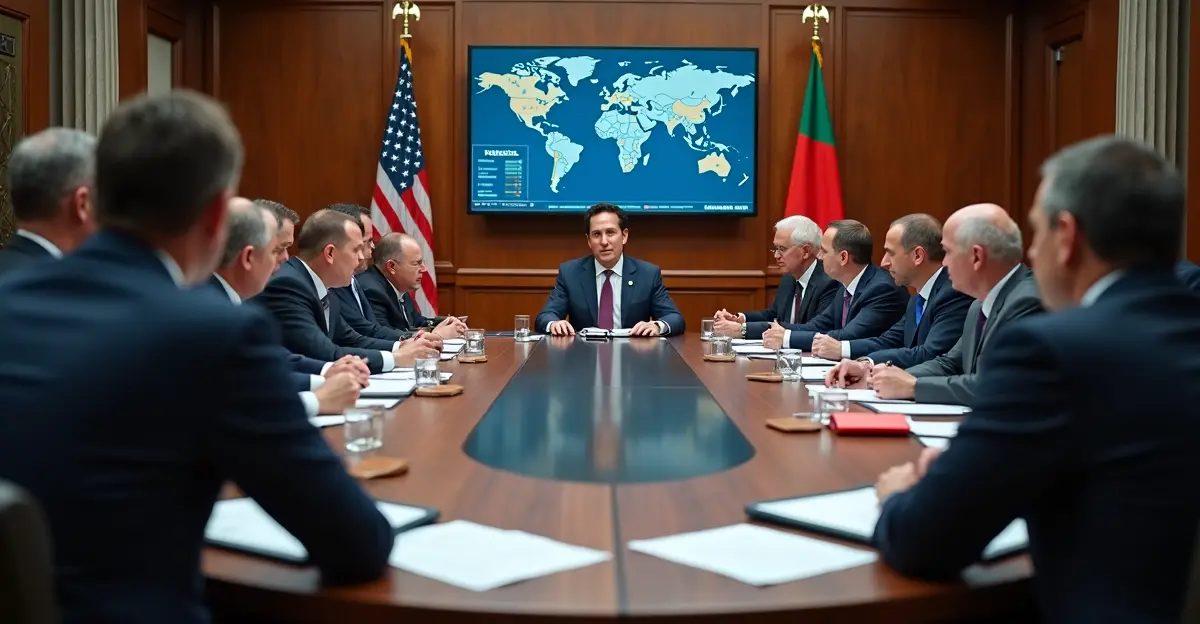
Just two days later, on February 4, 2026, the U.S. Department of State hosted the inaugural Critical Minerals Ministerial, led by Secretary of State Marco Rubio and Vice President JD Vance, with representatives from 54 countries and the European Commission. At this gathering, Secretary Rubio announced FORGE (Forum on Resource Geostrategic Engagement) as the successor to the Minerals Security Partnership (MSP), chaired by the Republic of Korea. Unlike the MSP's project-focused approach, FORGE operates on a 'membership by trade' model, conditioning participation on adherence to shared trade rules rather than joint capital deployment. The ministerial produced 11 new bilateral critical minerals frameworks or MOUs with countries including Argentina, Morocco, Peru, the Philippines, UAE, and the UK, bringing the total to 21 deals in five months. The U.S. mobilized over $30 billion in support for critical mineral projects, including EXIM's $10 billion for Project Vault. The FORGE multilateral framework aims to build secure, diversified, and resilient end-to-end supply chains for technologies essential to AI, robotics, batteries, and defense.
The EU's Parallel Push: CRMA and U.S.-EU Action Plan
The European Union has been moving in lockstep with Washington. Under the Critical Raw Materials Act (CRMA), which came into effect in 2024, the European Commission selected 60 Strategic Projects—both within the EU and in third countries—to boost extraction, processing, and recycling capacity for 14 critical raw materials including lithium, cobalt, rare earth elements, and graphite. The second cut-off date for applications closed on January 15, 2026, with over 160 applications submitted. On April 24, 2026, U.S. Trade Representative Ambassador Jamieson Greer and EU Trade Commissioner Maroš Šefčovič jointly announced the U.S.-EU Action Plan for Critical Minerals Supply Chain Resilience. This plan serves as the primary mechanism for coordinating trade policies and aims to reach a binding plurilateral agreement on trade in critical minerals. The EU Critical Raw Materials Act designates strategic projects as being of public interest, streamlining permitting and facilitating access to financing.
Coordinated Price Floors and a Preferential Trade Bloc
A centerpiece of the new Western strategy is the introduction of coordinated price floors for critical minerals. Vice President JD Vance unveiled the Critical Minerals Price Floor Proposal during the February 4 ministerial, calling for government-set reference prices within a preferential trading bloc of allied nations. Adjustable tariffs on imports from non-members—particularly targeting China—would enforce these floors to prevent cheap supply flooding and protect domestic and allied production. While no specific floor prices or implementation timelines have been finalized, the proposal addresses China's ability to undercut Western producers by flooding markets with subsidized minerals. The price floor mechanism is designed to reduce price volatility, encourage mining investment in partner countries, and ensure a stable return for producers. However, critics warn that it may raise costs for downstream manufacturers and could trigger retaliatory trade measures from Beijing. The critical minerals price floor proposal complements the broader FORGE framework and the U.S.-EU Action Plan.
New Dependencies: Argentina, Morocco, and the Partner Nation Strategy
As the West seeks to diversify away from China, new strategic dependencies are emerging. Argentina, which signed a bilateral framework with the U.S. on February 4, holds some of the world's largest lithium reserves, essential for EV batteries. Morocco, another signatory, possesses significant cobalt and phosphate reserves and has existing free trade agreements with both the U.S. and the EU, making it a natural hub for processing. Peru, the Philippines, and the UAE also signed MOUs, each offering different mineral endowments. The Atlantic Council's April 2026 report, 'From Alignment to Action: Building a Durable US-Argentina Critical Minerals Partnership,' highlights that Argentina is uniquely positioned to help the U.S. diversify away from Chinese-dominated supply chains, but warns that realizing this potential requires concrete policy actions, regulatory alignment, and sustained diplomatic engagement. The Argentina lithium partnership is emblematic of the broader challenge: building new supply chains from scratch takes years, and partner nations may themselves become sources of geopolitical risk.
The 5-to-7-Year Timeline and China's Unshakeable Grip
Despite the flurry of initiatives, China's dominance remains formidable. According to the Institute for Energy Research, China controls about 90% of global refining and processing capacity for rare earths and synthetic graphite. In 2025 and 2026, China restricted rare earth exports and limited exports of tungsten, antimony, and silver, demonstrating its willingness to weaponize its market power. While new mines are opening in the U.S., Australia, Brazil, and Africa, most concentrates still ship to Chinese refineries. The U.S. holds only 2% of global rare earth reserves, and permitting delays remain a key obstacle to onshoring processing capacity. Industry experts estimate that it will take 5 to 7 years for the new Western initiatives to meaningfully challenge China's 80%+ share of global rare earth and graphite processing. Even with $30 billion in mobilized support and 21 bilateral deals, the China critical minerals dominance will not be easily displaced.
Risks of Market Bifurcation
The creation of a Western preferential trading bloc carries significant risks. Market bifurcation—where the world splits into two separate trading systems for critical minerals—could lead to inefficiencies, higher costs, and reduced global trade. Developing nations may be forced to choose sides, and China could respond by deepening its own supply chain alliances with Russia, Africa, and Latin America. The price floor mechanism, while protecting Western producers, could also incentivize Chinese overproduction and dumping in non-aligned markets, further distorting global prices. Moreover, the 5-to-7-year timeline means that in the interim, Western industries remain vulnerable to supply disruptions and price manipulation. The success of Project Vault and FORGE will ultimately depend on sustained political will, regulatory streamlining, and the ability to attract private investment at scale.
Expert Perspectives
"Project Vault represents the most significant U.S. government commitment to critical minerals stockpiling in decades," said EXIM Chairman John Jovanovic in a February 2026 statement. "It delivers a net positive return for U.S. taxpayers while strengthening our domestic industrial base." Meanwhile, the Atlantic Council noted that FORGE represents an evolution from an 'America First' approach toward broader international coordination, recognizing that supply chain resilience requires multilateral partnerships. The EU's selection of 60 Strategic Projects under the CRMA signals a parallel commitment, with the European Commission emphasizing that these projects are critical for the green and digital transitions, as well as defense and aerospace resilience.
Frequently Asked Questions
What is Project Vault?
Project Vault is a $12 billion public-private initiative launched by the U.S. Export-Import Bank in February 2026 to establish the U.S. Strategic Critical Minerals Reserve. It stores essential raw materials in secure domestic facilities to protect manufacturers from supply shocks.
What is FORGE?
FORGE (Forum on Resource Geostrategic Engagement) is a 54-nation multilateral framework announced on February 4, 2026, that replaces the Minerals Security Partnership. It aims to create a preferential trade-and-investment zone for critical minerals with coordinated price floors.
How does the EU's Critical Raw Materials Act fit in?
The EU's CRMA, effective since 2024, selected 60 Strategic Projects to boost domestic and allied capacity for critical mineral extraction, processing, and recycling. It complements the U.S.-EU Critical Minerals Action Plan announced in April 2026.
What are critical minerals price floors?
Price floors are government-set minimum prices for critical minerals like cobalt and lithium within a preferential trading bloc of allied nations. They are enforced through adjustable tariffs on imports from non-members, particularly China, to protect domestic producers from cheap supply flooding.
How long will it take to challenge China's dominance?
Industry experts estimate a 5-to-7-year timeline to meaningfully challenge China's 80%+ share of global rare earth and graphite processing, given the complexity of building new mining and processing capacity.
Conclusion: A New Geopolitical Reality
The launch of Project Vault and FORGE, combined with the EU's CRMA Strategic Projects and the U.S.-EU Action Plan, represents the most consequential reshaping of Western critical mineral strategy in decades. These initiatives aim to create a resilient, diversified supply chain that reduces dependence on China, but they face significant hurdles: China's entrenched processing dominance, the long timeline for new projects, and the risks of market bifurcation. The coming years will test whether the West can translate political ambition into tangible supply chain security, or whether China's grip on critical minerals will prove as unshakeable as its manufacturing prowess.




Follow Discussion