


 Deutsch
 English
 Español
 Français
 Nederlands
 Português


 Share
Share




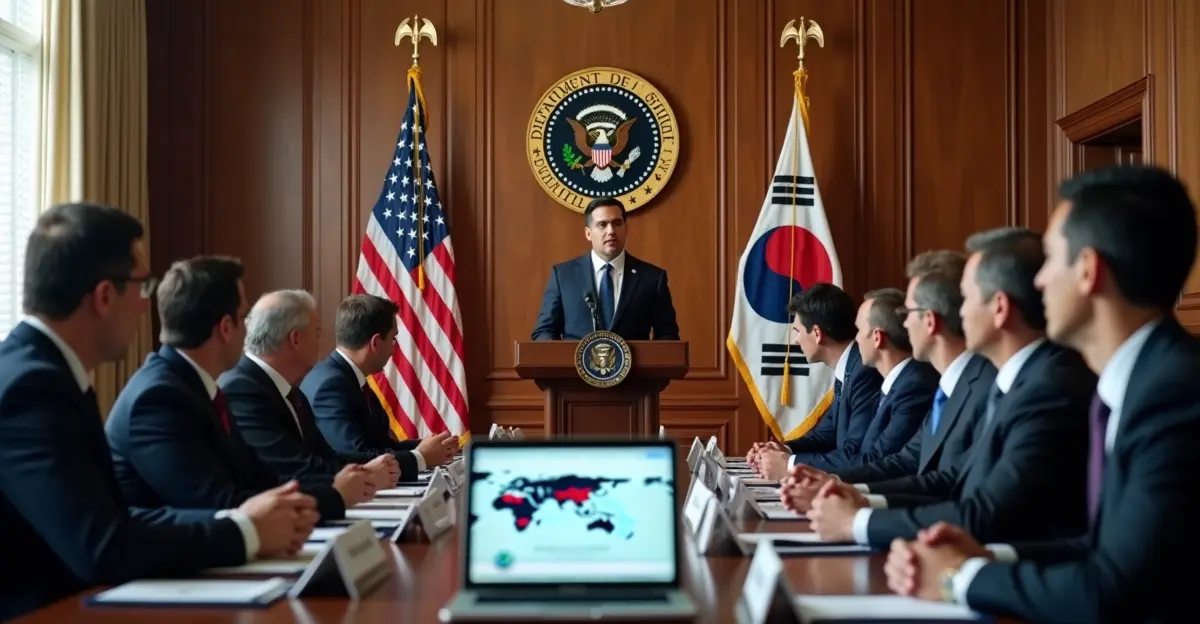
In a decisive escalation of strategic competition over critical mineral supply chains, the United States launched the Forum on Resource Geostrategic Engagement (FORGE) on February 4, 2026, alongside a $30+ billion financing package and 11 new bilateral critical minerals frameworks. The initiative, announced at the 2026 Critical Minerals Ministerial hosted by Secretary of State Marco Rubio and Vice President JD Vance, represents the most aggressive Western push yet to counter China's dominance in rare earth and battery mineral supply chains. With China projected to control over 60% of refined lithium and cobalt and roughly 80% of battery-grade graphite by 2035, FORGE and its companion Project Vault aim to fundamentally reshape global supply chain dynamics.
What Is FORGE? A New Plurilateral Coalition for Critical Minerals
FORGE succeeds the Minerals Security Partnership (MSP) as a plurilateral coalition designed to create a preferential trade-and-investment zone for critical minerals. Unlike the MSP's project-focused approach, FORGE introduces coordinated price floors to counter adversarial market manipulation by state actors, particularly China. The coalition is chaired by South Korea through June 2026 and seeks to link over 21 bilateral framework agreements into a functioning system covering roughly two-thirds of the global economy. The Minerals Security Partnership transition to FORGE reflects a strategic shift from project-based cooperation toward a more comprehensive trade architecture.
The $30 Billion Financing Package and Project Vault
The U.S. government has mobilized over $30 billion in letters of interest, loans, and investments for critical mineral projects over the past six months. Central to this effort is Project Vault, a $12 billion public-private partnership backed by a $10 billion Export-Import Bank (EXIM) loan and nearly $2 billion in private capital. Project Vault establishes the U.S. Strategic Critical Minerals Reserve, storing essential raw materials—including rare earths, lithium, uranium, and copper—in secure domestic facilities. Equipment manufacturers such as GE Vernova, Boeing, and General Motors have expressed interest in the initiative, which aims to protect domestic manufacturers from supply shocks and price volatility. The U.S. critical minerals stockpile strategy marks a reversal of decades of underinvestment since the closure of the U.S. Bureau of Mines in 1996.
China's Dominance: By the Numbers
China's grip on critical mineral supply chains is the result of a decades-long, state-directed strategy. Between 2000 and 2021, Beijing channeled nearly $57 billion into mineral extraction and refining across nearly 20 countries in Africa, Latin America, and Asia. As of 2024, China accounts for 99% of battery-grade graphite production, 60% of lithium chemical processing, 70% of refined cobalt, and over 80% of refined rare earth elements. Chinese companies own 80% of cobalt production in the Democratic Republic of Congo. By 2035, China is projected to supply over 60% of refined lithium and cobalt and around 80% of battery-grade graphite and rare earths, according to the Global Critical Minerals Outlook 2025. The China critical mineral supply chain leverage gives Beijing substantial geopolitical leverage, as demonstrated by 2026 export controls that triggered price spikes of up to sixfold for rare earths, tungsten, and antimony.
How FORGE's Price Floors and Trade Zone Would Work
FORGE's most innovative feature is the establishment of reference prices for critical minerals that function as price floors, maintained through adjustable tariffs. Vice President JD Vance outlined the mechanism at the ministerial: member countries would agree on minimum prices for key minerals, with tariffs applied to imports from non-members that undercut those floors. This approach directly targets China's ability to flood markets with below-cost processed minerals, a tactic that has driven Western competitors out of business. The preferential trade zone would also streamline investment approvals, harmonize environmental standards, and facilitate technology transfer among members. However, coordinating reference prices across different minerals and production stages—from mining to refining to battery manufacturing—presents significant technical and political challenges. The critical minerals price floor mechanism is unprecedented in scale and complexity.
Can FORGE and Project Vault Shift Global Supply Chains?
Analysts remain divided on whether these initiatives can meaningfully reduce dependence on China. The Atlantic Council notes that FORGE's "membership by trade" model avoids the pitfalls of pooled financing but may lack the enforcement mechanisms needed to prevent free-riding. Chatham House warns that building independent processing capacity requires 5-7 years and $30-50 billion in investment, while NATO holds only 6-9 months of defense stockpiles. The U.S. accounted for only 1% of global critical mineral production in 2024, highlighting the scale of the catch-up required. On the positive side, the 54 countries represented at the ministerial—including major mineral producers like Argentina, Morocco, the Philippines, and the UAE—signal broad international appetite for alternatives to Chinese dominance. The Western critical mineral supply chain resilience efforts may accelerate if FORGE can translate bilateral agreements into genuine plurilateral cooperation.
Expert Perspectives
"FORGE represents a fundamental shift from America First unilateralism to a recognition that the United States cannot go it alone in critical minerals," said a senior State Department official who spoke on condition of anonymity. "We are building a coalition that spans the entire value chain, from mining to manufacturing, with coordinated pricing and investment." However, a European diplomat cautioned: "The price floor mechanism is clever, but it risks fragmenting global markets into competing blocs, which could raise costs for the energy transition at a time when we need to scale up renewable deployment."
Frequently Asked Questions
What is FORGE in critical minerals?
FORGE (Forum on Resource Geostrategic Engagement) is a U.S.-led plurilateral coalition launched in February 2026 to create a preferential trade-and-investment zone for critical minerals, with coordinated price floors to counter China's market dominance.
How much is the U.S. investing in critical minerals?
The U.S. government has mobilized over $30 billion in loans, investments, and letters of interest for critical mineral projects, including $10 billion from EXIM for Project Vault's domestic stockpile.
What is Project Vault?
Project Vault is a $12 billion public-private partnership that establishes a U.S. Strategic Critical Minerals Reserve, storing essential minerals like rare earths, lithium, and copper in secure domestic facilities to protect against supply disruptions.
How does China dominate critical minerals?
China controls 60-99% of global processing capacity for key minerals through decades of state-directed investment, owning stakes in mines across Africa, Latin America, and Asia, and maintaining tight export controls.
Can FORGE reduce dependence on China?
FORGE aims to build alternative supply chains, but analysts caution that meaningful scale remains years away, with China projected to supply over 60% of refined lithium and cobalt through 2035.
Conclusion: A High-Stakes Gamble for the Energy Transition
The launch of FORGE and Project Vault marks a decisive escalation in the strategic competition over critical minerals. Whether these initiatives can shift global supply chain dynamics depends on the coalition's ability to move from bilateral agreements to genuine plurilateral cooperation, enforce price floors without triggering trade wars, and attract sufficient private investment to build processing capacity at scale. The alternative—continued dependence on a single supplier with demonstrated willingness to weaponize export controls—poses unacceptable risks to national security and the global energy transition. As Secretary Rubio stated at the ministerial, "We are not just diversifying supply chains; we are building a new architecture for economic security." The success or failure of that architecture will shape the geopolitics of the energy transition for decades to come.



Follow Discussion