


 Deutsch
 English
 Español
 Français
 Nederlands
 Português


 Share
Share




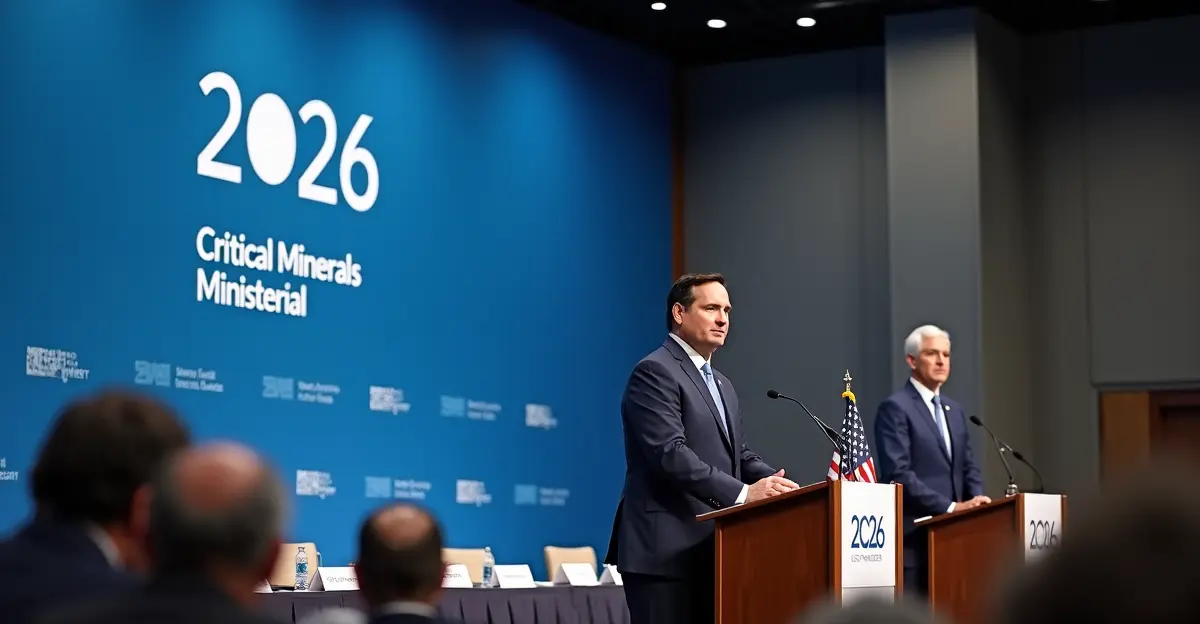
On February 4, 2026, the United States launched its most ambitious countermeasure yet to China's stranglehold on critical mineral supply chains. At the inaugural Critical Minerals Ministerial in Washington, D.C., Secretary of State Marco Rubio and Vice President JD Vance unveiled the Forum on Resource Geostrategic Engagement (FORGE), a plurilateral trade-and-investment bloc designed to rewire global markets for lithium, cobalt, rare earths, and other materials essential to AI, defense, batteries, and robotics. Backed by a $30+ billion U.S. government financing package—including a $10 billion domestic strategic reserve called Project Vault—FORGE represents a paradigm shift from bilateral deals to a coordinated Western alliance capable of challenging Beijing's near-monopoly on mineral processing.
What Is FORGE? The New Architecture of Mineral Security
FORGE succeeds the Minerals Security Partnership (MSP), which critics said lacked enforcement mechanisms. The new forum, initially chaired by South Korea, creates a preferential trade zone with coordinated price floors maintained through adjustable tariffs under Section 232 of the Trade Expansion Act. The goal is to insulate member economies from China's ability to flood markets or cut off supplies at will. According to the Atlantic Council, FORGE aims to link bilateral framework agreements into a functioning plurilateral system covering two-thirds of the global economy. At the Ministerial, 11 new bilateral critical minerals MOUs were signed with countries including Argentina, Morocco, Peru, the Philippines, the United Kingdom, and Uzbekistan, bringing the total to 21 deals in five months.
The Minerals Security Partnership transition to FORGE signals a recognition that voluntary coordination is insufficient. As Vice President Vance stated, the U.S. will establish reference prices for critical minerals at each production stage, operating as price floors maintained through adjustable tariffs. This mechanism is designed to prevent China from undercutting allied producers during market gluts—a tactic Beijing has used to drive competitors out of business.
China's Critical Mineral Chokehold: By the Numbers
China's dominance in critical mineral supply chains is staggering. According to a 2025 report by the Australian think tank Climate Energy Finance, Beijing has invested over $120 billion in overseas mining and upstream processing since 2023. Chinese firms now control approximately 90% of global rare earth refining, 60% of lithium processing, and over 70% of cobalt refining. The Institute for Energy Research projects that China will retain over 80% of synthetic graphite and rare earth processing capacity through 2030. With demand for these minerals projected to surge 400-600% by 2040 due to the energy transition and AI infrastructure buildout, the strategic vulnerability for Western economies is acute.
The China critical mineral export controls have already been weaponized. Beijing has restricted exports of rare earths, germanium, tungsten, antimony, and silver to the U.S. and Japan, demonstrating the leverage that concentrated processing confers. A Council on Foreign Relations report warns that the U.S. cannot out-mine or out-process China on its own—a leapfrog strategy centered on innovation, recycling, and substitute materials is needed. FORGE aims to buy time for such technologies to mature while building immediate supply chain resilience.
Project Vault: A $10 Billion Strategic Reserve
A centerpiece of the new U.S. strategy is Project Vault, a $12 billion public-private partnership (backed by a $10 billion Export-Import Bank loan and nearly $2 billion in private investment) to create the U.S. Strategic Critical Minerals Reserve. The reserve will store essential raw materials—including rare earths, lithium, cobalt, and copper—in secure domestic facilities to protect manufacturers from supply shocks. EXIM Chairman Jovanovic promoted the initiative as a transformative approach to bolstering American manufacturing competitiveness, with support from companies including GE Vernova, Mercuria Energy, and Boeing.
The Project Vault strategic reserve is designed to stabilize prices and provide a buffer against Chinese export restrictions. Unlike traditional stockpiles, Project Vault is structured as an independently governed commercial entity that can buy and sell minerals to smooth market volatility. This addresses a key weakness of previous U.S. mineral policy: the lack of a domestic buyer of last resort for critical materials.
Price Floors and Tariff Enforcement: The New Rules of the Game
FORGE's most innovative—and potentially controversial—feature is its system of coordinated price floors. Vice President Vance announced that the U.S. will establish reference prices for critical minerals at each stage of production, from raw ore to refined metal. These reference prices will function as price floors, maintained through adjustable tariffs under Section 232. If a non-member country (read: China) attempts to dump minerals below cost, tariffs will automatically adjust to neutralize the price advantage.
This mechanism addresses a fundamental market failure: China's state-owned enterprises can sell below cost indefinitely, using predatory pricing to eliminate competitors. By creating a price floor backed by tariff enforcement, FORGE members can ensure that their domestic producers remain viable even during periods of global oversupply. The challenge, as the Atlantic Council notes, will be coordinating reference prices across different minerals and production stages—a technically complex task requiring sophisticated data sharing and dispute resolution mechanisms.
The Geopolitical Calculus: America First, Not American Alone
The launch of FORGE represents a pragmatic evolution of the Trump administration's approach to critical minerals. As one State Department official summarized, the strategy is "America First, not American alone." The Ministerial featured six U.S. cabinet members and representatives from 54 countries and the European Commission, signaling that Washington recognizes supply chain resilience requires broad international coordination.
South Korea's chairmanship of FORGE is strategically significant. As a major manufacturer of batteries and semiconductors, Seoul has immense skin in the game and close economic ties with both the U.S. and China. The choice of a middle-power chair may help FORGE avoid being perceived as a purely U.S.-led initiative, potentially attracting participation from Global South countries that are wary of great-power competition.
The Pax Silica semiconductor alliance complements FORGE by securing technology supply chains. Together, these initiatives create a layered defense: Pax Silica protects chip design and fabrication, while FORGE secures the raw materials that feed into those chips. The overlap between the two frameworks—both include allies like Japan, the Netherlands, and Taiwan—creates a comprehensive shield against Chinese coercion across the technology stack.
Expert Perspectives: Can FORGE Succeed?
Analysts are cautiously optimistic but highlight significant hurdles. Jose W. Fernandez, writing for Chatham House, notes that "the U.S. is taking an encouragingly multilateral approach to secure scarce minerals for the industries of the future—but the scale of China's dominance requires more cooperation still." The Foundation for Defense of Democracies argues that breaking China's hold requires more than tariffs, emphasizing the need for streamlined domestic permitting, investment in recycling technologies, and research into substitute materials like rare-earth-free magnets.
A key test will be whether FORGE can translate bilateral leverage into genuine multilateral coordination. The 21 bilateral MOUs signed to date are a promising start, but they must be harmonized into a single rulebook with consistent standards for labor, environment, and investment. The price floor mechanism, while innovative, could strain WTO relationships and provoke retaliation from Beijing. China has already demonstrated its willingness to use export controls as a weapon, and a coordinated Western price floor could escalate tensions further.
FAQ: Understanding FORGE and the New Critical Minerals Landscape
What is FORGE?
FORGE (Forum on Resource Geostrategic Engagement) is a plurilateral trade-and-investment bloc launched by the U.S. in February 2026 to coordinate critical minerals policy among allied nations. It succeeds the Minerals Security Partnership and includes coordinated price floors, joint financing, and a domestic strategic reserve.
How does Project Vault work?
Project Vault is a $12 billion public-private partnership that creates a U.S. Strategic Critical Minerals Reserve. Backed by a $10 billion EXIM loan, it will store lithium, cobalt, rare earths, and other critical minerals in secure domestic facilities to protect manufacturers from supply disruptions and price volatility.
Why are critical minerals important?
Critical minerals like lithium, cobalt, rare earths, and graphite are essential for manufacturing batteries, electric vehicles, wind turbines, AI chips, military hardware, and robotics. China currently controls 60-90% of global processing capacity for these materials, creating a strategic vulnerability for Western economies.
What are price floors and how will they be enforced?
Price floors are minimum prices set for critical minerals at each production stage. They will be enforced through adjustable tariffs under Section 232, which can be raised or lowered to neutralize predatory pricing by non-member countries like China.
Will FORGE lead to a trade war with China?
There is a risk of escalation. China has already used export controls on rare earths and other minerals as a geopolitical weapon. FORGE's price floor mechanism could provoke retaliation, though the U.S. hopes that the breadth of the coalition—covering two-thirds of the global economy—will deter Beijing from aggressive countermeasures.
Conclusion: A Defining Contest for the Decade
The 2026 Critical Minerals Ministerial marks a watershed moment in global economic statecraft. FORGE, Project Vault, and the associated $30+ billion financing package represent the most aggressive Western response yet to China's mineral dominance. Whether these initiatives succeed will depend on the ability of 54 nations to sustain coordination, enforce price disciplines, and invest in alternative technologies. The outcome will define global supply chain security for the rest of the decade—and determine which bloc controls the raw materials of the AI and energy transition.



Follow Discussion