


 Deutsch
 English
 Español
 Français
 Nederlands
 Português


 Share
Share




The race to control critical minerals — lithium, rare earths, cobalt, and gallium — has entered a new phase in 2026, as governments worldwide shift from market-driven supply chains to national security infrastructure. This structural transformation, driven by the weaponization of mineral supply chains, is redrawing global trade alliances and forcing every industrial economy to treat mineral access as a first-order geopolitical imperative. The February 2026 US-hosted Critical Minerals Ministerial, the launch of Project Vault, and China's intensifying export restrictions make this the defining geopolitical-economic story of early 2026.
Project Vault: America's $12 Billion Strategic Reserve
At the center of the US response is Project Vault, a $12 billion public-private partnership to establish the US Strategic Critical Minerals Reserve. Backed by a $10 billion Export-Import Bank (EXIM) loan and nearly $2 billion in private-sector investment, the initiative will store essential raw materials in secure facilities across the United States. Industry leaders from GE Vernova, Mercuria, Traxys, Hartree, Clarios, and Boeing have voiced support, emphasizing its role in bolstering American manufacturing competitiveness and national economic security.
Project Vault is part of a broader playbook that includes the FORGE alliance, which creates a preferential trade-and-investment zone for critical minerals with coordinated price floors to counter adversarial market manipulation. The US government has mobilized over $30 billion in loans and support for critical mineral projects, including EXIM's $10 billion commitment to Project Vault and Pax Silica, a $250 million initiative to support secure semiconductor supply chains.
China's Tightening Grip on Processing
China's dominance in critical mineral processing remains the central challenge. Beijing controls roughly 90% of global rare earth refining, 80% of tungsten processing, and 60% of antimony production. Over 80% of European firms depend on Chinese supply chains for critical minerals essential to defense, EVs, and renewable energy. Export controls introduced in 2025-2026 triggered price spikes of up to sixfold outside China, while licensing approvals for European firms fell below 25%.
In November 2025, China suspended a ban on exports of gallium, germanium, and antimony to the US, though these metals remain subject to broader export controls. The suspension, effective until November 2026, was seen as a tactical move rather than a genuine relaxation. Meanwhile, new rules introduced in the 2026 Import-Export Licensing Catalogue require export licenses for compounds containing samarium, gadolinium, and lutetium — critical materials used in electronics, automotive, aerospace, and medical devices. Notably, extraterritorial provisions introduced in October 2025 allow China to regulate downstream use of controlled materials even after they leave Chinese territory, though enforcement has been delayed until November 2026.
Analysts argue China is weaponizing control rather than scarcity, using temporary, reversible restrictions to maintain pricing power and extract strategic concessions while preventing large-scale Western alternative investment. Rebuilding independent alternatives could take 20-30 years, far exceeding the current geopolitical window. The EU critical raw materials strategy faces similar challenges, with current funding far below what's needed.
The FORGE Alliance: A New Geopolitical Bloc
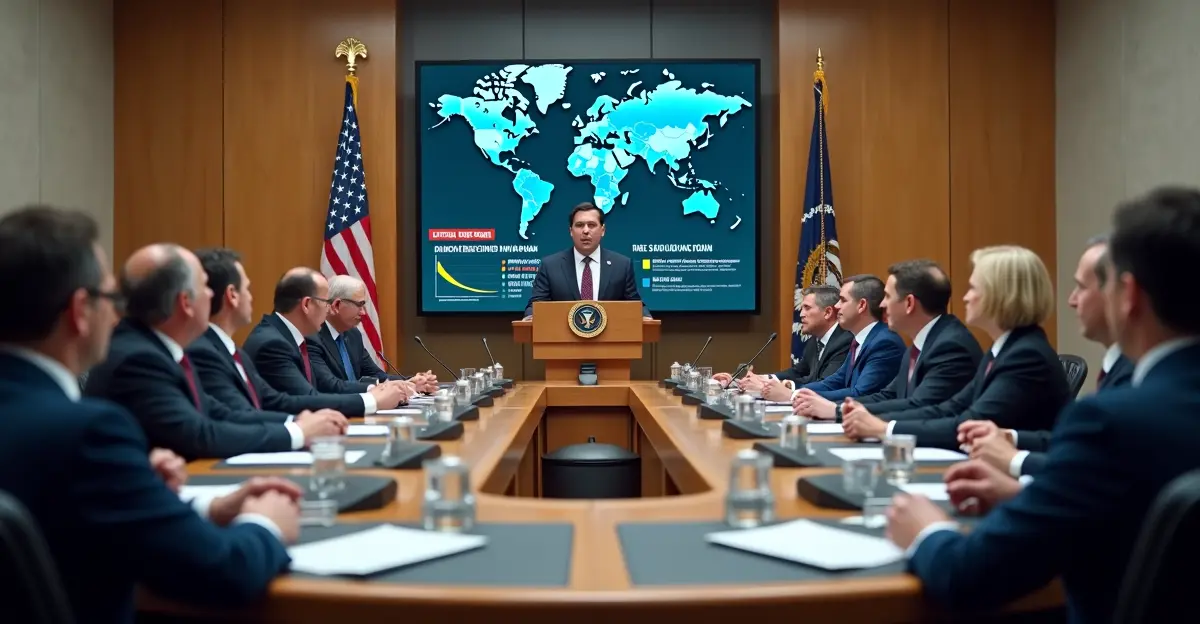
On February 4, 2026, the United States hosted the inaugural Critical Minerals Ministerial, led by Secretary of State Marco Rubio and Vice President JD Vance, with representatives from 54 countries and the European Commission. The centerpiece was the launch of the Forum on Resource Geostrategic Engagement (FORGE), the successor to the Minerals Security Partnership. Chaired by South Korea through June 2026, FORGE aims to link bilateral agreements into a functioning plurilateral system covering two-thirds of the global economy.
The US signed 11 new bilateral critical minerals frameworks or MOUs with countries including Argentina, Morocco, the Philippines, the UAE, and the UK. In total, the administration has signed 21 bilateral framework agreements in five months, with 17 more countries completing negotiations. Key features of FORGE include price coordination mechanisms, adjustable tariffs to uphold pricing integrity, and over $30 billion in US government-mobilized capital.
This marks a significant shift from multilateral to bilateral/minilateral approaches, representing the most ambitious attempt to reshape global mineral markets since the 1970s oil embargoes. The critical minerals supply chain risks are now front and center in national security planning.
Europe's RESourceEU Initiative
The European Union is not standing still. In December 2025, the European Commission adopted the RESourceEU Action Plan, building on the Critical Raw Materials Act (CRMA) to accelerate efforts to secure the EU's supply of critical raw materials. The initiative provides financing and concrete tools to protect industry from geopolitical and price shocks. Italy, France, and Germany are leading an EU plan to stockpile critical raw materials, focusing on lithium, rare earths, and other minerals essential for green energy and defense technologies.
However, the EU faces challenges delivering financing at scale for its CRMA's 60 Strategic Projects, with current funding far below what's needed and lacking credible demand signals like price floors. China's 15th Five-Year Plan will reinforce its dominance across refining and processing, with projections showing China supplying over 60% of refined lithium and cobalt, and roughly 80% of battery-grade graphite and rare earths by 2035.
Global Implications and the New Resource Geopolitics
The structural shift from market-driven supply chains to national security infrastructure has profound implications. New actors like the UAE and Saudi Arabia are entering the market, intensifying competition. The ODI's Senior Geopolitical Risks Advisor Olena Borodyna notes that understanding these geopolitical shifts is essential for both countries seeking supply chain diversification and producer nations aiming to capture value from rising demand.
The JPMorgan Chase Center for Geopolitics report 'Breaking the Critical Minerals Chokepoint' examines how concentrated production in a few countries creates vulnerabilities that could disrupt the energy transition. The report explores strategies for diversifying supply sources, increasing domestic processing capabilities, and fostering international partnerships.
Experts suggest the US must focus on disruptive technologies like advanced recycling rather than trying to out-mine China through traditional approaches. The window for decisive action is narrowing — analysts estimate 12-18 months to make meaningful progress before China's dominance becomes insurmountable.
FAQ
What is resource nationalism in critical minerals?
Resource nationalism refers to governments asserting sovereign control over critical mineral resources through stockpiling, export controls, and strategic alliances, treating mineral access as a matter of national security rather than market economics.
What is Project Vault?
Project Vault is a $12 billion US public-private partnership to establish a Strategic Critical Minerals Reserve, backed by a $10 billion EXIM loan and private investment, storing all 60 critical minerals in secure domestic facilities.
What is the FORGE alliance?
The Forum on Resource Geostrategic Engagement (FORGE) is a 54-nation alliance launched in February 2026, chaired by South Korea, that creates a preferential trade-and-investment zone for critical minerals with coordinated price floors to counter China's market dominance.
How much does China control critical mineral processing?
China controls roughly 90% of global rare earth refining, 80% of tungsten processing, 60% of antimony production, and over 80% of battery-grade graphite processing. Projections show China supplying over 60% of refined lithium and cobalt by 2035.
What is the EU's RESourceEU initiative?
RESourceEU is the European Commission's December 2025 action plan to secure critical raw materials supply, building on the Critical Raw Materials Act, with Italy, France, and Germany leading stockpiling efforts for lithium, rare earths, and other strategic minerals.
Conclusion
The great hoard of critical minerals is reshaping global power in 2026. With China's processing dominance, the US-led FORGE alliance and Project Vault, and Europe's RESourceEU initiative, the world is witnessing a fundamental reordering of supply chains. The outcome will determine not just who powers the green transition, but who holds the levers of geopolitical influence in the decades ahead. As Secretary Rubio stated at the Ministerial, we must reduce overconcentration that enables political coercion and supply chain disruptions. The race is on.

Follow Discussion