


 Deutsch
 English
 Español
 Français
 Nederlands
 Português


 Share
Share




Critical Minerals Geopolitics in 2026: The New Resource Wars and Global Supply Chain Realignment
The 2026 Critical Minerals Ministerial has concluded with 11 new bilateral agreements signed, representing the most significant restructuring of global mineral supply chains in decades. As lithium, rare earths, cobalt, and copper become the new oil of the 21st century, strategic competition over these resources is reshaping global power dynamics and creating urgent vulnerabilities for Western nations facing China's projected 60-80% control of refined minerals by 2035.
What Are Critical Minerals and Why Do They Matter?
Critical minerals are materials essential for modern technologies, national security, and the energy transition. Unlike traditional commodities, these minerals - including lithium for batteries, rare earth elements for magnets, cobalt for electronics, and copper for electrical infrastructure - have become strategic assets in the global energy transition. According to the International Energy Agency, demand for these minerals is projected to multiply 4-6 times by 2040 as countries accelerate their clean energy transitions.
The 2026 Critical Minerals Ministerial: A Watershed Moment
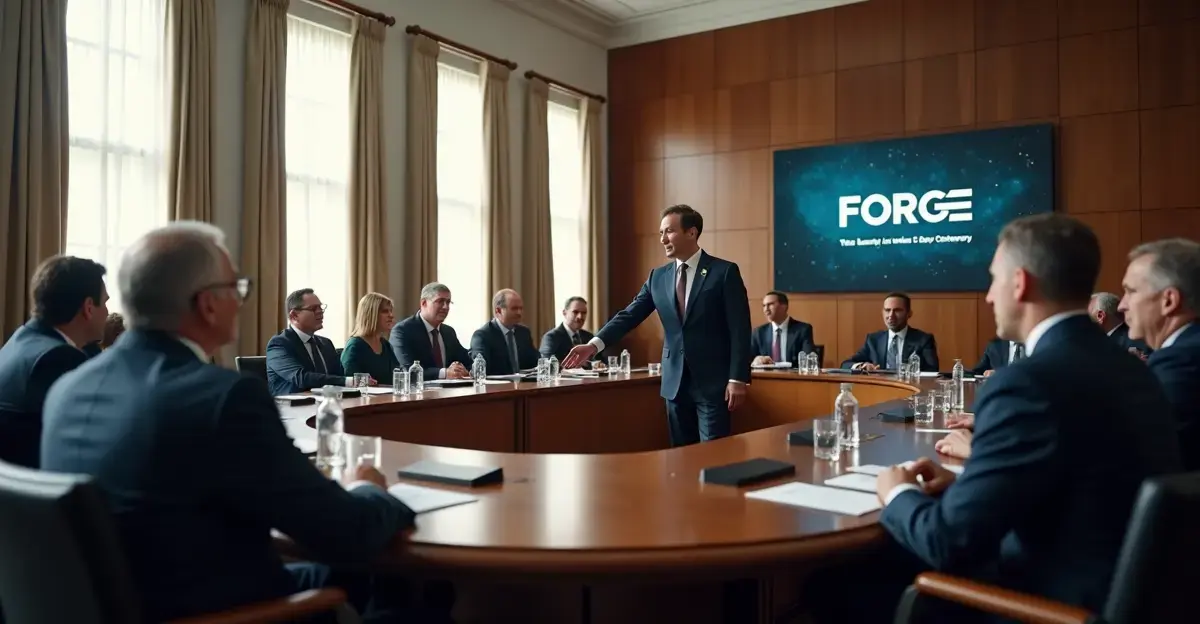
Hosted by U.S. Secretary of State Marco Rubio and Vice President JD Vance, the February 2026 ministerial brought together representatives from 54 countries and the European Commission. The event marked a decisive shift in global mineral policy, with the United States announcing over $30 billion in support for critical minerals projects over the past six months, including EXIM Bank's $10 billion Project Vault initiative to create a domestic strategic reserve.
Key Outcomes from the Ministerial
- 11 new bilateral critical minerals frameworks signed with countries including Argentina, Cook Islands, Ecuador, Guinea, and the United Kingdom
- Establishment of FORGE (Forum on Resource Geostrategic Engagement) as successor to the Minerals Security Partnership
- 17 additional countries completing negotiations for future agreements
- Creation of coordinated price floors to counter market manipulation
China's Dominance: The Strategic Vulnerability
China currently controls approximately 90% of global rare earth refining capacity and is projected to supply over 60% of refined lithium and cobalt, and 80% of battery-grade graphite and rare earths by 2035. This dominance creates what experts call "strategic choke points" in global supply chains. "China's control over processing and refining represents the single greatest vulnerability in Western supply chains," noted a recent Council on Foreign Relations report. The country has strategically used this leverage in trade disputes, restricting exports of rare earths, germanium, and other critical materials during conflicts with the United States and Japan.
China's Critical Minerals Control by 2035
| Mineral | Projected Chinese Control | Primary Applications |
|---|---|---|
| Rare Earth Elements | 80% | Magnets, electronics, defense systems |
| Refined Lithium | 65% | Electric vehicle batteries, energy storage |
| Cobalt Processing | 75% | Batteries, aerospace, medical devices |
| Battery-Grade Graphite | 90% | Battery anodes, lubricants |
The U.S. Strategic Response: Bilateral Agreements and FORGE
The Trump administration has secured 21 bilateral framework agreements in just five months, representing a dramatic acceleration of U.S. foreign policy toward resource security. These agreements create preferential trade-and-investment zones for critical minerals with coordinated price floors to counter adversarial market manipulation. Vice President JD Vance described the approach as establishing "reference prices for critical minerals at each stage of production" maintained through "adjustable tariffs to uphold pricing integrity."
FORGE: A New Strategic Framework
The Forum on Resource Geostrategic Engagement (FORGE) represents a shift from bilateral approaches to plurilateral collaboration. Chaired initially by South Korea, FORGE aims to align trade policy, price signals, and market access across partner economies. This initiative comes as global demand for lithium is forecast to grow 16% year-over-year in 2026, with 58% coming from electric vehicles and 30% from energy storage systems.
Global Demand Projections and Resource Conflicts
According to J.P. Morgan research, the surging global demand for critical minerals is driven by three primary factors: artificial intelligence development, energy transition requirements, and increased defense spending. By 2035, data centers could account for nearly 9% of U.S. electricity demand, further increasing mineral needs. The energy transition remains the dominant driver, with renewable energy technologies requiring these minerals for wind turbines, solar batteries, and electric vehicles.
Demand Growth Projections (2026-2040)
- Lithium demand: 5x increase (primarily for EV batteries)
- Copper demand: 30% increase (electrical infrastructure)
- Rare earth elements: 3-4x increase (magnets, electronics)
- Cobalt: 2-3x increase (batteries, aerospace)
Geopolitical Implications and Resource Wars
The strategic competition over critical minerals is creating new dependencies and potential conflict zones. The Democratic Republic of Congo controls 75.9% of global cobalt production, while Brazil dominates niobium at 90.9%. These concentrations create what analysts call "resource nationalism" risks, where producing countries leverage their mineral wealth for geopolitical advantage. The Atlantic Council has warned that China could deplete U.S. stockpiles of critical minerals like neodymium and dysprosium within weeks if it imposed export bans during a geopolitical crisis.
Expert Perspectives on the Mineral Security Crisis
"The 2026 ministerial represents the most significant restructuring of global mineral supply chains since the oil crises of the 1970s," said Evelyn Nakamura, geopolitical analyst. "What we're witnessing is the weaponization of mineral supply chains, where control over processing and refining becomes as strategically important as control over the raw materials themselves." The ODI analysis notes that while the U.S. has prioritized domestic production expansion and bilateral partnerships, the European Union faces challenges scaling investment despite policy frameworks like the Critical Raw Materials Act.
Frequently Asked Questions
What are critical minerals?
Critical minerals are materials essential for modern technologies, national security, and the energy transition, including lithium, rare earth elements, cobalt, and copper. They differ from traditional commodities due to their strategic importance and supply chain vulnerabilities.
Why is China's dominance in critical minerals concerning?
China controls approximately 90% of global rare earth refining capacity and is projected to supply 60-80% of refined critical minerals by 2035. This creates strategic vulnerabilities for Western nations, as China has previously used export restrictions as leverage in trade disputes.
What is FORGE and how does it work?
The Forum on Resource Geostrategic Engagement (FORGE) is a new international framework launched in 2026 to coordinate critical minerals policy among partner nations. It establishes preferential trade zones with coordinated price floors to counter market manipulation and create stable investment conditions.
How much will demand for critical minerals grow by 2040?
Demand for energy transition minerals is projected to multiply 4-6 times by 2040, with lithium demand growing fivefold, copper demand increasing by over 30%, and rare earth elements seeing 3-4x growth.
What are the main drivers of critical minerals demand?
The three primary drivers are: 1) Energy transition requirements (EVs, renewables), 2) Artificial intelligence development and data centers, and 3) Increased defense spending and advanced military technologies.
Future Outlook and Strategic Considerations
As the global power dynamics continue to shift around mineral resources, the success of initiatives like FORGE and bilateral agreements will determine whether Western nations can reduce their dependence on Chinese processing. The coming years will see increased competition for mineral resources, potential resource conflicts in key producing regions, and continued innovation in recycling and alternative materials to bypass current supply chain vulnerabilities. The 2026 ministerial has set the stage for what analysts are calling "the new resource wars" of the 21st century.

Follow Discussion