


 Deutsch
 English
 Español
 Français
 Nederlands
 Português


 Share
Share




The $30 Billion Race: How Critical Minerals Became the New Frontline of Geopolitical Conflict in 2026
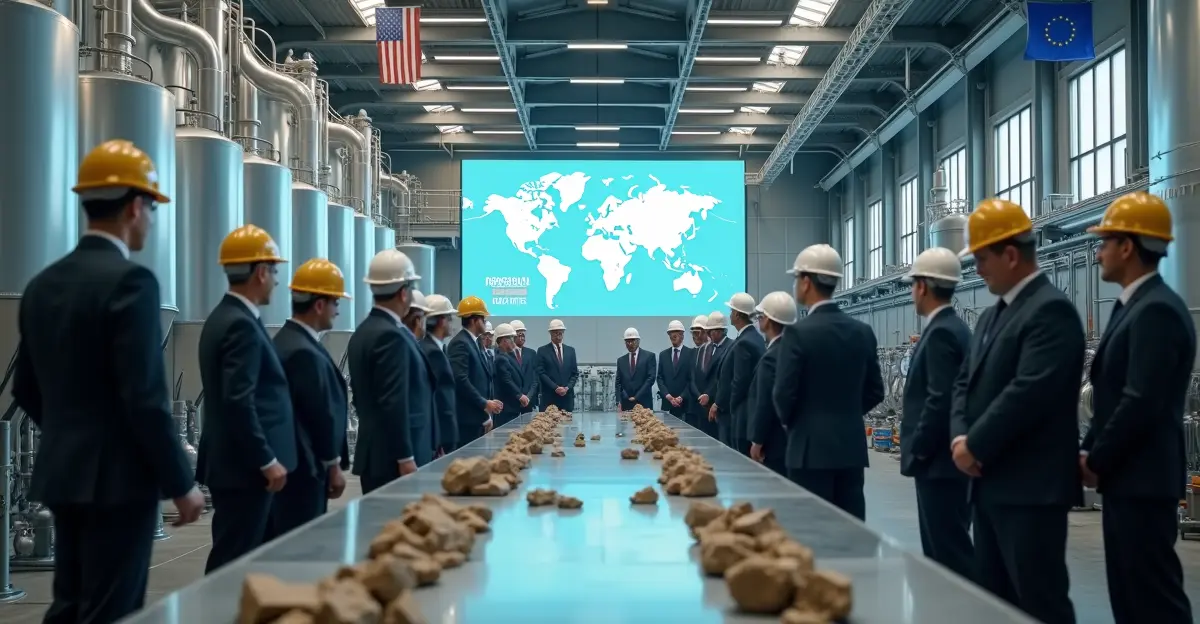
On February 4, 2026, the United States hosted the inaugural Critical Minerals Ministerial in Washington, D.C., gathering representatives from 54 nations and the European Commission. The event marked a decisive inflection point in the global scramble for critical minerals—lithium, cobalt, nickel, rare earth elements, and graphite—that underpin artificial intelligence infrastructure, defense systems, and the energy transition. With China controlling roughly 90% of rare earth processing and over 60% of refined lithium and cobalt capacity, the U.S. and its allies are racing to build alternative supply chains. The Ministerial produced over $30 billion in mobilized U.S. government financing, the launch of a new plurilateral forum called FORGE, and Project Vault—a $10 billion domestic strategic reserve. This analysis examines how the critical minerals geopolitics of 2026 is reshaping alliances, driving industrial policy, and creating new systemic risks for global supply chains.
Context: Why Critical Minerals Matter More Than Ever
Critical minerals are the building blocks of modern technology. Lithium and cobalt power electric vehicle batteries; rare earths are essential for wind turbines, military electronics, and the magnets in AI data center cooling systems; graphite and nickel are vital for energy storage. The International Energy Agency projects global demand for these minerals will nearly triple by 2030 and quadruple by 2050. Yet supply chains remain dangerously concentrated. China dominates processing across the board: 90% of rare earths, 80% of tungsten, 60% of antimony, and over 70% of battery-grade graphite. This concentration creates strategic vulnerabilities—a reality underscored by China's 2025-2026 export controls, which triggered price spikes of up to sixfold and saw licensing approval rates for European firms fall below 25% in some sectors. The U.S. critical minerals strategy has therefore become a national security imperative.
The 2026 U.S. Critical Minerals Ministerial: A New Playbook
FORGE Replaces the Minerals Security Partnership
Secretary of State Marco Rubio announced the Forum on Resource Geostrategic Engagement (FORGE) as the successor to the Minerals Security Partnership (MSP). Unlike the MSP, which functioned largely as a diplomatic dialogue, FORGE is designed as a plurilateral coalition creating a preferential trade-and-investment zone for critical minerals. Vice President JD Vance outlined plans for coordinated price floors—"reference prices for critical minerals at each stage of production"—with adjustable tariffs to ensure pricing integrity and counter adversarial market manipulation. South Korea will chair FORGE through June 2026, and the initiative aims to link 21 bilateral framework agreements signed over the past five months into a functioning system covering two-thirds of the global economy.
Project Vault: A $10 Billion Domestic Strategic Reserve
President Trump announced Project Vault, a $10 billion Export-Import Bank initiative to establish the U.S. Strategic Critical Minerals Reserve. Structured as an independently governed public-private partnership, the reserve will store essential raw materials in secure facilities across the United States. Backed by $10 billion in EXIM loans and nearly $2 billion in private-sector investment, Project Vault aims to buffer against supply disruptions and price volatility. The reserve complements $30 billion in total U.S. government support mobilized over the past six months, including letters of interest, loans, and direct investments in mining and processing projects across allied nations.
Bilateral Frameworks and Private Sector Engagement
The Ministerial produced 11 new bilateral critical minerals framework agreements with countries including Argentina, Morocco, the Philippines, the United Arab Emirates, and the United Kingdom, bringing the total to 21 deals. These frameworks cover joint investment, technology transfer, and streamlined permitting. The event also featured private sector engagement through Pax Silica, a consortium of technology and mining firms, and an MOU between Glencore and the Orion Critical Mineral Consortium for investment in the Democratic Republic of the Congo's mining sector.
China's 15th Five-Year Plan: Tightening the Grip
China's 15th Five-Year Plan (2026-2030), released in late 2025, reinforces the country's dominance in critical minerals. The plan designates energy and resource security as a national priority, targeting comprehensive energy production of 5.8 billion tons of standard coal by 2030. Critical minerals are positioned as fundamental to new energy vehicles, renewable energy, consumer electronics, aerospace, and defense. The plan emphasizes optimizing industrial chains, strengthening competitive advantages in rare earths and rare metals, and shifting from raw material extraction to higher-value processed products. Major provinces including Guangxi, Jiangxi, Guizhou, and Yunnan have aligned with ambitious local targets. However, analysts warn that China faces overcapacity risks—EV overcapacity alone is estimated at 5-10 million vehicles annually—which could trigger price wars and deflationary pressures. President Xi Jinping has warned about "involution," the phenomenon of investing ever more for diminishing returns. Despite these internal challenges, China is expected to maintain over 80% control of rare earth and graphite processing through 2030, and over 60% of refined lithium and cobalt by 2035. The China critical minerals export controls of 2025-2026 have demonstrated Beijing's willingness to weaponize this dominance, using temporary, reversible restrictions to extract strategic concessions rather than imposing outright bans.
The European Union's Response
The EU has moved to bolster its own critical minerals security through the Critical Raw Materials Act (CRMA), which came into effect in May 2024. The CRMA sets 2030 benchmarks: at least 10% extraction, 40% processing, and 25% recycling capacity domestically, with no more than 65% of any strategic raw material sourced from a single third country. In March 2025, the European Commission selected 47 Strategic Projects spanning 13 member states, covering lithium (22 projects), nickel (12), graphite (11), and cobalt (10), with total investment needs of approximately €22.5 billion. A second round of applications closed in January 2026. However, the EU faces challenges in scaling financing—mobilizing up to €3 billion by 2029 through RESourceEU—and lacks clear demand signals and risk-sharing mechanisms compared to the U.S. approach. Over 80% of European companies still depend on Chinese supply chains for materials essential to defense, EVs, and renewable energy.
Impact and Implications for Global Supply Chains
The 2026 critical minerals race is reshaping global alliances and creating new systemic risks. The U.S.-led FORGE framework aims to create a parallel trading system that could effectively split the global critical minerals market into Western and Chinese spheres. This carries significant implications for developing nations rich in mineral resources—such as the Democratic Republic of the Congo (cobalt), Chile (lithium), and Indonesia (nickel)—which now face competing demands from both blocs. The critical minerals supply chain risks are also driving innovation: the U.S. Department of Energy's ARPA-E and DARPA are funding research into rare-earth-free magnets, waste-based recovery from mine tailings, and AI-enabled materials discovery. Recycling and urban mining are emerging as faster, cheaper, and cleaner alternatives to traditional extraction. The Council on Foreign Relations recommends a "leapfrog" strategy focused on innovation rather than trying to out-mine China, noting that rebuilding independent Western supply chains could take 20-30 years. The window for decisive action is estimated at 12-18 months before prolonged vulnerability sets in.
Expert Perspectives
"The 2026 Critical Minerals Ministerial represents a paradigm shift from dialogue to action," said a senior State Department official. "FORGE creates the architecture for a resilient, diversified supply chain that can withstand geopolitical shocks." Analysts at the Atlantic Council note that the coordinated price floor mechanism is unprecedented in mineral policy and could stabilize investment in a sector where projects often require decades to deliver returns. However, critics warn that the approach risks escalating trade tensions with China and could fragment global markets. "We are witnessing the emergence of a critical minerals NATO," commented a European trade official. "But unlike the original alliance, this one is being built at a time when demand is exploding and supply is constrained."
Frequently Asked Questions
What are critical minerals?
Critical minerals are raw materials designated by governments as essential for economic and national security, with vulnerable supply chains. They include rare earth elements, lithium, cobalt, nickel, graphite, and tungsten, among others.
Why is China dominant in critical minerals?
China controls approximately 90% of rare earth processing and over 60% of refined lithium and cobalt capacity due to decades of strategic investment, low labor costs, and less stringent environmental regulations. It also holds significant mining assets in Africa and South America.
What is FORGE?
The Forum on Resource Geostrategic Engagement (FORGE) is a plurilateral coalition launched in February 2026 as the successor to the Minerals Security Partnership. It aims to create a preferential trade-and-investment zone for critical minerals with coordinated price floors, chaired initially by South Korea.
What is Project Vault?
Project Vault is a $10 billion U.S. Export-Import Bank initiative to establish a domestic strategic reserve for critical minerals. It is structured as a public-private partnership that will store essential raw materials in secure facilities across the United States.
How will the critical minerals race affect global supply chains?
The race is likely to create parallel supply chains—one Western-led and one Chinese-dominated—increasing costs and complexity for global manufacturers. Developing countries with mineral resources may benefit from increased investment but also face pressure to choose sides geopolitically.
Conclusion and Future Outlook
The 2026 critical minerals race is still in its early stages, but the trajectory is clear. The U.S. and its allies are moving from dependency to diversification through massive public investment, plurilateral frameworks, and technological innovation. China, meanwhile, is leveraging its processing dominance and export controls to maintain strategic advantage. The outcome will determine not only the shape of the global energy transition and AI infrastructure but also the balance of economic and military power for decades to come. With demand for critical minerals projected to quadruple by 2050, the nations that secure reliable, diversified supply chains will hold a decisive advantage in the 21st century. The next 12-18 months will be critical in determining whether the Western alliance can build a viable alternative to Chinese dominance—or whether the world will remain dependent on Beijing's strategic calculus.



Follow Discussion