


 Deutsch
 English
 Español
 Français
 Nederlands
 Português


 Share
Share




Washington Launches Ambitious Bid to Break China's Grip on Critical Minerals
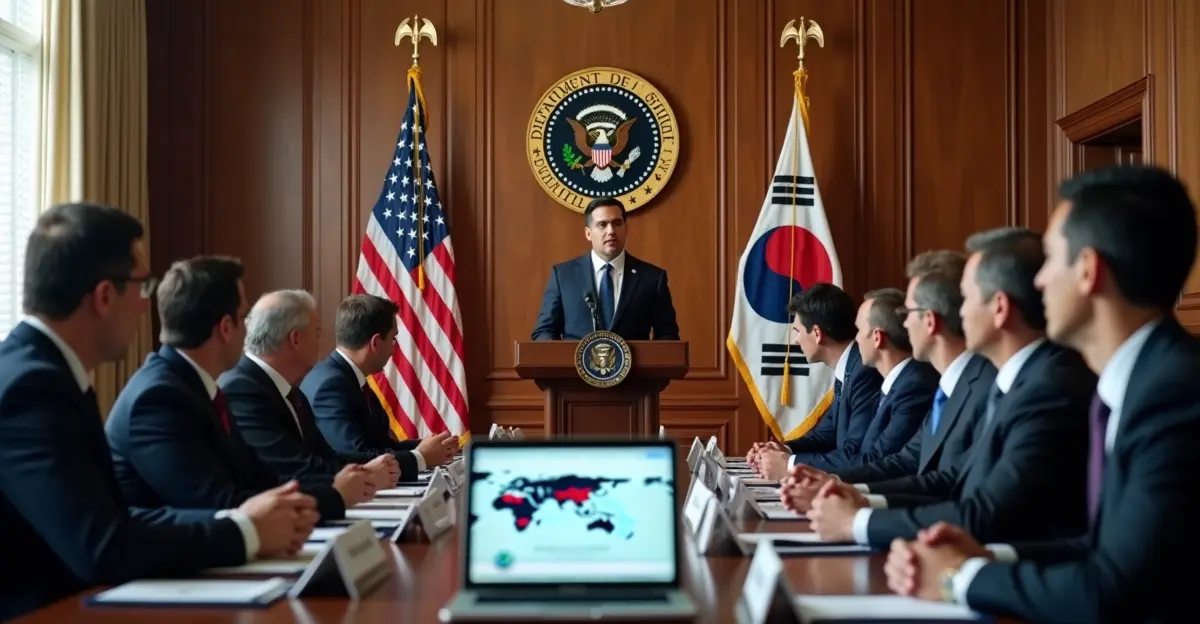
On February 4, 2026, the United States hosted the inaugural Critical Minerals Ministerial in Washington, D.C., bringing together representatives from 54 countries and the European Commission. The event marked the launch of the Forum on Resource Geostrategic Engagement (FORGE) and Project Vault, a $10 billion domestic strategic reserve for critical minerals. Together with 11 new bilateral framework agreements signed with countries including Argentina, Morocco, the Philippines, and the United Arab Emirates, these initiatives represent the most ambitious U.S. attempt to rewire the global critical minerals order and break China's decades-long dominance in rare earths and battery minerals.
The Critical Minerals Ministerial 2026 was led by Secretary of State Marco Rubio and Vice President JD Vance, with participation from six U.S. cabinet members, signaling whole-of-government coordination. The U.S. government has mobilized over $30 billion in financing support for strategic mineral supply chain projects over the past six months, according to the State Department.
What Is FORGE? The Plurilateral Successor to the Minerals Security Partnership
FORGE — the Forum on Resource Geostrategic Engagement — is designed as a plurilateral trade-and-investment bloc that replaces the Minerals Security Partnership (MSP). Unlike the MSP's looser coordination, FORGE aims to create a preferential trade zone with coordinated price floors for critical minerals, preventing China from undercutting competitors through subsidies and dumping. South Korea will chair FORGE through June 2026, providing initial institutional leadership.
The initiative seeks to link 21 bilateral agreements signed over five months into a functioning system covering two-thirds of the global economy. According to the Atlantic Council, FORGE represents a shift from bilateralism to plurilateralism with sharper commitments than its predecessor. Key challenges include translating bilateral leverage into genuine multilateral coordination and designing effective reference prices without creating perverse incentives.
How FORGE's Price Floors Work
FORGE's price floor mechanism uses coordinated tariffs among partner countries to establish minimum prices for critical minerals. This approach directly counters China's ability to flood markets with subsidized supply, a tactic Beijing has used to maintain its dominant position. The U.S. has clarified that Section 232 tariffs on critical minerals will serve as enforcement tools, with adjustable rates to protect the new pricing framework.
Project Vault: A $10 Billion Domestic Strategic Reserve
Announced by President Trump on February 2, 2026, Project Vault is a $10 billion Export-Import Bank (EXIM) loan initiative complemented by nearly $2 billion in private capital. The program establishes the U.S. Strategic Critical Minerals Reserve, a public-private partnership that will store essential raw materials in secure facilities nationwide. EXIM Chairman Jovanovic promoted the initiative on CNBC and Bloomberg, emphasizing its role in protecting American manufacturers from supply shocks.
Industry supporters include GE Vernova, Mercuria Energy Americas, Traxys, Hartree, Clarios, and Boeing. The reserve is designed to serve as a buffer against price volatility and geopolitical disruptions, ensuring that U.S. manufacturers of EVs, AI hardware, and defense systems have guaranteed access to critical inputs.
The 11 New Bilateral Agreements: From Argentina to Morocco
The Critical Minerals Ministerial produced 11 new bilateral critical minerals frameworks or memorandums of understanding (MOUs), bringing the total to 21 deals in five months. Key partners include:
- Argentina: Signed a landmark strategic framework on February 5, 2026, to accelerate mining and processing projects. Both countries will mobilize grants, guarantees, loans, and equity investments while streamlining permitting and establishing benchmark pricing frameworks.
- Morocco: A framework agreement leverages Morocco's phosphate reserves and processing capabilities, positioning the North African kingdom as a gateway to African mineral resources.
- Philippines: Partnership focuses on nickel and cobalt supply chains, critical for EV batteries.
- United Arab Emirates: Agreement taps UAE investment capital and logistics infrastructure to support mineral processing and trade.
- United Kingdom: Framework builds on existing collaboration in rare earth processing and recycling technologies.
The US bilateral critical minerals agreements with these countries are designed to create a network of trusted suppliers that can bypass Chinese-controlled processing hubs.
Pax Silica: Securing Technology Supply Chains
Complementing FORGE and Project Vault is Pax Silica, a U.S. Department of State initiative focused on AI and supply chain security. Launched in December 2025, Pax Silica brings together signatories including Australia, India, Japan, South Korea, Singapore, the UK, and others to secure supply chains spanning energy, critical minerals, semiconductors, and AI infrastructure. The State Department recently announced a $250 million Pax Silica Fund for critical minerals and manufacturing. The initiative recognizes that the 21st century runs on compute and critical minerals, unlike the 20th century which ran on oil and steel.
China's Dominance and the Urgency of Diversification
China currently controls approximately 90% of global rare earth processing, 80% of tungsten, and 60% of antimony — materials essential to defense, EVs, and renewable energy. Over 80% of European companies depend on Chinese supply chains, with alternative sources requiring 20 to 30 years to develop. Export controls introduced by Beijing in 2025–2026 triggered up to sixfold price spikes outside China, while licensing approvals for European firms fell below 25% in some sectors.
According to a multi-institutional analysis cited by Rare Earth Exchanges, China is weaponizing control rather than scarcity, using temporary restrictions to maintain pricing power and extract concessions. Western nations face a 12-to-18-month window to act decisively or accept prolonged vulnerability. The China rare earth export controls 2026 have accelerated the urgency of initiatives like FORGE.
Global Reactions and Strategic Implications
China immediately criticized the U.S. plan. On February 5, 2026, Beijing denounced the creation of a critical minerals trade bloc as a strategic move to challenge its influence over vital resources, according to Reuters. The dispute highlights escalating tensions between the world's two largest economies over resources deemed critical for economic and national security.
The European Union, while participating in the ministerial, has pursued its own path through the Critical Raw Materials Act, which selected 60 Strategic Projects. However, financing lags behind ambitions, with the RESourceEU Action Plan targeting only €3 billion by 2029. The U.S.-EU Critical Minerals Action Plan, signed alongside the ministerial, seeks to align standards and promote joint investment.
Emerging players like the UAE and Saudi Arabia are entering the market, intensifying competitive pressures. Resource-rich developing nations in Africa and South America face a strategic choice: align with the U.S.-led bloc, maintain ties with China, or pursue independent paths. The geopolitics of critical minerals in 2026 are reshaping alliances and investment flows globally.
Impact on Supply Chains for EVs, AI, and Defense
The initiatives directly affect three critical sectors:
- Electric Vehicles: Lithium, cobalt, nickel, and rare earths for magnets are essential for EV batteries and motors. FORGE's price floors aim to stabilize input costs for U.S. and allied automakers.
- AI Hardware: Semiconductors require gallium, germanium, and rare earths for advanced chips. Pax Silica specifically targets these supply chains.
- Defense Systems: Permanent magnets, laser guidance, and night vision technologies depend on rare earths. Project Vault's strategic reserve directly supports national security objectives.
S&P Global analysis indicates that rare earth supply bottlenecks will persist through 2026, with new mining and refining projects unlikely to come online quickly enough to resolve tightness. This underscores the importance of stockpiling and trade bloc coordination.
Expert Perspectives
"FORGE is the most significant attempt by the United States to create a parallel critical minerals ecosystem that can compete with China's established supply chains," said a senior fellow at the Atlantic Council's Global Energy Center. "The challenge will be translating 21 bilateral deals into a coherent plurilateral system with enforceable commitments."
EXIM Chairman Jovanovic stated: "Project Vault is not just about stockpiling — it's about creating a commercial ecosystem that makes the United States the preferred destination for critical mineral processing and manufacturing."
Secretary Rubio emphasized at the ministerial: "We are building a coalition of countries that share our values and our commitment to secure, diversified supply chains. This is about economic security and national security."
Frequently Asked Questions
What is FORGE in the context of critical minerals?
FORGE (Forum on Resource Geostrategic Engagement) is a U.S.-led plurilateral trade and investment bloc launched in February 2026 to create a preferential trade zone for critical minerals with coordinated price floors, replacing the Minerals Security Partnership.
How much funding does Project Vault provide?
Project Vault provides $10 billion in EXIM financing, complemented by nearly $2 billion in private investment, to establish the U.S. Strategic Critical Minerals Reserve — a domestic stockpile of essential raw materials.
Which countries signed bilateral agreements with the U.S. at the 2026 Ministerial?
Eleven countries signed new frameworks or MOUs, including Argentina, Morocco, the Philippines, the UAE, and the UK, bringing the total to 21 bilateral agreements in five months.
How does FORGE counter China's dominance in rare earths?
FORGE uses coordinated tariffs and price floors to prevent China from undercutting competitors through subsidies and dumping, while building alternative supply chains through partner countries and the Project Vault strategic reserve.
What is Pax Silica and how does it relate to FORGE?
Pax Silica is a U.S.-led initiative launched in December 2025 to secure technology supply chains for semiconductors, AI, and critical minerals. It complements FORGE by focusing on the technology stack from mineral extraction to chip manufacturing, with a $250 million fund.
Conclusion: A New Geopolitical Landscape for Critical Minerals
The launch of FORGE and Project Vault marks a paradigm shift in U.S. critical minerals policy. By combining plurilateral trade coordination, strategic stockpiling, and targeted bilateral agreements, Washington is creating an alternative ecosystem to China's dominant supply chains. The success of these initiatives will depend on execution — translating agreements into operational projects, maintaining coalition cohesion, and navigating China's likely countermeasures. As the energy transition accelerates and demand for critical minerals surges, the geopolitical order established in 2026 will shape global supply chains for decades to come.



Follow Discussion