


 Deutsch
 English
 Español
 Français
 Nederlands
 Português


 Share
Share




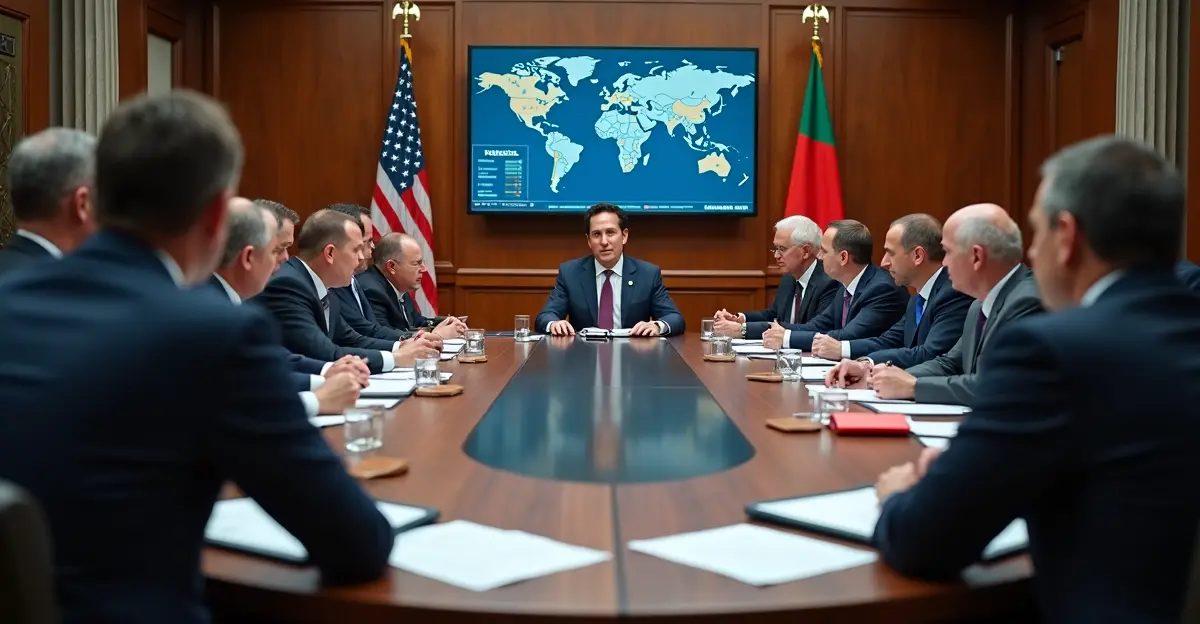
The global competition for critical minerals entered a decisive new phase on February 4, 2026, when the United States hosted the inaugural Critical Minerals Ministerial in Washington, D.C. Representatives from 54 countries and the European Commission gathered to launch the Forum on Resource Geostrategic Engagement (FORGE), the most ambitious restructuring of global mineral supply chains in decades. With the U.S. mobilizing over $30 billion and signing 11 new bilateral agreements, while China maintains projected control of over 60% of refined lithium and cobalt through 2035, a strategic competition is unfolding that will determine which nations control the essential inputs for artificial intelligence, the energy transition, and advanced defense systems.
What Is FORGE and Why Does It Matter?
FORGE, announced by U.S. Secretary of State Marco Rubio alongside Vice President JD Vance and six cabinet members, succeeds the Minerals Security Partnership (MSP) as the primary vehicle for allied coordination on critical minerals. Unlike its predecessor, FORGE is designed as a plurilateral coalition creating a preferential trade-and-investment zone for critical minerals, complete with coordinated price floors to counter adversarial market manipulation. The Republic of Korea was named the inaugural chair of FORGE, signaling the importance of Asian allies in the new framework.
The Minerals Security Partnership had laid groundwork since 2022, but FORGE represents a significant escalation. The initiative aims to link bilateral deals into a functioning system covering roughly two-thirds of the global economy. Key features include adjustable tariffs to uphold pricing integrity, coordinated price supports internationalized across partner economies, and a 'membership by trade' model that conditions participation on shared rules rather than joint capital deployment.
The $30 Billion Mobilization
The U.S. government has mobilized over $30 billion in letters of interest, loans, and investments for critical mineral projects over the past six months. The centerpiece is Project Vault, a $10 billion initiative by the Export-Import Bank of the United States (EXIM) to establish a domestic Strategic Critical Minerals Reserve. This reserve is designed to provide U.S. manufacturers with guaranteed access to rare earths and metals essential for electrification, defense, and advanced manufacturing.
The 11 new bilateral critical minerals frameworks signed at the Ministerial include agreements with Argentina, Morocco, the Philippines, the United Arab Emirates, the United Kingdom, the Cook Islands, and others. These bring the total number of bilateral deals to 21 in just five months, reflecting an unprecedented diplomatic push. The U.S. critical minerals policy now involves multiple agencies: the Department of Commerce handling Section 232 tariffs and monitoring, USTR leading trade negotiations, EXIM housing Project Vault, and the Pentagon managing the National Defense Stockpile.
China's Dominance and the Strategic Gap
China's position in critical mineral supply chains remains formidable. According to data from the Climate Energy Finance (CEF) think tank, China has invested over $120 billion in overseas mining and upstream processing since 2023, targeting lithium, copper, nickel, rare earths, and bauxite. Chinese firms have deployed an additional $220 billion into downstream sectors like battery manufacturing and solar infrastructure, creating a vertically integrated global cleantech expansion.
China currently controls roughly 90% of global rare earth refining, 60% of lithium processing, and over 70% of cobalt refining. Projections indicate that China will maintain control of over 60% of refined lithium and cobalt through 2035, even as Western nations accelerate their own processing capacity. The China critical minerals dominance extends beyond production to include export controls, which Beijing has used as a geopolitical lever in trade disputes with the United States and Japan.
The Response: Resource Nationalism 2.0
In response, governments worldwide are embracing what analysts call 'Resource Nationalism 2.0.' The U.S. has proposed Project Vault, a $12 billion strategic mineral reserve. Australia announced an $800 million critical minerals reserve, while the EU is advancing joint stockpile plans under RESourceEU. South Korea committed $172 million to expand stockpiles, and India partnered with Brazil to diversify supply away from China.
This shift toward stockpiling and state-directed investment represents a fundamental change from the free-market approach that dominated mineral trade for decades. Governments are building inventories not just as emergency buffers but as strategic assets against geopolitical risks. The International Institute for Strategic Studies (IISS) confirmed in its Military Balance 2026 report that global defense spending reached $2.63 trillion in 2025, with critical minerals now at the center of strategic competition.
New Players Reshaping Geopolitical Alliances
The critical minerals race is also redrawing traditional geopolitical alliances. Gulf states, led by Saudi Arabia and the United Arab Emirates, are rapidly emerging as significant players. In May 2025, the U.S. and Saudi Arabia signed a critical mineral cooperation pact to explore joint ventures in exploration, mining, and processing. Saudi mining company Maaden formed a joint venture with MP Materials and the U.S. Department of War to develop a rare earths refinery, while Saudi mining exploration spending hit a record $279.8 million in 2024.
The UAE signed one of the 11 new bilateral frameworks at the February Ministerial, and Gulf sovereign wealth funds are actively acquiring critical mineral assets globally, including stakes in Zambian copper mines and DRC tin production. The Gulf states critical minerals strategy is driven by Vision 2030 diversification goals and a recognition that mineral wealth offers a path beyond hydrocarbons.
Private Sector Partnerships: Pax Silica
A key feature of the new U.S. strategy is deep private sector engagement through the Pax Silica initiative. This economic-security coalition aims to build a full-spectrum ecosystem spanning AI, semiconductors, and advanced manufacturing to rival China's vertically integrated model. At the Ministerial, Glencore signed an MOU with the Orion Critical Mineral Consortium for copper and cobalt assets in the Democratic Republic of Congo, demonstrating how private capital is being mobilized alongside government commitments.
For Indo-Pacific members like Australia, Japan, Singapore, and South Korea, joining Pax Silica offers access to financing and technology but risks narrowing their strategic room with China. The initiative's long-term success depends on sustaining allied trust while managing unilateral tools like tariffs.
Expert Perspectives
'The launch of FORGE represents a paradigm shift in how the United States and its allies approach critical mineral security,' said Dr. Maria Shagina of the International Institute for Strategic Studies. 'By moving from a partnership model to a trade-and-investment zone with price mechanisms, FORGE creates real economic incentives for countries to align with Western supply chains.'
However, analysts caution that the road ahead is fraught with challenges. A November 2025 report by Resources for the Future concluded that U.S. domestic resources for key battery minerals are insufficient to meet projected electric vehicle demand through 2050, arguing that structured international cooperation is essential. The critical minerals supply chain risks remain significant, with long mine development lead times and high costs of geographically diversifying processing capacity.
FAQ: Critical Minerals and FORGE
What is FORGE?
FORGE (Forum on Resource Geostrategic Engagement) is a plurilateral coalition launched in February 2026 by the United States and 54 partner countries. It succeeds the Minerals Security Partnership and aims to create a preferential trade-and-investment zone for critical minerals with coordinated price floors.
Why are critical minerals important?
Critical minerals such as lithium, cobalt, rare earths, and graphite are essential inputs for AI, robotics, batteries, electric vehicles, renewable energy technologies, and advanced defense systems. Supply chain concentration poses risks of disruption and political coercion.
How much does China control?
China controls roughly 90% of global rare earth refining, 60% of lithium processing, and over 70% of cobalt refining. It has invested over $120 billion in overseas mining since 2023 and is projected to maintain dominance through 2035.
What is Project Vault?
Project Vault is a $10 billion initiative by the U.S. Export-Import Bank to establish a domestic Strategic Critical Minerals Reserve, providing U.S. manufacturers with guaranteed access to essential metals and rare earths.
How are Gulf states involved?
Saudi Arabia and the UAE are rapidly expanding their critical minerals capabilities through joint ventures with U.S. companies, sovereign wealth fund acquisitions, and bilateral agreements. Saudi Arabia has estimated its mineral reserves at $2.5 trillion.
Conclusion: A New Geopolitical Landscape
The February 2026 Critical Minerals Ministerial and the launch of FORGE mark a turning point in global power dynamics. With $30 billion in U.S. commitments, 11 new bilateral agreements, and the emergence of new players like the Gulf states, the critical minerals landscape is being fundamentally reshaped. The competition for control over the inputs of the 21st century economy will define geopolitical alliances for decades to come. As the IISS Military Balance 2026 confirms, with global defense spending at $2.63 trillion, critical minerals are no longer just an economic issue—they are a matter of national security.
Sources
- U.S. Department of State, 2026 Critical Minerals Ministerial Press Release, February 4, 2026
- Atlantic Council, 'US Critical Minerals Policy Goes Collaborative with FORGE,' February 2026
- The Fuse, 'FORGE: Trump Administration's Evolving Approach to Critical Minerals Partnerships,' February 2026
- IISS, The Military Balance 2026, February 2026
- Climate Energy Finance, 'China Spent $120B to Lock Down Critical Minerals Dominance,' 2025
- Resources for the Future, 'Resource Nationalism and the Resilience of Critical Mineral Supply Chains,' November 2025
- CNBC, 'Critical Minerals Stockpile Race,' February 25, 2026
- IISS, 'The Geopolitics of the Gulf States' Push for Critical Minerals,' July 2025




Follow Discussion