


 Deutsch
 English
 Español
 Français
 Nederlands
 Português


 Share
Share




The 2026 Critical Minerals Geopolitics: How FORGE and $30B in U.S. Financing Reshape Global Supply Chains
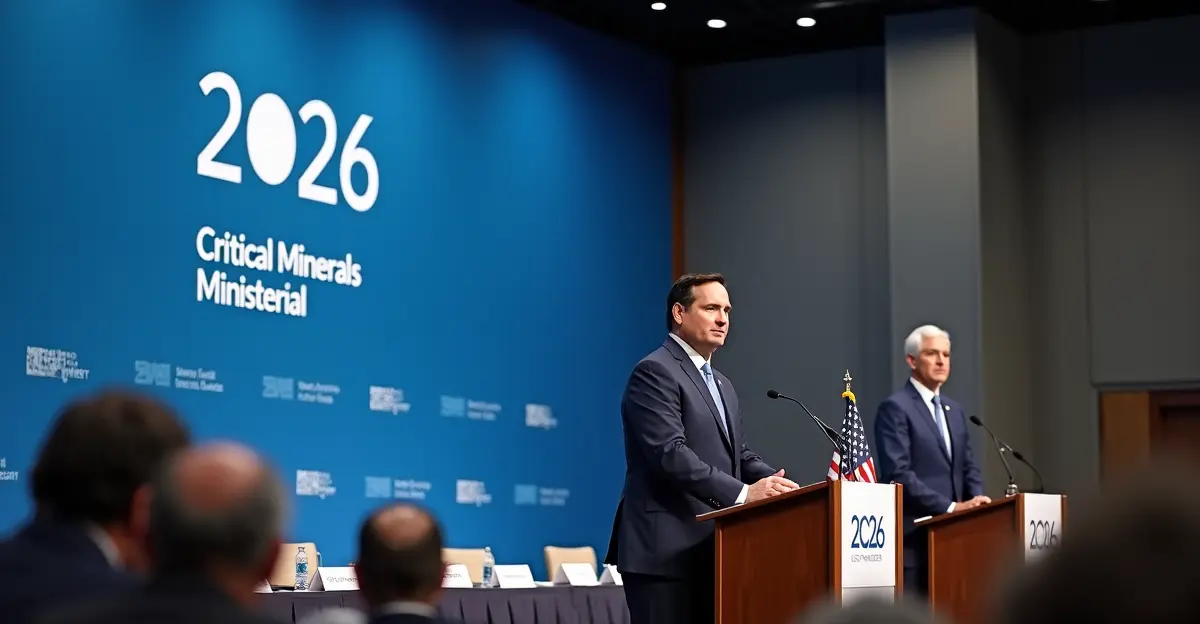
The global competition for critical minerals reached a pivotal moment on February 4, 2026, as the United States unveiled an unprecedented $30+ billion financing package and launched the Forum on Resource Geostrategic Engagement (FORGE) during the Critical Minerals Ministerial. This strategic escalation represents Washington's most aggressive response yet to China's projected 60-80% control of refined critical minerals by 2035, signaling a fundamental shift in how nations secure resources essential for energy transition, defense capabilities, and technological supremacy.
What is the 2026 Critical Minerals Ministerial?
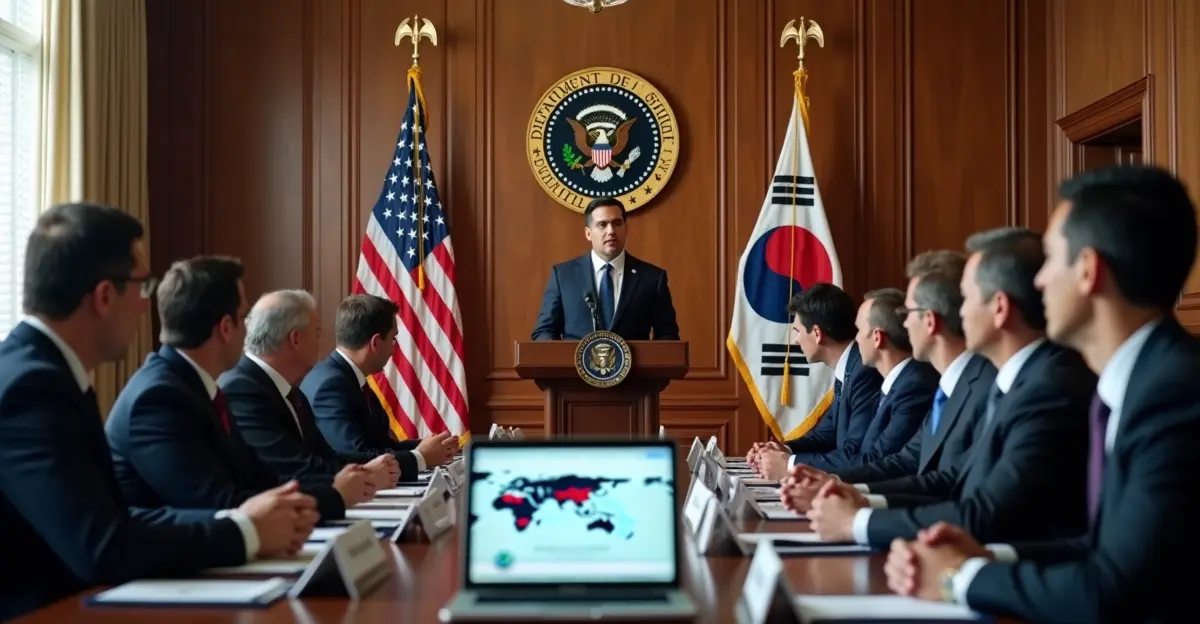
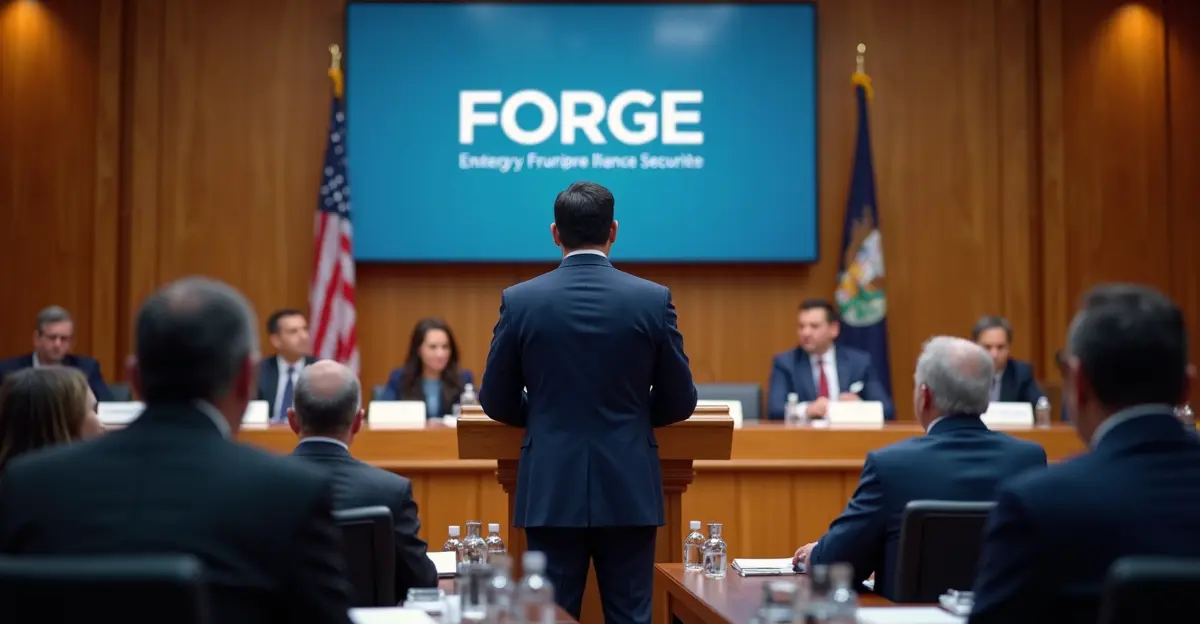
The 2026 Critical Minerals Ministerial, hosted by U.S. Secretary of State Marco Rubio with Vice President JD Vance and other cabinet officials, brought together representatives from 54 countries and the European Commission to address global supply chain security. The event focused on reducing market concentration that enables political coercion and supply disruptions, with key outcomes including 11 new bilateral critical minerals frameworks and the launch of FORGE as the successor to the Minerals Security Partnership. According to State Department documents, the U.S. has mobilized over $30 billion in support for critical minerals projects in the past six months alone, representing a massive financial commitment to reshaping global resource flows.
FORGE: The New Geopolitical Architecture for Critical Minerals
The Forum on Resource Geostrategic Engagement (FORGE) represents a fundamental evolution in international minerals cooperation. Unlike its predecessor, the Minerals Security Partnership, FORGE creates a preferential trade-and-investment zone with coordinated price floors to counter adversarial market manipulation. Vice President JD Vance described the initiative as establishing "reference prices for critical minerals at each stage of production" maintained through "adjustable tariffs to uphold pricing integrity."
Strategic Bilateral Frameworks
The geopolitical calculus behind the 11 new bilateral frameworks reveals a deliberate strategy to diversify supply chains. Agreements with Argentina, Cook Islands, Ecuador, and the UK represent targeted investments in regions with untapped mineral potential but limited processing capacity. These frameworks follow 10 other agreements signed in the previous five months, creating a network of 21 bilateral arrangements that collectively challenge China's global minerals dominance. The Cook Islands agreement, in particular, signals U.S. interest in deep-sea mining opportunities in the Pacific, while the Argentina deal focuses on lithium resources essential for electric vehicle batteries.
The $30+ Billion Financing Arsenal
The financial scale of the U.S. response is unprecedented in critical minerals policy. The $30+ billion package includes multiple components designed to address different vulnerabilities in the supply chain.
Project Vault: $10 Billion for Domestic Stockpiling
EXIM Bank's $10 billion Project Vault initiative represents a revolutionary approach to strategic reserves. This $12 billion public-private partnership (including $2 billion in private capital) allows companies to secure minerals at fixed prices to hedge against supply disruptions and price volatility. Unlike traditional government stockpiles, Project Vault is manufacturer-driven and demand-led, with companies identifying critical materials and committing financially to ensure availability during disruptions. The program functions like a long-term insurance policy where manufacturers pay commitment fees for access to materials during market disruptions, covering storage costs and interest.
Pax Silica: A New Model of Public-Private Partnership
The Pax Silica collaboration represents an innovative approach to resource security. Launched on March 26, 2026, with $250 million in foreign assistance funding, this initiative aims to support critical minerals extraction, processing, critical infrastructure, and manufacturing assets that enhance secure semiconductor supply chains. The fund is designed to catalyze trusted capital from sovereign wealth funds and private sources controlling over $1 trillion in assets, aligning with Secretary Rubio's 'Trade Not Aid' objective. This model leverages private sector expertise while maintaining strategic government oversight, creating a template for future public-private partnerships in resource security.
Can These Moves Counter China's Dominance?
The central question facing policymakers is whether these initiatives can realistically diversify supply chains away from China's projected 60-80% control of refined critical minerals by 2035. China currently controls over 80% of rare earth element processing and significant portions of other critical minerals like lithium, cobalt, and graphite. This dominance stems from decades of industrial policy, state-backed investments in mining operations worldwide, and advanced processing technologies.
Experts point to several challenges: traditional mining and processing projects take decades to scale, while China's processing advantage stems from cheap coal power and lax environmental standards. Regulatory hurdles and lengthy permitting processes (29 years to open a U.S. mine) further complicate Western efforts. However, the FORGE framework's coordinated price supports and Project Vault's demand-led approach represent innovative alternatives to traditional supply chain development.
Implications for Energy Transition and Global Power Balances
The strategic implications extend far beyond minerals markets. Critical minerals are essential for clean energy technologies, with lithium, cobalt, and rare earth elements powering electric vehicles, wind turbines, and solar panels. Supply chain vulnerabilities could delay global energy transition timelines, particularly as nations race to meet climate commitments.
Defense capabilities represent another critical dimension. Advanced weapons systems, communications technology, and surveillance equipment all depend on reliable access to specialized minerals. The U.S. Department of Defense has identified 35 minerals as critical to national security, making supply chain resilience a matter of strategic military importance. The geopolitical competition over these resources reflects broader power struggles in an increasingly multipolar world.
Expert Perspectives on the Strategic Shift
"The administration has moved from bilateral to plurilateral cooperation with FORGE, creating what amounts to a minerals trading bloc with coordinated price floors," notes a senior analyst at the Atlantic Council. "This represents an attempt to practice statecraft through markets rather than around them, with coordinated price supports distributed among like-minded countries rather than resting solely on U.S. taxpayers."
Another expert from the Council on Foreign Relations emphasizes the innovation dimension: "The U.S. cannot realistically out-mine or out-process China through traditional approaches. Instead, we need to leapfrog China's dominance by scaling disruptive technologies in materials engineering, waste-based recovery, and advanced recycling. These approaches are faster to deploy, cleaner, and more cost-competitive than traditional mining."
Frequently Asked Questions
What is FORGE and how does it differ from previous initiatives?
FORGE (Forum on Resource Geostrategic Engagement) is a global partnership launched in February 2026 as the successor to the Minerals Security Partnership. Unlike previous initiatives, FORGE creates a preferential trade-and-investment zone with coordinated price floors and adjustable tariffs to counter market manipulation, representing a more aggressive approach to supply chain security.
How does Project Vault work?
Project Vault is a $12 billion public-private partnership strategic minerals stockpile funded by a $10 billion EXIM Bank loan and $2 billion in private capital. Companies commit to purchase minerals at predetermined rates and pay storage costs, creating a manufacturer-driven reserve that functions like long-term insurance against supply disruptions.
What countries signed bilateral agreements with the U.S.?
The U.S. signed 11 new bilateral critical minerals frameworks/MOUs during the February 2026 Ministerial, including agreements with Argentina, Cook Islands, Ecuador, and the UK. These follow 10 other agreements signed in the previous five months, creating a network of 21 bilateral arrangements.
Can these initiatives realistically reduce dependence on China?
While challenging given China's decades-long head start and processing advantages, the combination of massive financing ($30+ billion), coordinated international frameworks (FORGE), and innovative approaches (Project Vault, Pax Silica) represents the most comprehensive Western response to date. Success will depend on sustained commitment and technological innovation.
What are the implications for energy transition timelines?
Secure critical minerals supply chains are essential for scaling clean energy technologies. Disruptions could delay global energy transition efforts, making initiatives like FORGE and Project Vault crucial for maintaining momentum toward climate goals while ensuring energy security.
Conclusion: A New Era in Resource Geopolitics
The 2026 Critical Minerals Ministerial outcomes represent a watershed moment in global resource competition. With FORGE establishing new international architecture and $30+ billion in financing deploying across multiple initiatives, the United States has signaled its determination to reshape critical minerals supply chains. While the challenge of China's dominance remains formidable, the scale and sophistication of the U.S. response suggests a new era in resource geopolitics where financial resources, international coordination, and innovative partnerships will determine which nations control the resources powering the 21st century economy.

Follow Discussion