


 Deutsch
 English
 Español
 Français
 Nederlands
 Português


 Share
Share




Critical Minerals Geopolitics: How the 2026 FORGE Alliance Reshapes U.S.-China Competition
The United States has launched a sweeping geopolitical offensive to counter China's dominance in critical minerals, convening 54 nations and the European Commission at the February 2026 Critical Minerals Ministerial. This landmark gathering represents the most significant escalation in strategic resource competition since the Cold War, with Washington announcing over $30 billion in government support for critical minerals projects and establishing the Forum on Resource Geostrategic Engagement (FORGE) alliance. The initiative aims to fundamentally reshape global supply chains for minerals essential to advanced technologies, defense systems, and the clean energy transition.
What is the 2026 Critical Minerals Ministerial?
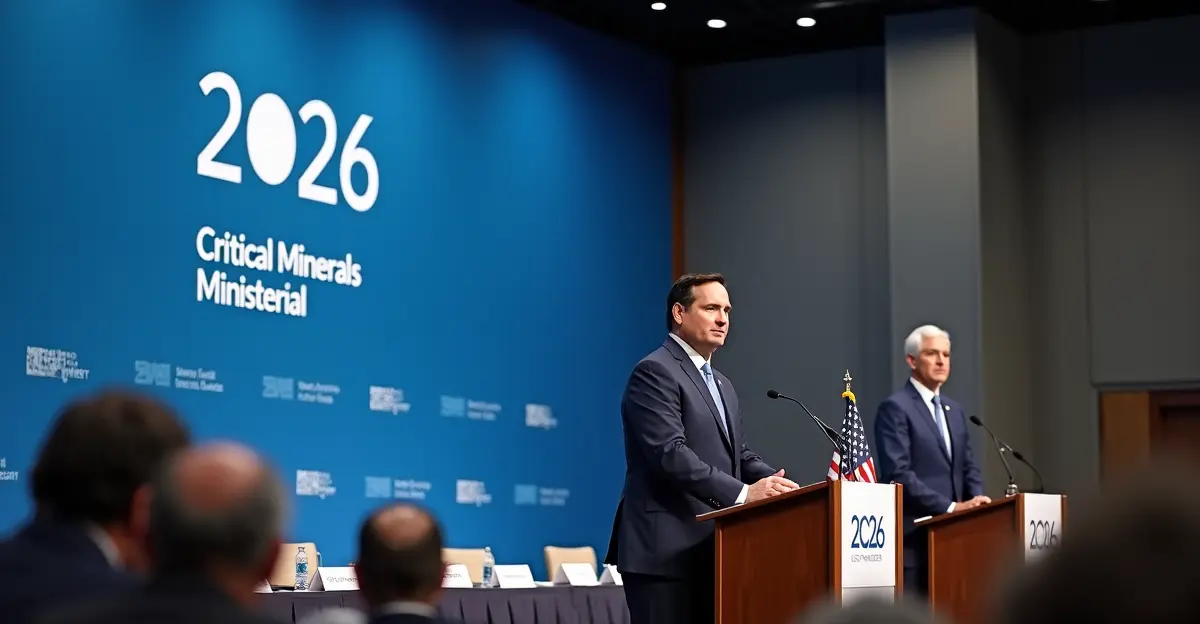
The inaugural Critical Minerals Ministerial, hosted by U.S. Secretary of State Marco Rubio on February 4, 2026, brought together representatives from 54 countries and the European Commission to address what officials describe as "the most pressing economic security challenge of our time." The event marked a strategic pivot from multilateral cooperation to bilateral and minilateral approaches in resource geopolitics, with the United States signing 21 new bilateral agreements with resource-rich nations in just five months. According to State Department documents, the ministerial focused on reducing market concentration and building secure, diversified supply chains for minerals essential to artificial intelligence, robotics, batteries, and defense technologies.
The FORGE Alliance: A New Geopolitical Architecture
The centerpiece of the ministerial was the launch of FORGE (Forum on Resource Geostrategic Engagement), which succeeds the Minerals Security Partnership and represents a fundamental shift in how Western nations approach resource security. Unlike previous initiatives, FORGE creates a preferential trade-and-investment zone with coordinated price floors designed to counter what U.S. officials call "adversarial market manipulation." The alliance is chaired by South Korea through June 2026 and seeks to link disparate bilateral agreements into a functioning plurilateral system covering two-thirds of the global economy.
Key Components of the FORGE Strategy
The FORGE framework includes three critical elements: coordinated price supports with international partners, enforceable trade benchmarks, and market access coordination. This approach represents an ambitious attempt to practice statecraft through markets rather than around them, focusing on creating stable investment conditions for mining and processing projects. The initiative has already secured 11 new bilateral critical minerals frameworks with countries including Argentina, the United Kingdom, United Arab Emirates, and Uzbekistan, with 17 more countries having completed negotiations.
$30+ Billion in U.S. Government Support
The Trump administration has mobilized unprecedented financial resources for critical minerals security, announcing over $30 billion in letters of interest, investments, loans, and support over the past six months. This massive financial commitment represents the largest government intervention in mineral markets since World War II and signals Washington's determination to compete directly with China's established supply chain dominance. The funding includes:
- $10 billion for Project Vault from the Export-Import Bank
- $2 billion in private-sector investment commitments
- $18 billion in additional government-backed financing
- Multiple bilateral investment treaties with resource-rich nations
Project Vault: The $10 Billion Strategic Reserve
Perhaps the most ambitious component of the U.S. strategy is Project Vault, a $12 billion public-private partnership to establish the U.S. Strategic Critical Minerals Reserve. Backed by a $10 billion EXIM Bank loan and nearly $2 billion in private-sector investment, this initiative aims to store all 60 minerals on the U.S. Critical Minerals List in secure facilities across the United States. Unlike traditional government stockpiles, Project Vault is manufacturer-driven and demand-led, with companies committing financially to ensure material availability during supply disruptions.
The program functions like a long-term insurance policy where manufacturers pay commitment fees in exchange for access to materials during market crises. It addresses shelf-life concerns through annual rotation of inventory and has release triggers based on predefined market-disruption criteria. While initially sourcing minerals globally (including potentially from China), the program aims to build domestic buffers while allied nations develop diversified supply chains. Project Vault is designed as a platform for allied economic security cooperation, with early interest from G7 partners and significant implications for the global energy transition.
China's Supply Chain Dominance: The Challenge
The urgency behind these initiatives stems from China's near-total control of critical minerals processing. According to recent analyses, China dominates midstream processing with 85-90% of rare earth refining, approximately 90% of battery components, 60% of lithium processing, and over 70% of cobalt refining. Since 2023, China has deployed over $120 billion in outbound investment across critical minerals, building end-to-end industrial control from mining through refining, logistics, and manufacturing.
This vertical integration strategy has created what experts describe as "structural power" in the global energy transition. While resource-rich countries like Australia produce over 50% of global lithium, they risk remaining upstream suppliers as China captures higher-value downstream processing and manufacturing. The geopolitical implications of this dominance became starkly apparent when China demonstrated willingness to weaponize supply chains through export controls on gallium and germanium in 2023.
Geopolitical Implications and Risks
The FORGE alliance represents a fundamental reordering of global resource politics, with several significant implications:
1. Shift from Multilateral to Bilateral/Minilateral Approaches
The U.S. strategy marks a clear departure from traditional multilateral frameworks like the World Trade Organization, instead favoring bilateral agreements and minilateral coalitions. This approach allows for faster negotiation and implementation but risks creating fragmented global standards and potentially exacerbating great power competition.
2. Creating New Dependencies
While aiming to reduce dependence on China, the FORGE initiative creates new dependencies on U.S.-led frameworks and financing mechanisms. Resource-rich nations must navigate between competing great power offers, with the risk of becoming pawns in broader geopolitical struggles. The economic security implications of this realignment will shape global politics for decades.
3. Impact on Energy Transition Timelines
The competition for critical minerals could accelerate or delay the global energy transition depending on how supply chains develop. Secure, diversified supplies could enable faster adoption of clean technologies, while supply disruptions or price volatility could slow progress. The success of initiatives like Project Vault will be crucial for maintaining momentum in renewable energy deployment.
Expert Perspectives on the Strategic Shift
Industry analysts and geopolitical experts offer mixed assessments of the FORGE initiative. "This represents the most significant attempt to reshape global mineral markets since the OPEC oil embargoes of the 1970s," says Dr. Sarah Chen, senior fellow at the Atlantic Council. "The question is whether Western nations can build the industrial capacity to match China's decades-long head start."
Other experts caution about implementation challenges. "Price floors sound good in theory, but they require enormous coordination and enforcement capacity," notes Michael Rodriguez, director of the Center for Strategic and International Studies' energy program. "The real test will be whether FORGE can deliver tangible projects that reduce processing dependence within the next 3-5 years."
FAQ: Understanding the 2026 Critical Minerals Initiatives
What is FORGE and how does it work?
FORGE (Forum on Resource Geostrategic Engagement) is a 54-nation alliance launched in February 2026 to coordinate critical minerals supply chains and counter China's market dominance. It creates a preferential trade zone with coordinated price floors and investment standards.
How much funding has the U.S. committed to critical minerals?
The U.S. government has mobilized over $30 billion in support for critical minerals projects in the past six months, including $10 billion for Project Vault strategic reserves and additional bilateral financing agreements.
What minerals are most critical in this competition?
The most strategically important minerals include rare earth elements (neodymium, dysprosium), lithium, cobalt, nickel, and graphite—all essential for electric vehicles, renewable energy systems, and advanced defense technologies.
Can the U.S. realistically compete with China's processing dominance?
While challenging, experts suggest the U.S. can compete through technological innovation, strategic partnerships, and significant investment. China's 60-90% processing dominance across key minerals represents a formidable but not insurmountable challenge.
What are the risks of the FORGE approach?
Key risks include creating new dependencies on U.S. frameworks, potential supply chain fragmentation, and the challenge of coordinating price mechanisms across diverse economies with competing interests.
Conclusion: A New Era in Resource Geopolitics
The 2026 Critical Minerals Ministerial and FORGE alliance launch mark a watershed moment in global resource politics. As the United States commits unprecedented resources to counter China's supply chain dominance, the world faces a fundamental reordering of how critical minerals are sourced, processed, and traded. The success of these initiatives will determine not only the balance of power in the 21st century but also the pace and security of the global energy transition. With $30+ billion now on the table and 54 nations aligned behind a new strategic framework, the race to secure the minerals that power modern civilization has entered its most decisive phase. The future of clean energy and advanced technologies now hinges on whether Western nations can build resilient, diversified supply chains before China's structural advantages become permanent.


Follow Discussion