


 Deutsch
 English
 Español
 Français
 Nederlands
 Português


 Share
Share




The global race for critical minerals—lithium, rare earths, cobalt, and graphite—has entered a new, more intense phase in 2026. With global military spending surpassing $2.6 trillion and geoeconomic confrontation topping the World Economic Forum's risk list, securing supply chains for these resources has become a strategic imperative for nations worldwide. The United States has launched FORGE (Forum on Resource Geostrategic Engagement) as a successor to the Minerals Security Partnership, mobilizing over $30 billion for critical mineral projects and signing 11 new bilateral frameworks. Meanwhile, the European Union is pushing 60 Strategic Projects under the Critical Raw Materials Act, and China's projected dominance—supplying over 60% of refined lithium and cobalt by 2035—is driving a multipolar contest that will define industrial policy, defense readiness, and energy transition capacity for the rest of the decade.
Context: The Strategic Imperative
Critical minerals are the building blocks of modern technology, from electric vehicle batteries and wind turbines to advanced military hardware. The World Economic Forum's Global Risks Report 2026 ranked geoeconomic confrontation as the top short-term risk, reflecting escalating trade tensions, tariffs, and strategic economic rivalry among major powers. The geoeconomic confrontation risk is compounded by the fact that China controls approximately 90% of rare earth refining, 60% of lithium processing, and over 70% of cobalt refining, according to a report by the Australian think tank Climate Energy Finance. This concentration creates vulnerabilities that nations are racing to address.
The IMF's April 2026 World Economic Outlook, titled "Global Economy in the Shadow of War," warned that defense spending booms typically weaken fiscal balances and lead to sharp increases in public debt alongside large reductions in social spending. As roughly half of all countries have raised military budgets, the IMF defense spending warning underscores the trade-off between guns and butter that policymakers now face.
FORGE: America's New Mineral Alliance
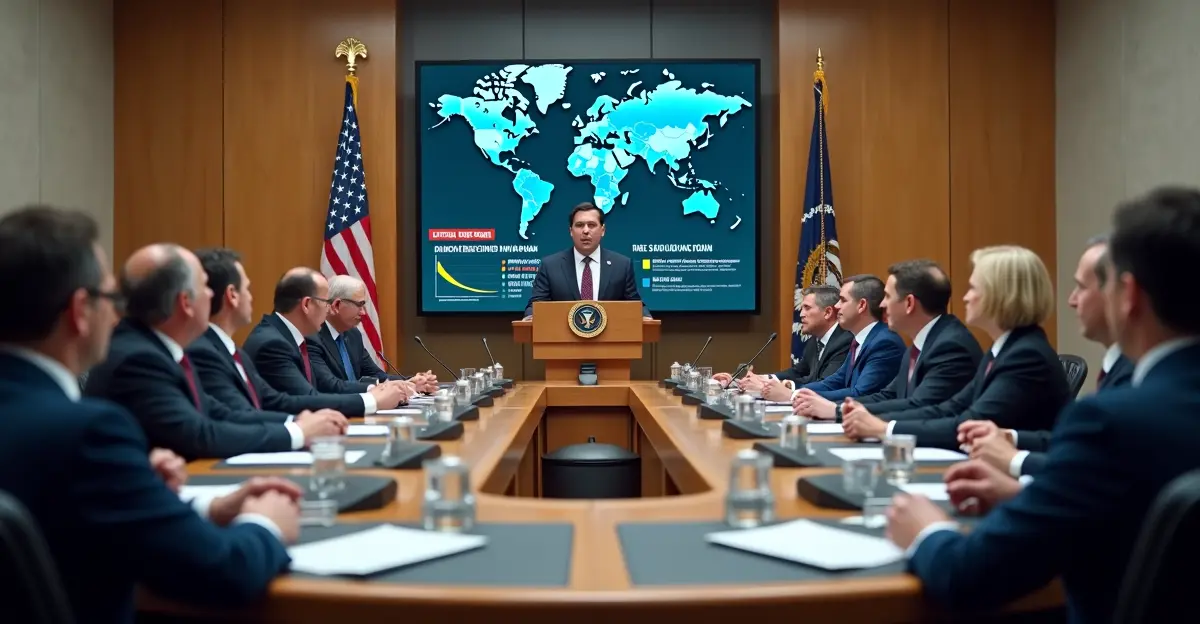
On February 4, 2026, the U.S. Department of State hosted the inaugural Critical Minerals Ministerial, bringing together representatives from 54 countries and the European Commission. Secretary of State Marco Rubio announced the creation of FORGE (Forum on Resource Geostrategic Engagement) as the successor to the Minerals Security Partnership (MSP), chaired by the Republic of Korea. The U.S. government has mobilized over $30 billion in letters of interest, investments, and loans for critical mineral supply chain projects over the past six months.
Key Outcomes of the Ministerial
- 11 new bilateral frameworks signed with countries including Argentina, Morocco, the Philippines, UAE, UK, and others.
- Project Vault: A $12 billion stockpiling initiative combining $10 billion in EXIM loans with $2 billion in private-sector partnerships to create a physical strategic minerals stockpile for civilian use.
- Preferential trade zone: Vice President JD Vance described using adjustable tariffs to uphold pricing integrity and create stable investment conditions, with initial talks underway with the EU and Japan.
- South Korea's chairmanship: Seoul will lead FORGE through June 2026, building on its previous chairmanship of the MSP.
The Atlantic Council notes that FORGE marks a shift toward a plurilateral coalition creating a preferential trade-and-investment zone for critical minerals with coordinated price floors to counter adversarial market manipulation. The initiative aims to link bilateral deals into a plurilateral system covering two-thirds of the global economy, though operational details remain under development.
Europe's Response: The Critical Raw Materials Act
The European Union has been equally active. The Critical Raw Materials Act (CRMA), which came into effect in 2024, has already designated 60 strategic projects in its first call, with over 160 applications submitted in the second call that closed on January 15, 2026. Of these new applications, 75 focus on the battery value chain, 21 on rare earths for permanent magnets, and several are linked to defense applications.
In December 2025, the European Commission announced the ReSourceEU Action Plan, allocating up to €3 billion ($3.5 billion) for 2026 to secure critical raw materials supply. The plan aims to reduce import dependency on battery, rare earth, and defense-related minerals, accelerate strategic projects under the CRMA, and fast-track environmental permitting. Two priority projects received support: Vulcan Energy's lithium extraction in Germany (€250 million from the EIB) and Greenland Resources' molybdenum mine.
The EU will also impose export restrictions on scrap permanent magnets and aluminum from early 2026, ban exports of waste lithium-ion batteries to non-OECD countries from September 2026, and establish a European Critical Raw Materials Centre modeled on Japan's JOGMEC. The EU Critical Raw Materials Act represents a comprehensive approach to reducing dependence on concentrated suppliers.
China's Dominance and New Entrants
China's position remains formidable. According to a report by the Institute for Energy Research, China is expected to remain the world's dominant supplier of critical mineral processing through 2030, controlling over 80% of the market in synthetic graphite and rare earths. China has invested over $120 billion in overseas mining and upstream processing since 2023, deploying an additional $220 billion into downstream sectors like battery manufacturing, EVs, solar, and wind infrastructure.
However, new players are emerging. Saudi Arabia has announced it possesses $2.5 trillion in mineral reserves and is investing heavily in exploratory mining for critical and rare earth minerals. In May 2025, the U.S. and Saudi Arabia signed a critical mineral cooperation pact to explore joint ventures and investment opportunities. The UAE is also positioning itself as a critical minerals hub, leveraging its sovereign wealth funds and logistics infrastructure.
These Gulf state critical mineral investments are reshaping the global landscape, creating a multipolar contest where traditional alliances are being tested and new partnerships formed.
Impact on Defense and Industrial Policy
The intersection of critical minerals supply and defense readiness is increasingly clear. The IISS Military Balance 2026 reports that global defense spending reached $2.63 trillion in 2025, up from $2.48 trillion in 2024, driven by strong increases in Europe and the Middle East. Critical minerals are essential for advanced military technologies, including precision-guided munitions, radar systems, and hypersonic weapons.
China has already weaponized mineral exports, restricting shipments of rare earths, germanium, tungsten, antimony, and silver in trade disputes with the U.S. and Japan. The critical minerals defense readiness nexus means that supply chain security is now a core component of national security strategy.
Expert Perspectives
"The launch of FORGE represents a fundamental shift in how the United States approaches critical minerals," said a senior State Department official who spoke on condition of anonymity. "We are moving from bilateral agreements to a plurilateral system that can create stable, predictable markets and reduce the leverage of adversarial suppliers."
French Finance Minister Roland Lescure argued that higher defense spending can create a "double dividend" by boosting sovereignty and domestic jobs. However, World Bank President Ajay Banga noted that while defense has become a priority, overseas development funding has shrunk, creating difficult trade-offs for developing nations.
FAQ
What is FORGE?
FORGE (Forum on Resource Geostrategic Engagement) is a U.S.-led plurilateral initiative launched in February 2026 to secure critical mineral supply chains. It succeeds the Minerals Security Partnership and is chaired by South Korea through June 2026.
Why are critical minerals important for national security?
Critical minerals like lithium, rare earths, and cobalt are essential for manufacturing advanced military technologies, including precision weapons, radar, and communication systems. Supply concentration in adversarial nations creates strategic vulnerabilities.
How much has the U.S. invested in critical mineral projects?
The U.S. government has mobilized over $30 billion in letters of interest, investments, and loans for critical mineral supply chain projects since mid-2025, including $12 billion for Project Vault, a strategic stockpiling initiative.
What is the EU's Critical Raw Materials Act?
The CRMA, effective since 2024, aims to secure the EU's supply of raw materials through accelerated permitting and easier access to funding. It has designated 60 strategic projects, with over 160 applications in the second round.
Will China remain dominant in critical mineral processing?
According to multiple reports, China is projected to supply over 60% of refined lithium and cobalt by 2035 and control over 80% of rare earth processing through 2030, despite efforts by other nations to diversify supply chains.
Conclusion
The scramble for critical minerals in 2026 represents a defining geopolitical and economic challenge. With the U.S. launching FORGE, the EU pushing strategic projects under the CRMA, and new entrants like Saudi Arabia and the UAE entering the fray, the landscape is becoming increasingly multipolar. China's entrenched dominance, combined with rising defense spending and geoeconomic confrontation, ensures that supply chain security will remain a top priority for governments worldwide. The decisions made in the coming months will shape industrial policy, defense readiness, and the pace of the energy transition for years to come.

Follow Discussion