

 Deutsch
 English
 Español
 Français
 Nederlands
 Português

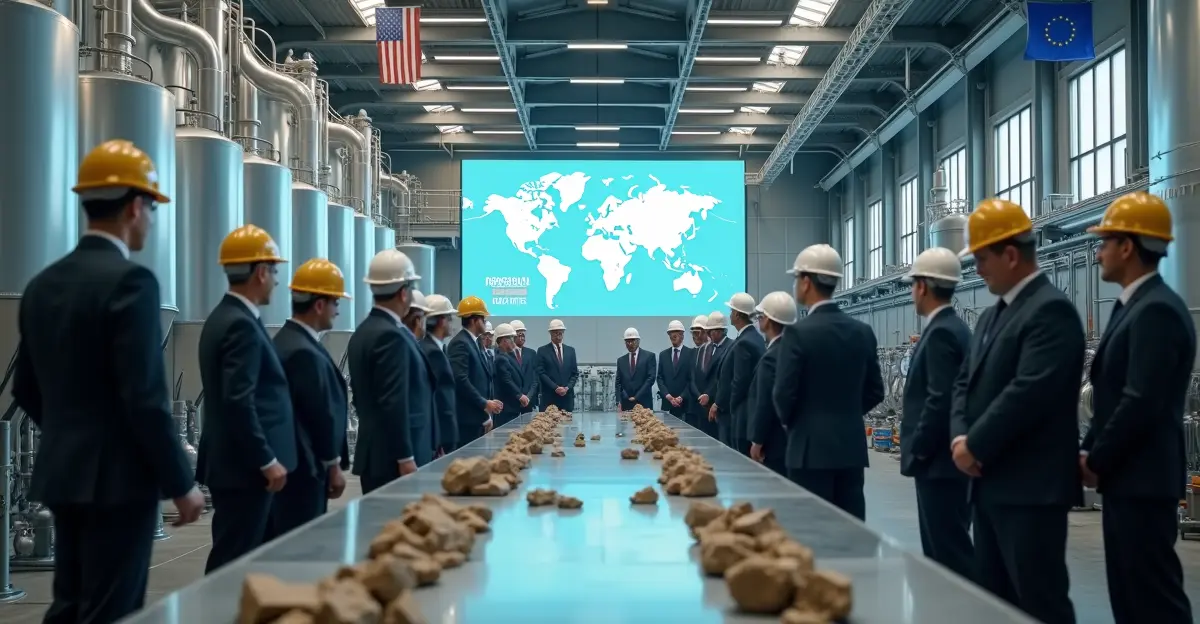





The year 2026 marks a decisive inflection point in global geopolitics, as the contest for critical mineral supply chains has become the central axis of geoeconomic competition. With the United States hosting a 54-nation Critical Minerals Ministerial in February, the European Union launching 60 Strategic Projects under its Critical Raw Materials Act, and China projected to supply over 60% of refined lithium and cobalt through its 15th Five-Year Plan, a three-way struggle is intensifying. This article analyzes how bilateral deals, price floor mechanisms like the new U.S.-EU Action Plan, and sovereign financing from Gulf states are rewriting the rules of global trade and industrial strategy.
The February 2026 Critical Minerals Ministerial: A Watershed Moment
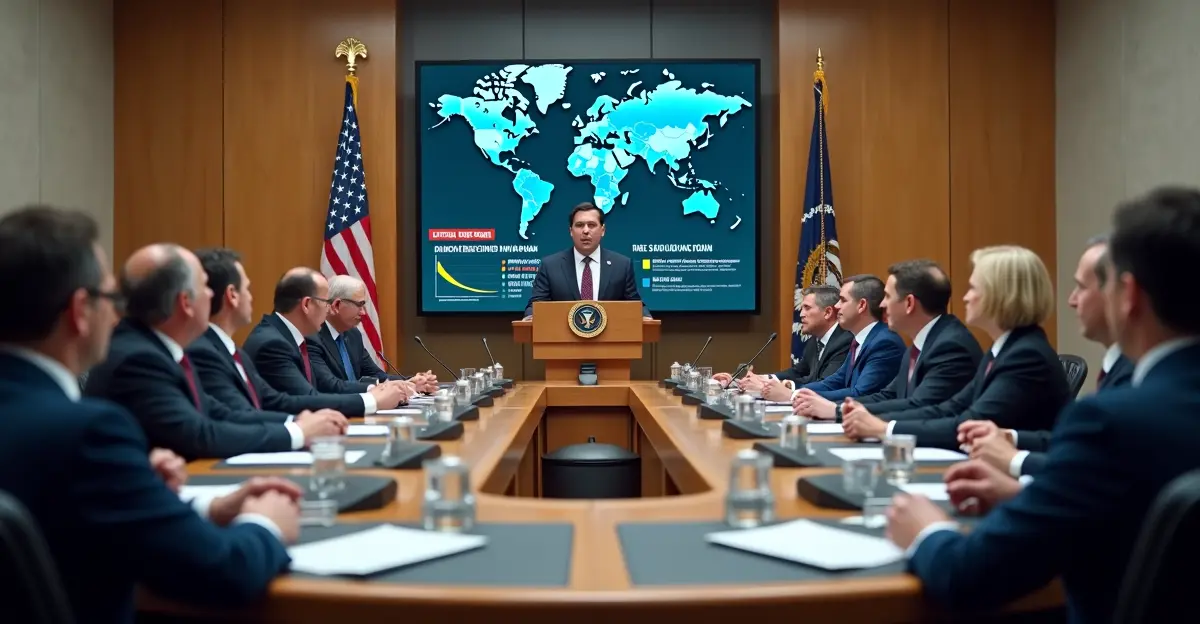
On February 4, 2026, the U.S. Department of State convened representatives from 54 countries and the European Commission for the inaugural Critical Minerals Ministerial. Led by Secretary of State Marco Rubio and Vice President JD Vance, the event produced three landmark outcomes: eleven new bilateral critical minerals frameworks with countries including Argentina, Morocco, the Philippines, the UAE, and the United Kingdom; the creation of FORGE (Forum on Resource Geostrategic Engagement), a preferential trade-and-investment zone with coordinated price floors; and the mobilization of over $30 billion in U.S. government support, including the Export-Import Bank's $10 billion Project Vault for a domestic strategic reserve.
The ministerial marked a significant escalation in policy coordination. As Secretary Rubio stated, 'We are building secure, diversified, and resilient end-to-end supply chains for the minerals that power AI, robotics, batteries, and autonomous technologies.' The FORGE initiative succeeds the Minerals Security Partnership and is chaired by the Republic of Korea, linking disparate bilateral agreements into a functioning plurilateral system covering two-thirds of the global economy.
Europe's Strategic Projects: The EU Critical Raw Materials Act in Action
Simultaneously, the European Union is advancing its Critical Raw Materials Act (CRMA), which has already selected 60 Strategic Projects from over 330 applications across two calls. These projects span extraction, processing, recycling, and substitution of critical raw materials, with 75 applications focused on the battery value chain and 21 on rare earths for permanent magnets. The December 2025 launch of the RESourceEU plan provided concrete funding amounts, further accelerating interest.
The EU's approach emphasizes accelerated permitting and easier access to financing, but challenges remain. A February 2026 report from the European Court of Auditors highlighted persistent vulnerabilities, noting that over 80% of European companies depend on Chinese supply chains for critical minerals essential to defense, EVs, and renewable energy. The EU Critical Raw Materials Act aims to reduce this dependency by boosting domestic mining and processing capacity, though analysts caution that meaningful scale remains 5-7 years away.
China's 15th Five-Year Plan: Reinforcing Dominance
As 2026 opens, China's 15th Five-Year Plan (2026-2030) places critical minerals at the center of national strategy. Premier Li Qiang's 2026 Government Work Report emphasizes enhancing energy and resource supply security, targeting 5.8 billion tons of standard coal production capacity by the end of the plan. China already controls approximately 90% of global rare earth processing, 80% of tungsten refining, and 60% of antimony production.
Beijing's export controls, tightened in 2025-2026, have triggered price spikes of up to sixfold for neodymium-praseodymium oxide, with licensing approval rates for European firms falling below 25%. According to a multi-institutional analysis, China is weaponizing control rather than scarcity, using temporary reversible restrictions to maintain pricing power and extract strategic concessions. The China critical minerals export controls have exposed acute Western vulnerability, with NATO holding only 6-9 months of defense stockpiles for high-intensity conflict.
The U.S.-EU Action Plan: Price Floors and Plurilateral Ambitions
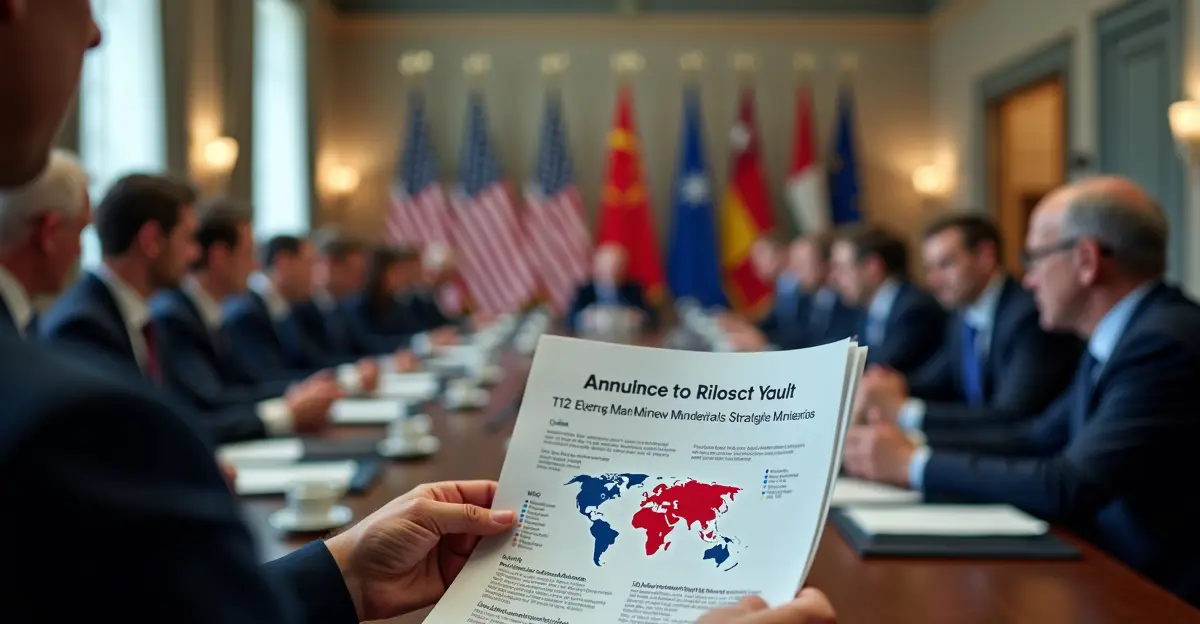
On April 24, 2026, U.S. Trade Representative Ambassador Jamieson Greer announced the U.S.-EU Action Plan for Critical Minerals Supply Chain Resilience. This agreement serves as the primary bilateral mechanism to coordinate trade policies, exploring measures such as border-adjusted price floors to strengthen domestic critical minerals industries. Ambassador Greer emphasized a shared commitment to addressing non-market policies that have distorted supply chains, thanking EU Trade Commissioner Maroš Šefčovič for his dedication to securing transatlantic trade.
The Action Plan aims toward a binding plurilateral agreement on critical minerals trade, potentially encompassing Japan, Mexico, and other allies. Vice President JD Vance has proposed a preferential trade zone with enforceable price floors tied to fair market value, reinforced through adjustable tariffs. This approach directly counters China's ability to manipulate prices and force mine closures globally. The US-EU critical minerals agreement represents a paradigm shift in how Western economies approach resource security.
Gulf Sovereign Wealth Funds: New Players in the Critical Minerals Arena
Gulf states are pivoting from oil dependency to critical minerals as part of their economic diversification strategies. Saudi Arabia's Vision 2030 leads this charge, with mining company Maaden forming a joint venture with MP Materials and the U.S. Department of War for a rare earths refinery. Exploration spending hit a record 1.05 billion riyals in 2024. Abu Dhabi's International Resources Holding (IRH) and the Qatar Investment Authority are acquiring critical mineral assets globally, from African copper mines to Australian lithium projects.
A February 2026 report from the Observer Research Foundation Middle East maps how Gulf sovereign wealth funds are strategically positioning portfolios to capitalize on the energy transition. The region now hosts 9% of global primary aluminum supply and is investing heavily in copper smelting, with Vedanta's $2 billion Saudi copper smelter and Glencore's planned 400,000 tonnes-per-year facility. These Gulf sovereign wealth fund investments are reshaping supply chain dynamics, offering alternative financing and processing hubs outside traditional Western-Chinese rivalries.
Expert Perspectives and Strategic Implications
Analysts at the Center for Strategic and International Studies (CSIS) note that the Critical Minerals Ministerial introduced a new international cooperation strategy, but caution that sustained commitment across multiple administrations is essential. The Atlantic Council describes FORGE as 'practicing statecraft through markets rather than around them,' a recognition that market mechanisms must complement diplomatic efforts.
However, the timeline for meaningful impact remains challenging. Building new rare earth separation facilities takes 12-18 months minimum, with meaningful scale requiring 5-7 years. Meanwhile, China's 15th Five-Year Plan is expected to reinforce its dominance through 2035. Western nations face a narrow 12-18 month window to act decisively before prolonged vulnerability becomes entrenched.
Frequently Asked Questions
What is the Critical Minerals Ministerial?
The Critical Minerals Ministerial, hosted by the U.S. in February 2026, brought together 54 nations and the European Commission to address concentrated global critical mineral supply chains. It launched FORGE, signed 11 new bilateral frameworks, and mobilized over $30 billion in support.
How does China's 15th Five-Year Plan affect critical minerals?
China's 2026-2030 plan prioritizes critical minerals like rare earths, lithium, and cobalt, reinforcing China's dominant position in processing and refining. Export controls have triggered price spikes and reduced licensing for foreign firms, exposing Western vulnerabilities.
What is the U.S.-EU Action Plan on critical minerals?
Announced April 24, 2026, the Action Plan coordinates trade policies on critical minerals supply chains, exploring border-adjusted price floors to strengthen domestic industries. It aims toward a binding plurilateral agreement on critical minerals trade.
Why are Gulf states investing in critical minerals?
Gulf states are diversifying from oil through sovereign wealth fund investments in mining, refining, and global acquisitions. Saudi Arabia, UAE, and Qatar are positioning as trusted partners in supply chain realignment, leveraging financial resources and strategic geography.
What are price floors for critical minerals?
Price floors are minimum prices set for critical minerals to prevent market manipulation by dominant producers like China. The U.S.-EU Action Plan explores border-adjusted price floors to ensure fair market value and protect domestic industries from predatory pricing.
Conclusion: The Race Ahead
The 2026 critical minerals landscape is defined by unprecedented policy coordination and strategic urgency. The U.S.-led FORGE alliance, the EU's Strategic Projects, and Gulf sovereign investments represent a multipolar response to China's entrenched dominance. Yet the gap between ambition and execution remains wide. As the IEA projects global demand for critical minerals will nearly triple by 2030, the decisions made in 2026 will determine whether the West can secure its technological and defense future—or remain dependent on a single supplier. The chokepoint is not just a bottleneck; it is the defining geoeconomic story of our time.
Sources
- U.S. Department of State: 2026 Critical Minerals Ministerial
- USTR: U.S.-EU Action Plan for Critical Minerals Supply Chain Resilience
- European Court of Auditors: Critical Raw Materials for the Energy Transition
- China Critical Minerals Sector Under 15th Five-Year Plan
- Atlantic Council: US Critical Minerals Policy Goes Collaborative with FORGE
- ORF Middle East: Mapping Gulf Sovereign Wealth Funds
- CSIS: Critical Minerals Ministerial Analysis
- Informed Clearly: China Critical Mineral Stranglehold 2026



Follow Discussion