


 Deutsch
 English
 Español
 Français
 Nederlands
 Português


 Share
Share




The Geopolitical Battle for Critical Minerals: How Supply Chain Vulnerabilities Are Reshaping Global Power Dynamics
The global competition for critical minerals has emerged as the defining geopolitical struggle of the 2020s, with supply chain vulnerabilities creating new fault lines between nations. Recent stress tests by the Atlantic Council reveal that US critical mineral stockpiles could be depleted within weeks during a geopolitical crisis, highlighting acute vulnerabilities in Western supply chains. Simultaneously, the 2026 Critical Minerals Ministerial brought together 54 countries to address supply chain concentration, signaling escalating strategic competition over resources essential for defense technologies, renewable energy transitions, and economic sovereignty.
What Are Critical Minerals and Why Do They Matter?
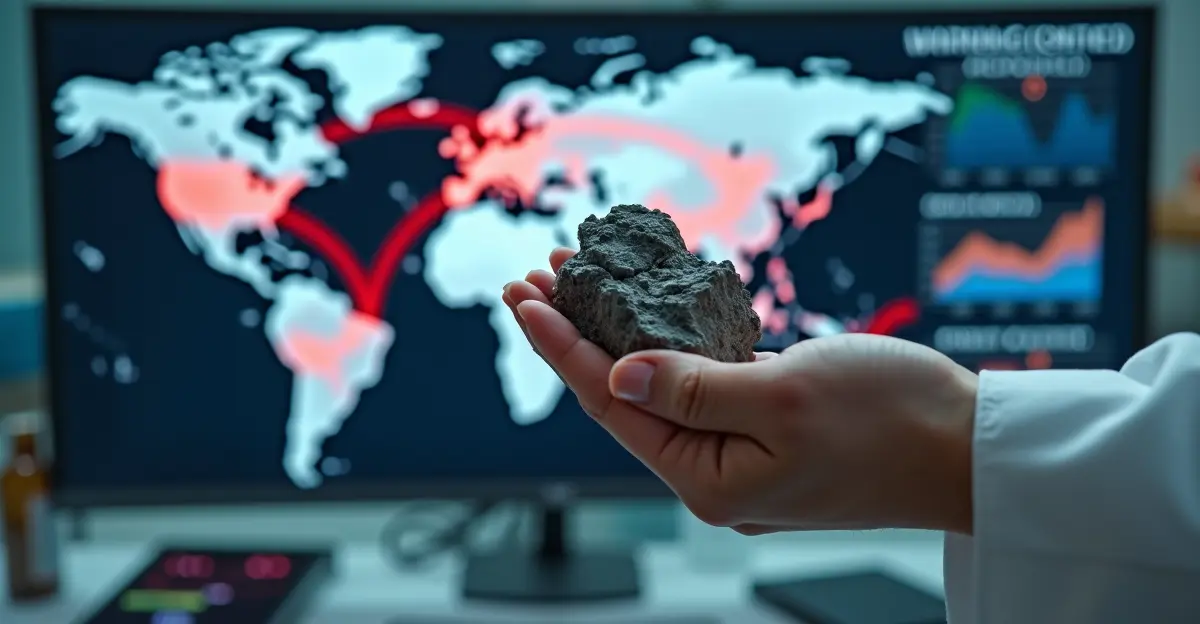
Critical minerals encompass a range of essential materials including rare earth elements, lithium, cobalt, copper, and nickel that are vital for modern technologies. These minerals power everything from smartphones and electric vehicles to advanced weapons systems and renewable energy infrastructure. Unlike traditional fossil fuels, these materials are geographically concentrated, with China controlling approximately 70% of rare-earth output and 80-90% of processing capacity. This concentration creates significant global supply chain vulnerabilities that nations are now scrambling to address.
China's Dominance and the Geopolitical Landscape
China's strategic positioning in the critical minerals sector represents one of the most significant shifts in global economic power since the oil crises of the 1970s. The country's dominance extends beyond mining to include refining and processing capabilities, giving Beijing unprecedented leverage over global technology supply chains. According to recent analysis, China's strategy has evolved from early rare earth industry development to a comprehensive framework under the National Plan for Mineral Resources, identifying 24 strategic minerals essential for economic growth and technological advancement.
The Processing Gap: Where Real Power Resides
While many countries possess mineral deposits, China controls the crucial processing stage where raw materials are transformed into usable forms. This processing dominance means that even minerals mined elsewhere often must travel through Chinese facilities, creating dependencies that extend across global supply chains. The rare earth elements supply chain illustrates this perfectly: while deposits exist worldwide, China's refining capabilities give it strategic control over the entire technology ecosystem.
Western Responses: Policy Initiatives and Strategic Alliances
The EU's Critical Raw Materials Act
The European Union has responded with its Critical Raw Materials Act, adopted by the Council in March 2026 to strengthen supply security and promote circularity within EU industry. This comprehensive framework aims to reduce dependency on external sources while enhancing domestic production capabilities. The legislation represents a strategic shift toward ensuring industrial resilience and supporting the EU's green transition by securing essential materials needed for clean energy technologies and digital infrastructure.
US Strategic Initiatives and FORGE
The United States has launched multiple initiatives to counter supply chain vulnerabilities, most notably through the 2026 Critical Minerals Ministerial that brought together 54 countries and the European Commission. Secretary of State Marco Rubio and Vice President JD Vance announced the creation of FORGE (Forum on Resource Geostrategic Engagement) as the successor to the Minerals Security Partnership. The U.S. government is mobilizing over $30 billion in support for critical mineral projects, including Project Vault - a $10 billion EXIM Bank loan to establish a domestic strategic reserve.
Bilateral Agreements and Stockpiling
In the past six months alone, the U.S. has signed 11 new bilateral critical minerals frameworks with countries including Argentina, the Cook Islands, Ecuador, Guinea, Morocco, Paraguay, Peru, the Philippines, UAE, UK, and Uzbekistan. This represents a significant acceleration in diplomatic efforts to diversify supply chains. Simultaneously, strategic stockpiling has become a key component of national security strategies, with the U.S. establishing a $12 billion critical minerals reserve to buffer against potential disruptions.
The Atlantic Council's Warning: Weeks, Not Months
The Atlantic Council's recent stress test analysis paints a sobering picture of Western vulnerabilities. Scenario A1 examines a geopolitical crisis where China imposes export bans on neodymium, dysprosium, and refined manganese - minerals vital for defense, AI, semiconductors, EVs, and clean energy. The analysis concludes that such a scenario would deplete US stockpiles within weeks, force hard trade-offs in defense/civilian allocation, and cause global price spikes. Scenario A2 adds extreme weather disruptions in key mining regions, compounding the geopolitical crisis with production delays and resource competition.
Transforming Energy Security: From Fossil Fuels to Minerals
The global energy security paradigm is undergoing a fundamental transformation. Where nations once competed for oil and gas reserves, they now vie for access to lithium, cobalt, and rare earth elements essential for renewable energy systems. Demand for critical minerals used in clean energy technology could increase more than 3.4 times by 2040, according to World Economic Forum analysis. This shift represents a profound change in global power dynamics, with resource-rich nations gaining new strategic importance while traditional energy powers must adapt to new realities.
Defense Implications
Critical minerals are essential for advanced military technologies including precision-guided weapons, communication systems, and surveillance equipment. The defense sector's dependence on these materials creates vulnerabilities that military planners are only beginning to address. As noted in the Atlantic Council report, during a crisis, governments would face difficult choices between allocating scarce minerals to defense systems or civilian technologies, potentially compromising both national security and economic stability.
Economic Sovereignty and Industrial Policy
The critical minerals competition has sparked a renaissance in industrial policy, with governments taking unprecedented roles in shaping supply chains. The U.S. approach, characterized by state intervention, equity stakes in mining companies, and strategic stockpiling, represents a significant departure from previous free-market orthodoxy. This shift reflects growing recognition that market mechanisms alone cannot address the strategic vulnerabilities created by concentrated supply chains. However, critics warn that simply shifting dependence from China to the United States may not solve underlying problems and could create new geopolitical tensions.
Expert Perspectives and Future Outlook
Industry analysts emphasize that building alternative production capacity will take years, highlighting the urgent need for more robust supply chain resilience strategies. "While stockpiling provides short-term security, true resilience requires diversified production, advanced recycling technologies, and international cooperation," notes one minerals policy expert. The transition to a more secure critical minerals ecosystem will require sustained investment, technological innovation, and diplomatic engagement across multiple fronts.
Frequently Asked Questions
What are the most critical minerals for national security?
The most critical minerals include rare earth elements (neodymium, dysprosium), lithium for batteries, cobalt for electronics and defense systems, copper for electrical infrastructure, and manganese for steel production and batteries. These materials are essential for both military technologies and civilian economic activities.
How long could US stockpiles last in a crisis?
According to Atlantic Council stress tests, US critical mineral stockpiles could be depleted within weeks during a geopolitical crisis involving export restrictions from dominant suppliers. This vulnerability highlights the urgent need for diversified supply chains and strategic reserves.
What is FORGE and how does it differ from previous initiatives?
FORGE (Forum on Resource Geostrategic Engagement) is the successor to the Minerals Security Partnership, launched at the 2026 Critical Minerals Ministerial. Chaired by South Korea, FORGE represents a more comprehensive approach to supply chain security, incorporating more countries and focusing on the entire value chain from mining to recycling.
Can recycling solve critical mineral shortages?
While recycling will play an increasingly important role, current recycling rates for many critical minerals remain low. Scaling up recycling infrastructure and developing new recovery technologies will be essential but cannot fully meet growing demand, particularly as renewable energy and electric vehicle adoption accelerates.
How does climate change affect critical mineral supply chains?
Climate change creates dual pressures: increasing demand for minerals needed for clean energy technologies while simultaneously disrupting mining operations through extreme weather events, water scarcity, and energy constraints. This creates complex challenges for supply chain resilience.
Conclusion: A New Era of Resource Competition
The geopolitical battle for critical minerals represents a fundamental shift in how nations conceptualize security, prosperity, and power. As the world transitions from fossil fuel dependence to mineral-intensive renewable energy systems, access to these essential materials will increasingly determine economic competitiveness and strategic influence. The coming years will test whether nations can build cooperative frameworks for resource security or whether competition will lead to fragmentation and conflict. What remains clear is that the era of taking mineral supply chains for granted has ended, replaced by a new reality where resource security equals national security.

Follow Discussion