


 Deutsch
 English
 Español
 Français
 Nederlands
 Português


 Share
Share




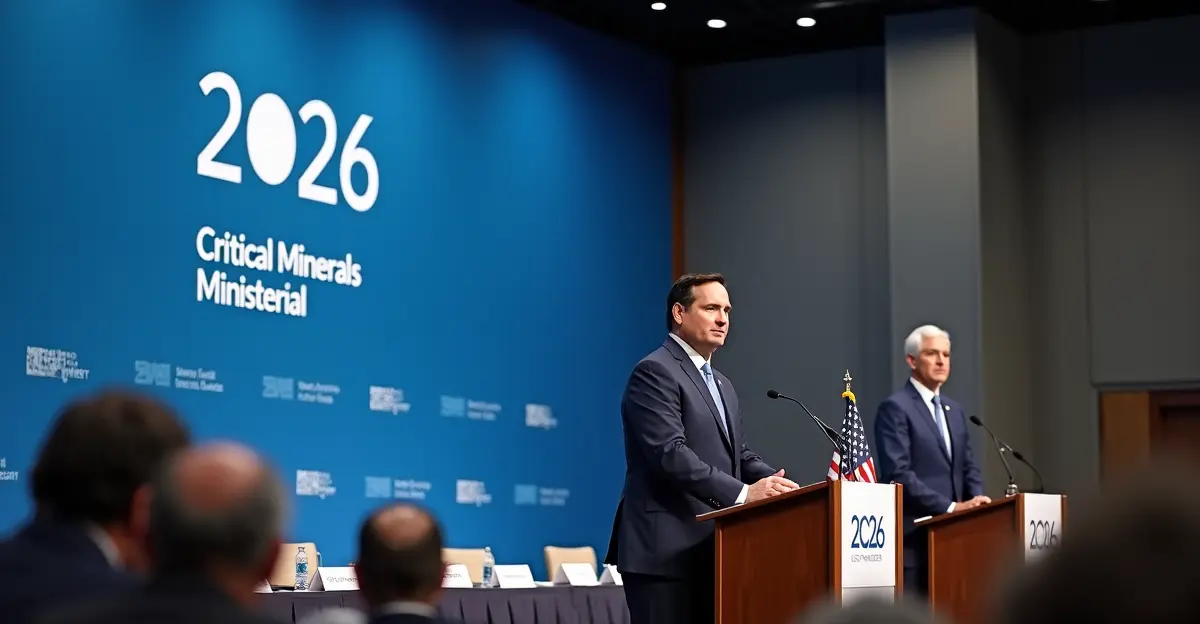
On February 4, 2026, the United States launched the Forum on Resource Geostrategic Engagement (FORGE) at the inaugural Critical Minerals Ministerial in Washington, D.C., mobilizing over $30 billion in financing to counter China's near-total dominance of critical minerals processing. With China controlling roughly 90% of rare earth refining and 60% of lithium processing, and having imposed export controls in 2025 that caused sixfold price spikes outside its borders, the US and 54 partner nations are racing to build independent supply chains through Project Vault, bilateral agreements with resource-rich nations, and coordinated price floors. This article analyzes whether the FORGE initiative can realistically break Chinese dominance within the narrowing 12-to-18-month window experts warn remains before Western dependencies become structurally entrenched.
Context: The Critical Minerals Crisis
China's stranglehold on critical minerals processing has been decades in the making. Through strategic state investment, Beijing controls the majority of global refining capacity for rare earth elements, lithium, cobalt, and graphite — materials essential for electric vehicle batteries, wind turbines, defense systems, and artificial intelligence hardware. In 2025, China escalated its leverage by imposing export controls on several critical minerals, triggering price spikes of up to 600% in Europe and North America. The International Energy Agency (IEA) estimates that $6.5 trillion of global economic activity is now at risk from supply disruptions. The 2025 critical minerals crisis exposed the fragility of Western supply chains and galvanized the US-led response.
What Is FORGE? The New Multilateral Framework
FORGE (Forum on Resource Geostrategic Engagement) is the successor to the Minerals Security Partnership (MSP), which had been criticized for lacking concrete financing and enforcement mechanisms. Chaired by the Republic of Korea, FORGE brings together 54 countries and the European Commission in a plurilateral bloc designed to create a 'preferred critical minerals trade zone.' Unlike the MSP, FORGE includes enforceable price floors to stabilize markets and attract private investment — a key demand from mining companies wary of volatile commodity cycles.
Key Features of FORGE
- Plurilateral membership: 54 partner nations plus the EU, spanning resource-rich countries (Argentina, Morocco, Philippines, UAE, UK) and processing hubs (South Korea, Japan, Australia).
- Price floor mechanism: A coordinated floor price for critical minerals to ensure profitability for new mines and processing facilities outside China.
- Bilateral frameworks: 11 new bilateral critical minerals agreements signed at the February 2026 Ministerial, including with Argentina, Morocco, the Philippines, UAE, and the UK.
- Financing commitments: Over $30 billion in letters of interest, investments, and loans mobilized through the US Export-Import Bank (EXIM), the Development Finance Corporation, and allied institutions.
Project Vault: America's Strategic Reserve
A centerpiece of the US strategy is Project Vault, a $12 billion public-private partnership administered by EXIM Bank to establish the US Strategic Critical Minerals Reserve. Unlike the Strategic Petroleum Reserve, Project Vault functions as a hybrid futures market and stockpile: private firms pay subscription fees for guaranteed access during supply disruptions. Participants include Boeing, Western Digital, and other major industrial consumers. The reserve will initially store 60 differentiated minerals, though experts note that storing processed materials — rather than raw ore — is critical to bypass China's refining monopoly. The Project Vault critical minerals reserve represents the largest US government intervention in mineral markets since the Cold War.
Can FORGE Break China's Dominance?
Despite the ambitious scale of FORGE and Project Vault, analysts remain skeptical about the timeline. China's processing infrastructure has been built over 30 years with massive state subsidies, and replicating that capacity in the West will require sustained investment and regulatory reform. The US currently has no domestic rare earth processing facilities at commercial scale, and building new refineries takes 5–7 years. China's export controls are currently suspended until November 10, 2026, providing a temporary window — but experts warn that full supply chain independence remains at least half a decade away.
Challenges Ahead
- Processing gap: Even if mining expands, most ore must still be sent to China for refining. FORGE's bilateral agreements aim to build processing capacity in partner countries, but few have the infrastructure or expertise.
- Price competition: China can undercut new Western projects by flooding the market with cheap processed minerals, making price floors essential but difficult to enforce.
- Voluntary participation: Project Vault's subscription model is voluntary, raising concerns that large self-insuring firms may opt out, hollowing out the risk pool.
- Geopolitical friction: Some resource-rich nations, such as Indonesia and the Democratic Republic of Congo, have resisted US overtures, preferring to develop their own processing capacity or maintain ties with China.
Expert Perspectives
"FORGE represents a genuine shift from bilateral to plurilateral strategy, but the real test is whether the US and its allies can sustain political will over a decade," said Cullen S. Hendrix, a senior fellow at the Peterson Institute for International Economics. "China's dominance is not just about mining — it's about processing, logistics, and long-term contracts. Breaking that requires more than money; it requires a coordinated industrial policy that the West has not attempted since the 1950s."
Vice President JD Vance, speaking at the Ministerial, framed the initiative as a matter of national security: "We cannot allow a single adversary to hold the keys to our energy future, our defense, and our technological edge. FORGE and Project Vault are the beginning of a new era of resource security."
Impact and Implications
The success or failure of FORGE will have profound consequences for global geopolitics. If the US-led bloc can build independent supply chains within the next 12–18 months, it could reduce China's leverage over critical technologies and accelerate the energy transition. Failure, however, would entrench Chinese dominance and leave Western economies vulnerable to future supply shocks. The geopolitics of critical minerals in 2026 is increasingly shaping alliances, trade policy, and defense spending worldwide.
FAQ
What is FORGE?
FORGE (Forum on Resource Geostrategic Engagement) is a US-led plurilateral bloc launched in February 2026 to coordinate critical minerals supply chains among 54 partner nations, replacing the Minerals Security Partnership.
How much funding is behind FORGE?
Over $30 billion in letters of interest, investments, and loans have been mobilized, including $12 billion for Project Vault, the US Strategic Critical Minerals Reserve.
Can FORGE break China's rare earth monopoly?
Analysts say full independence is 5–7 years away, but FORGE aims to create a 'preferred trade zone' with price floors to attract investment and reduce dependence within a 12–18 month window.
What is Project Vault?
Project Vault is a $12 billion public-private partnership to establish a US Strategic Critical Minerals Reserve, functioning as a hybrid futures market and stockpile for 60 minerals.
Why is China's dominance a problem?
China controls ~90% of rare earth refining and ~60% of lithium processing, and its 2025 export controls caused sixfold price spikes, threatening $6.5 trillion in global economic activity.
Conclusion
The FORGE offensive marks the most significant escalation in the resource war between the US-led bloc and China. With concrete outcomes including 11 new bilateral frameworks, a $10 billion strategic reserve, and the formal launch of a plurilateral trade zone, the February 2026 Critical Minerals Ministerial was a pivotal moment. Yet the road ahead is steep: building processing capacity, enforcing price floors, and maintaining political cohesion across 54 nations will test the West's resolve. The next 12–18 months will determine whether FORGE becomes a historic breakthrough or a costly lesson in the limits of geopolitical ambition.



Follow Discussion