


 Deutsch
 English
 Español
 Français
 Nederlands
 Português


 Share
Share




The New Mineral Order: Inside FORGE and the Race to Break China's Rare Earth Stranglehold
On February 4, 2026, the United States launched the Forum on Resource Geostrategic Engagement (FORGE), a plurilateral coalition of 54 countries designed to counter China's near-total dominance over rare earth and critical mineral supply chains. With China controlling 90% of global rare earth processing and export controls that triggered sixfold price spikes outside China, Western nations face a 12-to-18-month window to build alternative processing capacity before strategic vulnerability becomes permanent. This article analyzes whether FORGE's $30 billion in financing, bilateral trade frameworks, and coordinated price floors can structurally reduce dependency, or whether a 'managed dependence' hybrid model is the only realistic path forward.
China's Stranglehold: The Scale of the Challenge
China dominates global critical mineral processing at every stage. According to a multi-institutional analysis drawing on data from the European Parliament Research Service, OECD, and CSIS, Beijing controls 90% of rare earth processing, 80% of tungsten, and 60% of antimony. Export controls introduced in 2025 and 2026 have triggered price spikes of up to sixfold for materials outside China, with licensing approval rates for European firms falling below 25% in some sectors. Over 80% of European companies depend on Chinese supply chains for minerals essential to defense, electric vehicles, and renewable energy.
Analysts argue that China is weaponizing control rather than scarcity. By using temporary and reversible restrictions, Beijing maintains pricing power and extracts strategic concessions while simultaneously discouraging Western investment in alternative capacity. The rare earth supply chain bottlenecks are expected to persist through 2026, according to S&P Global, as new projects in the U.S., Australia, and other regions face significant technical, regulatory, and capital-intensive hurdles.
FORGE: A New Framework for Mineral Security
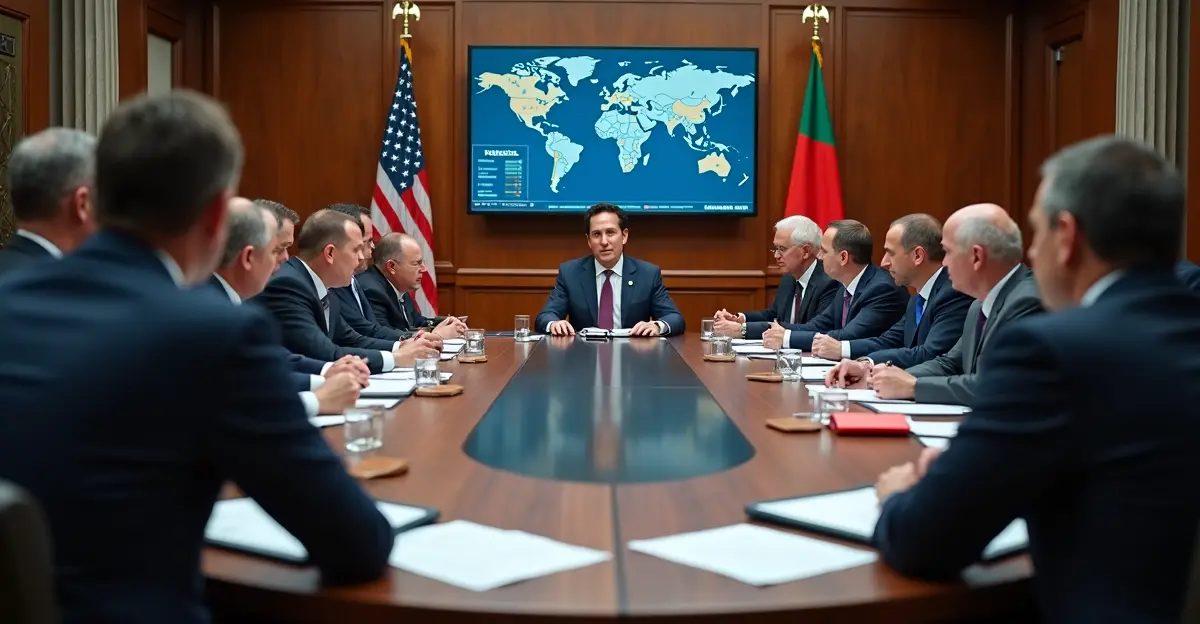
FORGE, announced at the inaugural Critical Minerals Ministerial hosted by Secretary of State Marco Rubio and Vice President JD Vance, succeeds the 2022 Minerals Security Partnership. The coalition brings together 54 countries representing two-thirds of global GDP. South Korea will chair FORGE through June 2026, tasked with linking bilateral agreements into a functioning plurilateral system.
The initiative's core innovation is a preferential trade-and-investment zone for critical minerals, paired with coordinated price floors maintained through adjustable tariffs. Vice President Vance explicitly proposed this mechanism to reduce the market volatility that kills long-cycle mining projects. The ministerial produced eleven new bilateral critical minerals frameworks or MOUs with countries including Argentina, Morocco, the Philippines, the UAE, and the UK, bringing the total to twenty-one deals in five months.
Project Vault: The $10 Billion Strategic Reserve
Alongside FORGE, the Trump administration announced Project Vault — a $12 billion public-private initiative ($10 billion in Export-Import Bank loans plus nearly $2 billion in private capital) to establish the U.S. Strategic Critical Minerals Reserve. This decentralized program will stockpile strategic minerals like neodymium, dysprosium, and lithium in secure facilities nationwide, protecting U.S. manufacturers from supply shocks. EXIM Chairman Jovanovic promoted the project on CNBC and Bloomberg, highlighting support from GE Vernova, Mercuria Energy, Traxys, Hartree, Clarios, and Boeing.
The announcement sent rare earth stocks surging, with Critical Metals Corp. (CRML) rising 35% in a single session. Key beneficiaries include MP Materials, USA Rare Earth, Energy Fuels, and American Rare Earths. Beyond miners, infrastructure plays like Olin, Caterpillar, and Fluor also stand to benefit from the build-out of domestic processing capacity.
Can FORGE Break the Dependency?
The central question is whether FORGE's architecture can structurally reduce dependence on China within a realistic timeframe. The administration has mobilized over $30 billion in letters of interest, investments, and loans for critical mineral projects over the past six months. However, analysts estimate that building meaningful domestic processing capacity will take three to seven years, while rebuilding independent Western supply chains from scratch could take 20 to 30 years.
The EU Critical Raw Materials Act designated 47 strategic projects, but only five are fully funded. The World Economic Forum's 2026 Global Risks Report ranks geoeconomic confrontation as the top global threat, underscoring the urgency. A temporary 12-month pause on Chinese export controls, agreed after a November 2025 Xi-Trump summit in Busan, expires on November 10, 2026 — creating a hard deadline for FORGE to demonstrate results.
The Price Floor Debate
FORGE's proposed price floor mechanism is both its most innovative and most controversial element. Proponents argue that stable prices are essential to attract the billions in capital needed for new mines and processing facilities. Critics warn that price floors could distort markets, invite WTO challenges, and ultimately raise costs for manufacturers. The approach represents a significant departure from traditional free-market orthodoxy, reflecting the geopolitical weaponization of critical minerals as a defining feature of 2026's economic landscape.
Expert Perspectives
Secretary of State Marco Rubio stated at the ministerial: 'Critical minerals are not just an economic issue — they are a national security imperative. FORGE represents a coalition of nations committed to ensuring that no single country can hold the global economy hostage.'
Vice President JD Vance added: 'We are building a preferential trade bloc with enforceable price floors to stabilize markets and protect against non-market distortions. This is about creating certainty for investors and security for our nations.'
Analysts at the Atlantic Council describe FORGE as a 'step forward' in U.S. critical minerals policy, noting that the shift toward internationalized price coordination rather than unilateral interventions signals a more mature approach. However, they caution that the 12-to-18-month window for decisive action is narrowing rapidly.
FAQ
What is FORGE?
FORGE (Forum on Resource Geostrategic Engagement) is a plurilateral coalition of 54 countries launched by the United States in February 2026 to counter China's dominance over rare earth and critical mineral supply chains. It succeeds the Minerals Security Partnership and aims to create a preferential trade-and-investment zone with coordinated price floors.
How much does China control rare earth processing?
China controls approximately 90% of global rare earth processing, 80% of tungsten, and 60% of antimony. It also produces over two-thirds of global rare earth mine supply.
What is Project Vault?
Project Vault is a $12 billion public-private initiative ($10 billion in EXIM loans plus $2 billion in private capital) to establish a U.S. Strategic Critical Minerals Reserve. It will stockpile strategic minerals like neodymium, dysprosium, and lithium in secure facilities nationwide.
Can FORGE break China's stranglehold?
Analysts are divided. FORGE's $30 billion in financing and 54-country coalition represent the most significant Western countermove to date. However, rebuilding independent supply chains could take 20-30 years, while the current geopolitical window for action is estimated at 12-18 months. A 'managed dependence' hybrid model may be the most realistic outcome.
When do China's export control pauses expire?
A temporary 12-month pause on Chinese export controls, agreed after a November 2025 Xi-Trump summit in Busan, expires on November 10, 2026. This creates a hard deadline for FORGE to demonstrate tangible progress.
Conclusion: A Defining Geopolitical Test
The inaugural Critical Minerals Ministerial on February 4, 2026, with FORGE's launch and Project Vault's announcement, marks the most significant Western countermove to date against China's mineral leverage. Whether this plurilateral approach can structurally reduce dependency or merely manage it remains the defining geopolitical and economic question of early 2026. The future of rare earth supply chains hangs in the balance as the clock ticks toward November 2026.




Follow Discussion