


 Deutsch
 English
 Español
 Français
 Nederlands
 Português


 Share
Share




China's Rare Earth Export Controls: The New Geopolitical Chokepoint in Energy Transition
In October 2025, China announced sweeping expansions to its rare earth export controls, transforming theoretical supply chain vulnerabilities into immediate strategic crises for global energy security, defense, and technology sectors. The new regulations, announced by China's Ministry of Commerce (MOFCOM) on October 9, 2025, extend licensing requirements to 12 rare earth elements and related processing equipment, while introducing unprecedented "foreign direct product" rules that require foreign companies to obtain licenses for products containing Chinese-sourced materials. This strategic escalation gives Beijing disproportionate leverage through its 91% control of global rare earth processing and 94% dominance in permanent magnet manufacturing, directly impacting millions of electric vehicles, industrial motors, and critical infrastructure components worldwide at a crucial moment in the global energy transition.
What Are Rare Earth Elements and Why Do They Matter?
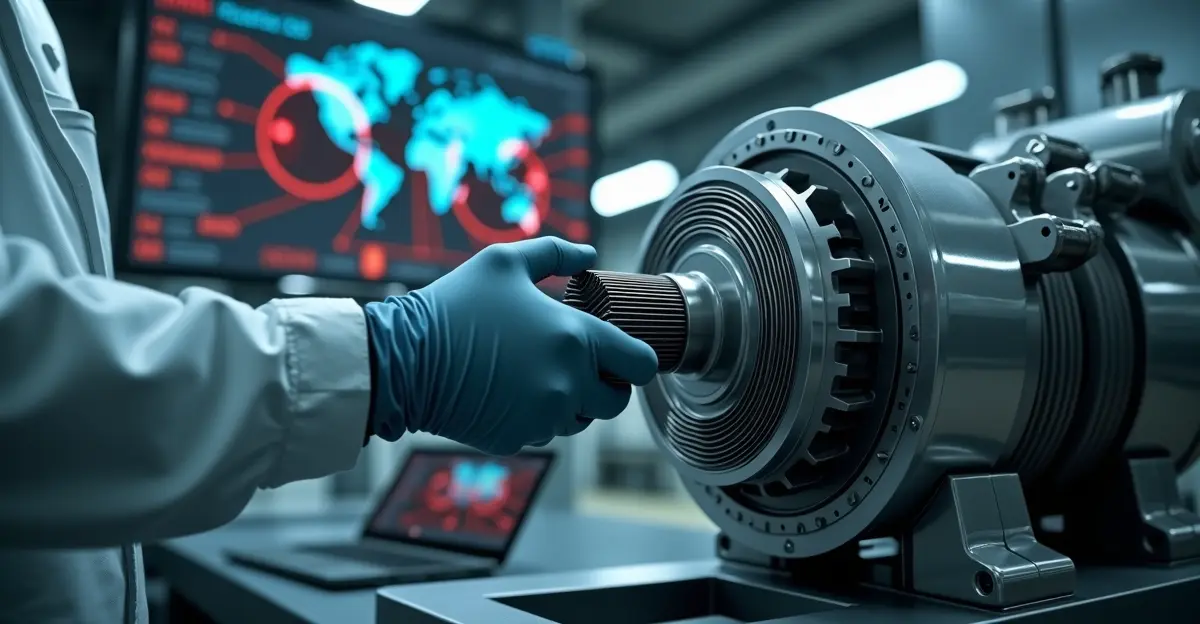
Rare earth elements (REEs) are a set of 17 chemically similar metals essential for modern technology, despite their misleading name suggesting scarcity. These elements, including neodymium, dysprosium, and praseodymium, are critical components in permanent magnets that power electric vehicle motors, wind turbine generators, industrial automation systems, and advanced defense technologies. According to Wikipedia, while relatively abundant in Earth's crust, REEs are difficult to extract and process economically, creating natural bottlenecks in global supply chains. The global energy transition has dramatically increased demand for these strategic minerals, with electric vehicles alone consuming approximately 22% of U.S. rare earth demand in 2025.
The October 2025 Export Control Expansion
China's October 2025 regulatory expansion represents the most significant tightening of rare earth controls in over a decade. The new measures, detailed in MOFCOM Notice 2025 No. 61, introduce several critical changes:
- Expanded Element Coverage: Adds five additional rare earth metals (holmium, erbium, thulium, europium, and ytterbium) to the controlled list, bringing the total to 12 of the 17 rare earth elements
- Foreign Direct Product Rules: Requires foreign companies to obtain licenses for products containing Chinese-sourced rare earth materials, regardless of where final manufacturing occurs
- Compliance Notice System: Mandates detailed supply chain documentation and disclosure of material origins
- Non-Automatic Licensing: Establishes case-by-case export approvals with processing times up to 45 working days
- 0.1 Percent Rule: Gives China extraterritorial oversight over products containing even trace amounts of Chinese-origin rare earths
Most restrictions took effect December 1, 2025, creating a narrow 2.5-month negotiation window that coincided with the APEC summit between U.S. President Trump and Chinese President Xi Jinping.
China's Strategic Dominance in Rare Earth Processing
China's leverage stems from decades of strategic investment that created near-total control over the global rare earth value chain. According to industry data, China controls approximately 91% of global rare earth separation and refining production and 94% of sintered permanent magnet manufacturing. This dominance extends across the entire supply chain:
| Segment | China's Global Share | Key Applications |
|---|---|---|
| Rare Earth Mining | 60% | Raw material extraction |
| Separation & Refining | 91% | Purification for industrial use |
| Permanent Magnet Manufacturing | 94% | EV motors, wind turbines, defense systems |
| Heavy Rare Earth Processing | 99% | Advanced military and aerospace applications |
The country achieved this dominance through strategic industry consolidation, merging numerous producers into state-aligned giants like China Rare Earth Group, while accepting environmental costs that Western nations typically avoid. China's real advantage lies in midstream processing, where it owns 99% of global heavy rare earth refining capacity essential for advanced military systems like F-35 fighter jets, submarines, and precision-guided missiles.
Immediate Impacts on Global Industries
The October 2025 controls create immediate vulnerabilities across multiple critical sectors. The semiconductor industry faces particular pressure, as rare earths are essential for chip manufacturing equipment and advanced electronics. Defense contractors, already grappling with supply chain challenges, must now navigate complex licensing requirements for systems containing Chinese-sourced materials. The renewable energy sector, crucial for the global decarbonization timeline, faces potential delays in wind turbine and electric vehicle production.
"China's restrictions transform rare earths from economic assets into instruments of geopolitical leverage," notes a recent analysis from SFA Oxford. "This creates short-term supply disruptions while forcing Western nations to accelerate efforts to build alternative refining and production capacity."
The automotive industry, targeting millions of electric vehicle sales by 2030, now faces uncertainty about permanent magnet supplies for motor production. Industrial manufacturers relying on high-performance motors for automation and robotics must reassess their supply chain resilience.
Global Response and Diversification Efforts
In response to China's October 2025 measures, the United States announced unprecedented 100% additional tariffs on all Chinese goods effective November 1, 2025, escalating trade tensions. Western nations are accelerating efforts to develop alternative supply chains, with venture capitalists pouring a record $628 million into U.S. rare earth startups in 2025—a nearly 3,000% increase from 2024.
Key diversification initiatives include:
- U.S. Domestic Production: The Trump administration is supporting the sector through price guarantees and supply chain coordination with allies
- European Union Strategy: The EU is developing comprehensive rare earth security policies through its Critical Raw Materials Act
- Alliance Building: Western nations are forming mineral security partnerships to share technology and develop alternative sources
- Recycling Innovation: Increased investment in rare earth recycling technologies to reduce primary material dependence
Despite these efforts, the U.S. still lags far behind China's production capacity of 620,000 tons versus 67,000 tons domestically, highlighting the scale of the challenge.
Long-Term Implications for Energy Transition
China's October 2025 export controls represent a fundamental shift in how strategic minerals are weaponized in geopolitical competition. The measures create a new chokepoint in the global energy transition, potentially delaying decarbonization timelines and increasing costs for clean energy technologies. As noted in a European Parliament analysis, the EU faces significant supply chain vulnerabilities that threaten both economic security and technological sovereignty.
The broader implications extend beyond immediate supply disruptions:
- Technology Development: Potential slowdown in innovation for next-generation clean energy technologies
- Cost Inflation: Increased prices for electric vehicles, renewable energy systems, and advanced electronics
- Geopolitical Realignment: Accelerated decoupling of Western and Chinese technology ecosystems
- Environmental Trade-offs: Pressure to develop new mining operations with potentially higher environmental impacts
Frequently Asked Questions
What specific rare earth elements did China add to export controls in October 2025?
China added five additional rare earth metals to its controlled list: holmium, erbium, thulium, europium, and ytterbium. This brings the total to 12 of the 17 rare earth elements under export restrictions.
How do the new "foreign direct product" rules work?
The foreign direct product rules require companies outside China to obtain export licenses for products containing Chinese-sourced rare earth materials, regardless of where final manufacturing occurs. This gives China extraterritorial oversight through the "0.1 percent rule" covering even trace amounts.
What percentage of global rare earth processing does China control?
China controls approximately 91% of global rare earth separation and refining production and 94% of sintered permanent magnet manufacturing, with near-total dominance (99%) in heavy rare earth processing essential for advanced military applications.
When did the October 2025 restrictions take effect?
Most restrictions took effect December 1, 2025, creating a 2.5-month window between the October 9 announcement and implementation date that coincided with APEC summit negotiations.
How are Western nations responding to China's export controls?
Western responses include unprecedented U.S. tariffs, record investment in domestic rare earth startups ($628 million in 2025), EU critical materials strategies, alliance building for alternative sourcing, and accelerated recycling technology development.



Follow Discussion