


 Deutsch
 English
 Español
 Français
 Nederlands
 Português


 Share
Share




What Are China's New Rare Earth Export Controls?
China's Ministry of Commerce Notice 2025 No. 61, effective December 1, 2025, represents a strategic escalation in the weaponization of critical mineral supply chains. The regulation imposes strict export controls on rare earth elements (REEs), requiring foreign companies to obtain Chinese export permits for any product containing ≥0.1% Chinese-origin rare earths, even if manufactured outside China. This move comes as China controls approximately 85% of global rare earth processing capacity and 90% of permanent magnet production, creating critical vulnerabilities for Western defense, renewable energy, and electric vehicle industries. The timing coincides with intensifying U.S.-China technology competition and reflects Beijing's calibrated approach to maintaining export flexibility while preserving geopolitical leverage.
The Strategic Calculus Behind China's Rare Earth Dominance
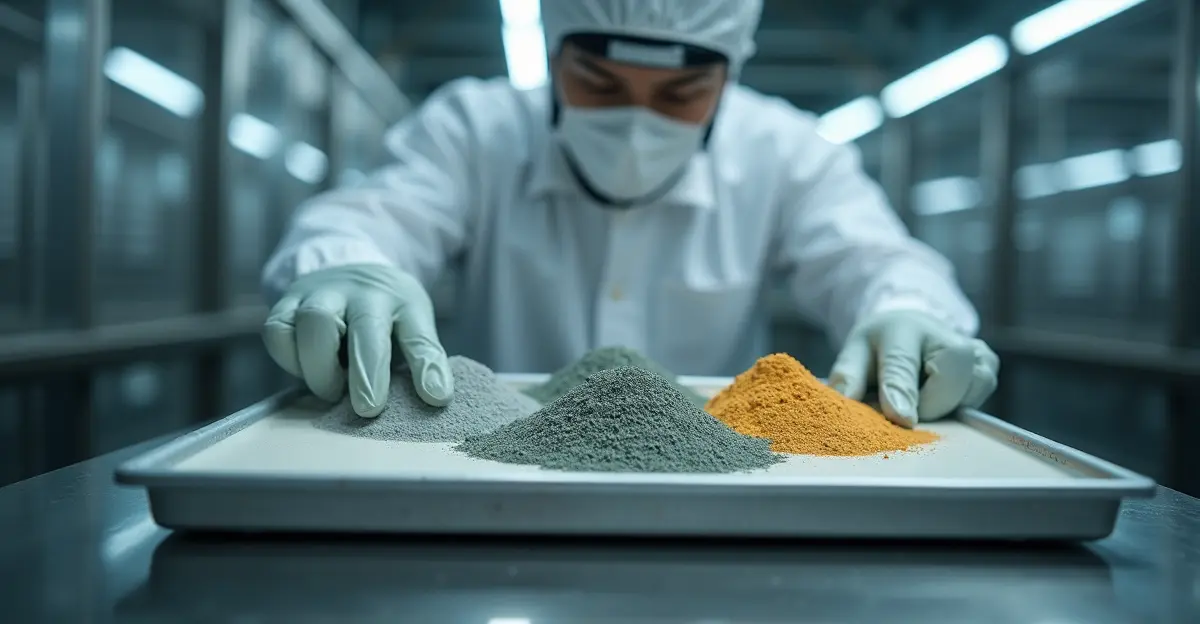
China's dominance in rare earth supply chains is the result of decades of strategic investment and vertical integration. While controlling about 60% of global rare earth mining, China's real power lies in processing and separation technologies where it commands 85-90% of global capacity. This concentration creates what experts call a 'processing bottleneck' - a technological barrier that cannot be quickly replicated by alternative suppliers. 'China treats rare earths as instruments of national power rather than commercial commodities,' notes a supply chain analyst from Discovery Alert. The US-China technology competition has accelerated this strategic positioning, with Beijing using export licensing and industrial consolidation to maintain leverage over global industries.
Key Provisions of Notice 2025 No. 61
The new regulations establish several critical requirements:
- Mandatory export permits for products with ≥0.1% Chinese-origin rare earth content
- Declaration of Compliance for every transfer of controlled materials
- Restrictions on exports for military applications and WMD uses
- Limitations on advanced semiconductor manufacturing applications
- Supply chain tracing requirements throughout manufacturing processes
These measures effectively give China oversight over approximately $135-270 billion worth of high-tech products globally, extending Beijing's influence far beyond raw material exports.
Global Impact on Energy Transition and Technology Manufacturing
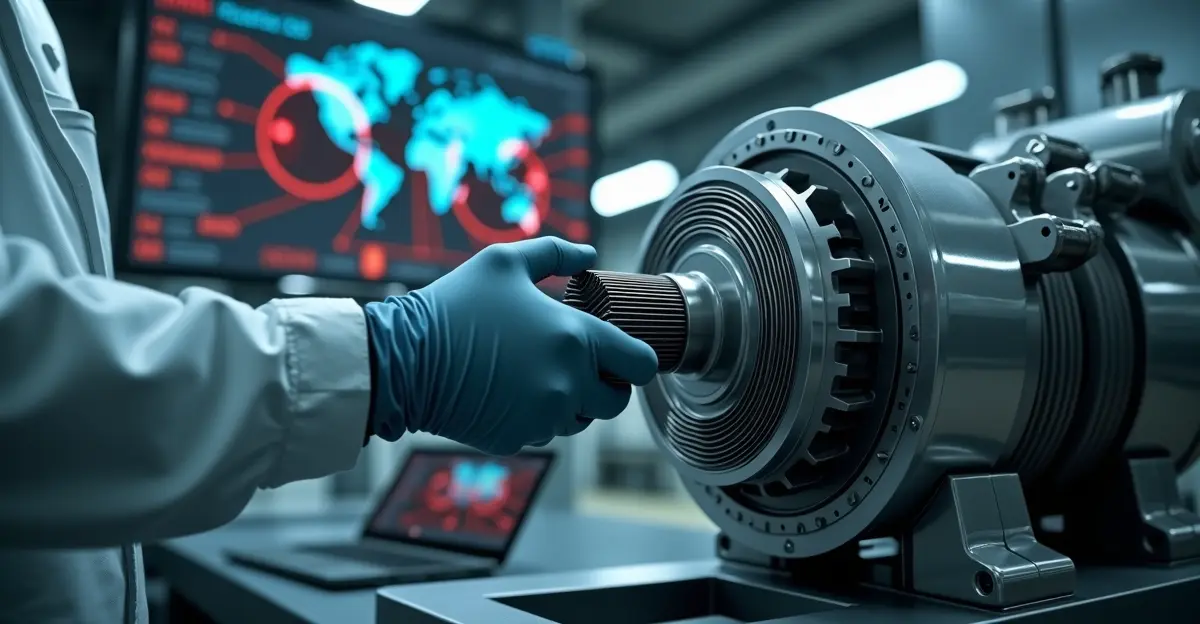
The new controls create immediate challenges for global energy transition efforts. Rare earth elements like neodymium, dysprosium, and praseodymium are essential for electric vehicle motors, wind turbine generators, and advanced electronics. With global supply chains holding only about two months of reserves, industries face significant production risks. The renewable energy sector is particularly vulnerable, as wind turbines require permanent magnets containing rare earths that currently have no commercially viable substitutes at scale. Defense applications face similar challenges, with advanced weapons systems, radar, and communication equipment all dependent on these critical materials.
Vulnerable Industries and Supply Chain Risks
| Industry | Rare Earth Dependency | Risk Level |
|---|---|---|
| Electric Vehicles | Permanent magnets for motors | High |
| Wind Energy | Generator magnets | Critical |
| Defense Systems | Guidance systems, radar | Critical |
| Consumer Electronics | Smartphones, displays | Medium-High |
| Semiconductors | Manufacturing processes | High |
Western Countermeasures and Supply Chain Diversification
The United States, European Union, and allied nations are responding with multiple strategies to reduce dependence on Chinese rare earths. The U.S. Inflation Reduction Act includes a 10% tax credit for domestic manufacturers of critical minerals and provides $500 million under the Defense Production Act to secure domestic production. However, as noted by Kleinman Energy researchers, 'the IRA has limitations, particularly in addressing REEs used in EV motors and environmental challenges associated with mining.' The EU's Critical Raw Materials Act aims to boost domestic processing capacity, while 'friendshoring' initiatives seek to shift supply chains to politically aligned nations like Australia, Canada, and African partners.
Alternative Supply Chain Development
Several key initiatives are underway:
- U.S. Domestic Production: Revitalizing mines in Mountain Pass, California and developing new processing facilities
- Australian Partnerships: Expanding Lynas Corporation's processing capacity in Malaysia and Western Australia
- Canadian Resources: Developing rare earth deposits in the Northwest Territories and Quebec
- African Exploration: Tapping into reserves in South Africa, Malawi, and Tanzania
- Recycling Initiatives: Developing technologies to recover rare earths from electronic waste
The global critical minerals race is intensifying, with nations recognizing that control over these materials represents strategic power in the 21st century economy.
Geopolitical Implications and Future Outlook
China's rare earth controls represent a new phase in economic statecraft, where control over critical materials becomes a primary tool of geopolitical influence. The calibrated nature of Notice 2025 No. 61 - maintaining export flexibility while creating leverage - suggests Beijing is testing the limits of its economic power without triggering complete supply chain collapse. This approach mirrors previous instances of rare earth weaponization, including the 2010 embargo against Japan during territorial disputes and selective restrictions during U.S.-China trade tensions.
According to MOFCOM spokesperson statements, China maintains these are 'not export bans but legitimate controls to refine its export system and safeguard global peace and supply chain stability.' However, the practical effect is to give Beijing significant influence over global technology development timelines and manufacturing costs. The EU carbon border tax and other Western trade measures may face reciprocal pressure through rare earth access restrictions.
Frequently Asked Questions
What are rare earth elements and why are they important?
Rare earth elements are 17 metallic elements essential for modern technologies including electric vehicles, wind turbines, smartphones, and defense systems. Despite their name, they're relatively abundant but difficult to process economically.
How much of global rare earth processing does China control?
China controls approximately 85% of global rare earth processing capacity and 90% of permanent magnet production, creating significant supply chain dependencies for other nations.
What industries are most affected by China's export controls?
The electric vehicle, wind energy, defense, semiconductor, and consumer electronics industries face the highest risks due to their dependence on rare earth materials with limited substitutes.
How are Western nations responding to these controls?
The U.S., EU, and allies are pursuing domestic production incentives, 'friendshoring' partnerships with allied nations, recycling initiatives, and research into alternative materials through legislation like the Inflation Reduction Act and Critical Raw Materials Act.
How long will it take to develop alternative rare earth supply chains?
Experts estimate it could take a decade or more for other nations to develop comparable processing capabilities due to China's specialized technology, environmental regulations, and decades-long head start in the industry.
Conclusion: A New Era of Resource Geopolitics
China's Notice 2025 No. 61 marks a significant milestone in the weaponization of critical mineral supply chains, reflecting broader shifts in global power dynamics. As the world transitions to renewable energy and advanced technologies, control over rare earth elements has become a central geopolitical battleground. The coming years will test whether Western nations can successfully diversify supply chains or remain structurally dependent on Chinese processing dominance. The outcome will shape not only economic competitiveness but also national security and the pace of global energy transition.


Follow Discussion