


 Deutsch
 English
 Español
 Français
 Nederlands
 Português


 Share
Share




Europe's Historic Military Buildup: The €800 Billion Question
In the wake of NATO's 2025 Hague Summit, where allies committed to a 3.5% GDP defense spending floor by 2035, European nations are executing the largest peacetime military buildup in modern history. Combined defense budgets across the European Union and NATO European members are projected to reach €800 billion annually by the end of the decade, marking a structural shift away from reliance on the United States. This rearmament drive, fueled by Russia's war in Ukraine and growing uncertainty over U.S. security guarantees, represents the defining strategic realignment of 2026.
Global military spending hit a record $2.89 trillion in 2025, with European expenditure surging 14% to $864 billion, according to the Stockholm International Peace Research Institute (SIPRI). The U.S. 2026 National Defense Strategy, published in January, explicitly pivots toward Indo-Pacific deterrence, reducing European force posture while demanding allies meet a new 5% GDP spending standard. This twin dynamic — Europe's urgency to rearm and America's strategic reorientation — is reshaping the transatlantic security architecture.
The Numbers Behind the Buildup
Germany's €108 Billion Defense Budget
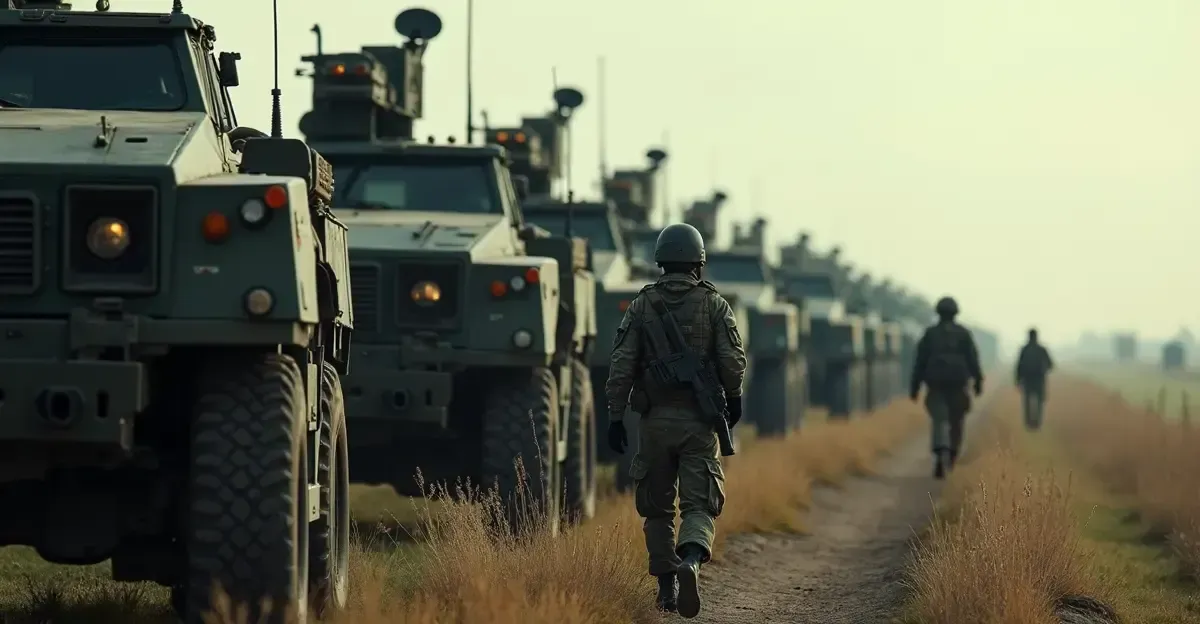
Germany has unveiled a record €108.2 billion defense budget for 2026, combining an €82.7 billion regular Bundeswehr allocation with €25.5 billion from the special 'Zeitenwende' fund. This spending raises German defense outlays to approximately 2.8% of GDP, with a trajectory toward 3.5% by 2029. Major procurement includes up to 1,000 Leopard 2A8 tanks, 3,500 Boxer armored vehicles, and new air-defense systems. Defense Minister Boris Pistorius emphasized that 'the security situation comes before budget constraints.' The German defense budget 2026 represents nearly double France's €57.2 billion allocation, making Berlin Europe's largest military spender.
Poland Leads NATO at 4.5% of GDP
Poland has approved a record defense budget of 4.69% of GDP for 2026 — the highest in NATO — allocating 187 billion zlotys ($46.9 billion). Warsaw aims to grow its army to 300,000 soldiers and is modernizing equipment with major purchases from the United States and South Korea. As a frontline state bordering Ukraine and Russia's Kaliningrad exclave, Poland's defense spending surge reflects existential security concerns. The country is also the largest beneficiary of the EU's SAFE loan program, with €43.7 billion in tentative allocations.
The EU's SAFE Defense Loan Program
The European Union's Security Action for Europe (SAFE) instrument, adopted in May 2025, provides up to €150 billion in competitively priced loans to member states for urgent defense investments. Disbursements began in early 2026, with 19 member states submitting National Defence Investment plans. Crucially, SAFE requires joint procurement of European-made equipment, with no more than 35% of component costs originating outside the EU, EEA-EFTA, or Ukraine. This 'Buy European' clause is designed to strengthen the continent's defense industrial base and reduce transatlantic dependencies.
Industrial Capacity Constraints
Europe's defense industry faces significant capacity bottlenecks. The HCSS report 'Catching up: Europe's Path to Strategic Autonomy in the Defence Industry' (2026) highlights fragmented national markets, insufficient R&D investment, and a shortage of skilled labor. Ammunition production lines, dormant since the Cold War, are being reactivated but remain years from full capacity. A paper by five German experts argues that European sovereignty in defense is within reach but requires investing around €50 billion annually for a decade to close critical gaps in air defense, long-range strike, and military mobility.
Yet there are signs of a structural shift. European defense-tech venture capital funding surged to €2.6 billion in 2025 — a 13-fold increase since 2022. Startups like Helsing and Stark Defence are winning major contracts, including a €540 million German drone deal, signaling a move toward software-defined warfare. The traditional defense primes — Airbus, Rheinmetall, BAE Systems — are scaling up, but the European defense innovation ecosystem is increasingly driven by agile newcomers.
Geopolitical Implications
The U.S. Pivot and Transatlantic Strains
The 2026 U.S. National Defense Strategy explicitly frames China as the 'pacing challenge' and prioritizes homeland defense and Indo-Pacific deterrence. Force posture shifts include reducing European deployments while bolstering presence in the First Island Chain. The strategy warns allies against relying on U.S. subsidies, demanding they meet the new 5% GDP spending standard. This has created a credibility gap: European capitals question whether Washington would risk a conflict with China over Taiwan while Europe faces Russian aggression. The transatlantic security divide is widening, accelerating Europe's push for strategic autonomy.
Russia's Response
Russia increased its military spending by 5.9% to $190 billion in 2025, representing 7.5% of its GDP. Moscow views Europe's rearmament as a direct threat, with Kremlin spokesperson Dmitry Peskov warning of 'countermeasures.' The Baltic states and Poland are particularly vulnerable, given their proximity to Russian forces and the Suwałki Gap. Europe's buildup is partly designed to deter Russian aggression without relying on U.S. reinforcements, but it also risks triggering a new arms race.
Macroeconomic Consequences
The fiscal burden of rearmament is substantial. Poland's 2026 budget deficit is projected at 6.5% of GDP, well above the EU's 3% threshold. Germany is borrowing heavily through its special fund, while France and Italy face rising debt-to-GDP ratios. The European Commission has activated the national escape clause of the Stability and Growth Pact, allowing member states to increase defense spending without triggering excessive-deficit procedures. However, economists warn that sustained high defense spending could crowd out social investments and green transition funding. The macroeconomic impact of rearmament will be a key policy battleground in 2026-2027.
Expert Perspectives
'Europe is finally taking its security seriously, but money alone won't solve the problem,' says Dr. Sophia Besch, a defense expert at the Carnegie Endowment. 'The real challenge is industrial: we need to produce ammunition at scale, integrate air defense systems across borders, and develop a genuine European defense technological and industrial base. That will take a decade, not a budget cycle.'
Commissioner Andrius Kubilius, responsible for EU defense, called SAFE a 'big step forward for defence readiness,' noting there is 'no time for the luxury of incremental improvement.' The question now is whether Europe can convert political urgency, higher spending, and new EU instruments into the hard military capacity required to defend itself.
Frequently Asked Questions
What is Europe's €800 billion rearmament plan?
The 'ReArm Europe' plan, proposed by the European Commission in March 2025, aims to mobilize approximately €800 billion in defense spending over four years. It includes a €150 billion SAFE loan program, activation of fiscal flexibility for national defense budgets, and incentives for joint procurement of European-made equipment.
How does the 2025 NATO Hague Summit affect defense spending?
The Hague Summit Declaration committed allies to invest at least 3.5% of GDP on core defense requirements by 2035, with an overall target of 5% including infrastructure and resilience. This replaced the previous 2% guideline and marked a significant escalation in NATO's burden-sharing expectations.
Why is Europe pursuing strategic autonomy from the U.S.?
Europe's push for strategic autonomy is driven by two factors: the U.S. strategic pivot toward the Indo-Pacific, which reduces American focus on European security, and the perception that Washington's commitment to NATO may waver under future administrations. The 2026 U.S. National Defense Strategy explicitly prioritizes China over Russia, accelerating European self-reliance.
What are the main industrial challenges to Europe's rearmament?
Key challenges include fragmented national defense markets, insufficient production capacity for ammunition and advanced systems, a shortage of skilled labor, and over-reliance on U.S. components. The EU's 'Buy European' clauses aim to address these, but full capacity may take until 2030.
How does Poland's defense spending compare to other NATO members?
Poland leads NATO with defense spending at 4.69% of GDP in 2026, followed by Estonia (3.4%), Greece (3.1%), and the United States (3.3% of GDP, though the U.S. spends the most in absolute terms at $954 billion). Germany is at 2.8% but rising rapidly.
Conclusion: A Defining Moment for European Security
Europe's €800 billion rearmament is more than a budgetary exercise — it is a geopolitical declaration. The continent is betting that it can achieve strategic autonomy within a decade, building a defense industrial base capable of deterring Russia without relying on the United States. The risks are considerable: industrial bottlenecks, fiscal strain, and potential escalation with Moscow. But the alternative — continued dependence on a distracted superpower — is no longer acceptable to European capitals. As the 2026 defense budgets take effect, the world is watching whether Europe can turn its financial commitments into real military capability.


Follow Discussion