


 Deutsch
 English
 Español
 Français
 Nederlands
 Português


 Share
Share




For the first time in NATO history, a European ally has surpassed the United States in defense spending per capita, and all 32 allies now exceed the previous 2% GDP threshold. Ahead of the July 2026 Ankara summit, where leaders will assess progress on the new 5% GDP defense pledge adopted at The Hague in 2025, a structural transformation of European defense is underway. This article analyzes the economic implications, industrial base challenges, and geopolitical signals of Europe's unprecedented rearmament — and what it means for transatlantic relations and global security architecture.
Europe's Defense Spending Surge: By the Numbers
According to NATO's annual report released in March 2025, European allies and Canada increased defense spending by nearly 20% in real terms in 2025 compared to 2024, reaching a record $574 billion (€497 billion). Overall NATO defense expenditure exceeded $1.4 trillion. Between 2014 and 2025, Europe and Canada more than doubled their annual defense expenditure with a 106% real-term increase. All allies now meet or exceed the previous 2% of GDP target, with Poland leading at 4.30% of GDP, followed by the Baltic states. For the first time, Norway has surpassed the United States in defense spending per capita, a milestone that underscores the shifting burden-sharing dynamics within the Alliance.
The NATO defense spending tracker maintained by the Atlantic Council shows that 34% of European and Canadian defense budgets now go to major equipment purchases, up from just 14% in 2014. This shift from personnel costs to capital investment signals a genuine modernization effort rather than mere budget inflation.
The New 5% GDP Target: A Quantum Leap
At the 2025 NATO summit in The Hague, allies adopted a historic new pledge to spend 5% of GDP on defense and defense-related items by 2035, with an interim target of 3.5% of GDP on 'pure' defense. NATO Secretary-General Mark Rutte called the agreement a 'quantum leap' for collective defense, noting it would create jobs and address significant threats. The commitment requires members to submit annual plans showing credible progress toward the goal.
The 2025 NATO summit in The Hague marked a turning point after years of pressure from U.S. President Donald Trump for European allies to share more of the defense burden. Some member states, particularly Spain, had expressed reservations, with German Foreign Minister Johann Wadephul stating that Spain ultimately recognized opposing 31 other members made no sense.
Stress-Testing the 5% Target Ahead of Ankara
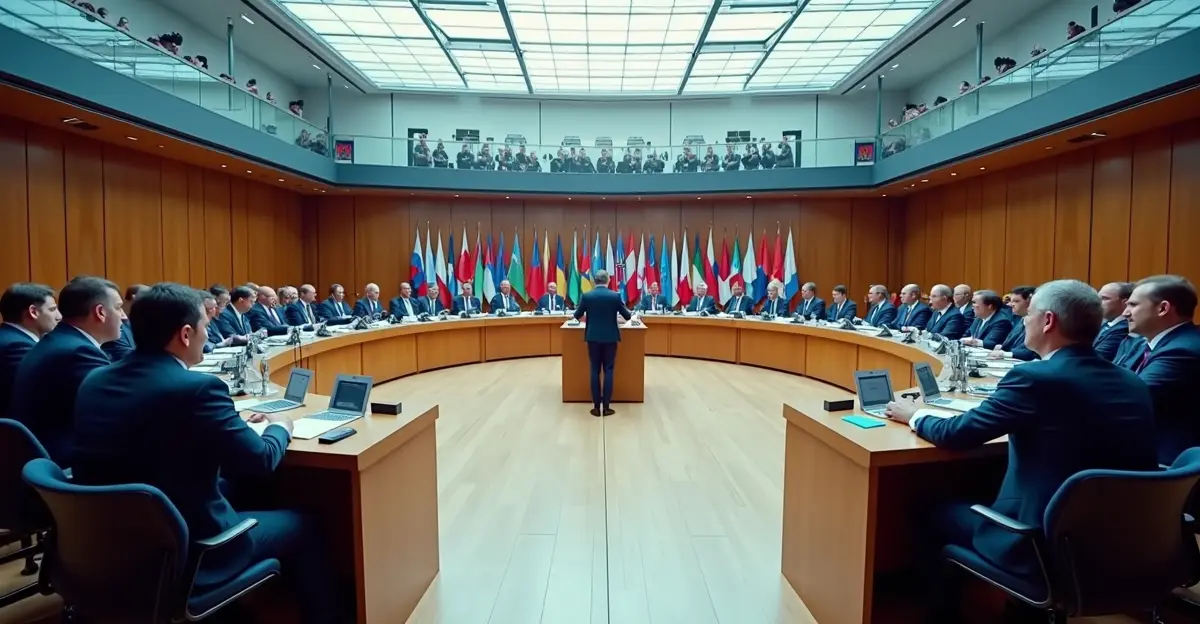
The July 2026 Ankara summit, hosted by Türkiye at the Beştepe Presidential Compound, will be the first major test of the new pledge. Leaders are expected to review national implementation plans, assess capability gaps, and address industrial production bottlenecks. The summit marks the second time Türkiye has hosted a NATO summit, following Istanbul in 2004, and comes amid heightened transatlantic tensions over issues including Iran and Greenland.
Economic Implications: Growth vs. Fiscal Strain
The macroeconomic impact of Europe's defense buildup is significant. Goldman Sachs estimates that European defense spending grew 3.9% annually from 2014 to 2024, but the new 5% target will require sustained increases of 6-8% annually through 2035. For context, the EU's GDP is nine times larger than Russia's, and its population of 450 million provides a substantial tax base. However, decades of underinvestment — an estimated €1.1 trillion in lost defense spending from 2006 to 2020 — mean Europe starts from a deep hole.
The economic impact of European rearmament is already visible in defense sector employment and industrial output. NATO Secretary-General Rutte urged European industries to boost production capacity, warning that demand is outstripping supply. The European defense industrial base remains fragmented across national borders, with over 150 different weapons systems in use compared to roughly 30 in the U.S. military.
Industrial Base Challenges
European defense companies face significant headwinds: overregulation, national protectionism, limited cross-border consolidation, and reliance on a constrained U.S. defense industrial base. Between 2020 and 2024, 64% of European NATO procurement came from the United States. McKinsey has identified opportunities for consolidation through cross-border mergers and joint ventures, but political resistance remains strong. The European Parliamentary Research Service notes that the EU's Defense Technological and Industrial Base (EDTIB) requires coordinated investment in research, development, and production scaling to meet the new targets.
Geopolitical Signals: A New Transatlantic Bargain
Europe's military awakening sends multiple geopolitical signals. First, it demonstrates a credible commitment to burden-sharing that could reset the transatlantic relationship. Second, it provides NATO with enhanced conventional deterrence capabilities on the European continent, reducing reliance on U.S. rapid reinforcement. Third, it signals to adversaries — particularly Russia — that European nations are prepared to invest seriously in their own defense.
The World Economic Forum's 2026 Global Risks Report ranks geoeconomic confrontation as the top short-term global risk, with 68% of surveyed leaders expecting a more fragmented multipolar order over the next decade. In this context, Europe's defense buildup is both a response to and a driver of geoeconomic competition. The geoeconomic confrontation risks identified by the WEF underscore the stakes: trade fragmentation, supply chain weaponization, and capital controls are reshaping the security landscape.
Expert Perspectives
'This is the most significant transformation of European defense since the founding of NATO,' said Kristen Taylor, lead analyst at the Atlantic Council's Transatlantic Security Initiative. 'The 20% spending increase in 2025 is not a one-off — it reflects a structural shift in how European nations view their security responsibilities.'
However, analysts caution that headline budget numbers alone don't resolve capability gaps. Equipment spending has risen, but personnel shortages, ammunition stockpile depletion, and interoperability issues persist. The war in Ukraine has exposed critical vulnerabilities in European defense production, particularly in artillery shells, air defense systems, and precision munitions.
FAQ
What is the new NATO defense spending target?
At the 2025 Hague summit, NATO allies committed to spending 5% of GDP on defense and defense-related items by 2035, with an interim target of 3.5% of GDP on 'pure' defense. This more than doubles the previous 2% guideline established in 2014.
Which NATO country spends the most on defense as a share of GDP?
Poland leads NATO at 4.30% of GDP in 2025, followed by Lithuania, Latvia, and Estonia. The United States spends approximately 3.19% of GDP on defense, while the NATO European average is now above 2.3%.
When and where is the next NATO summit?
The 2026 NATO summit will be held on July 7-8, 2026, at the Beştepe Presidential Compound in Ankara, Türkiye. It will focus on assessing progress toward the 5% defense spending pledge and addressing industrial production capacity.
How much did European NATO allies spend on defense in 2025?
European allies and Canada spent a record $574 billion (€497 billion) on defense in 2025, a 20% real-term increase from 2024. This represents 34% of total NATO defense expenditure, with the U.S. accounting for the remaining 59%.
What are the main challenges to Europe's defense buildup?
Key challenges include industrial fragmentation, overregulation, reliance on U.S. equipment, personnel shortages, and the need for sustained political will. Decades of underinvestment have left Europe with significant capability gaps that cannot be closed overnight.
Conclusion: The Defining Security Story of 2026
Europe's military awakening represents the most consequential shift in transatlantic defense since the Cold War. With all allies exceeding the 2% threshold, a European nation surpassing the U.S. in per capita defense spending for the first time, and a new 5% target being stress-tested at the Ankara summit, the structural transformation of European defense is no longer aspirational — it is underway. The economic, industrial, and geopolitical implications will reverberate for decades, reshaping not only NATO but the broader global security architecture. As geoeconomic confrontation tops the global risk register, Europe's willingness to invest in its own defense may prove to be the defining strategic decision of the decade.





Follow Discussion