


 Deutsch
 English
 Español
 Français
 Nederlands
 Português


 Share
Share




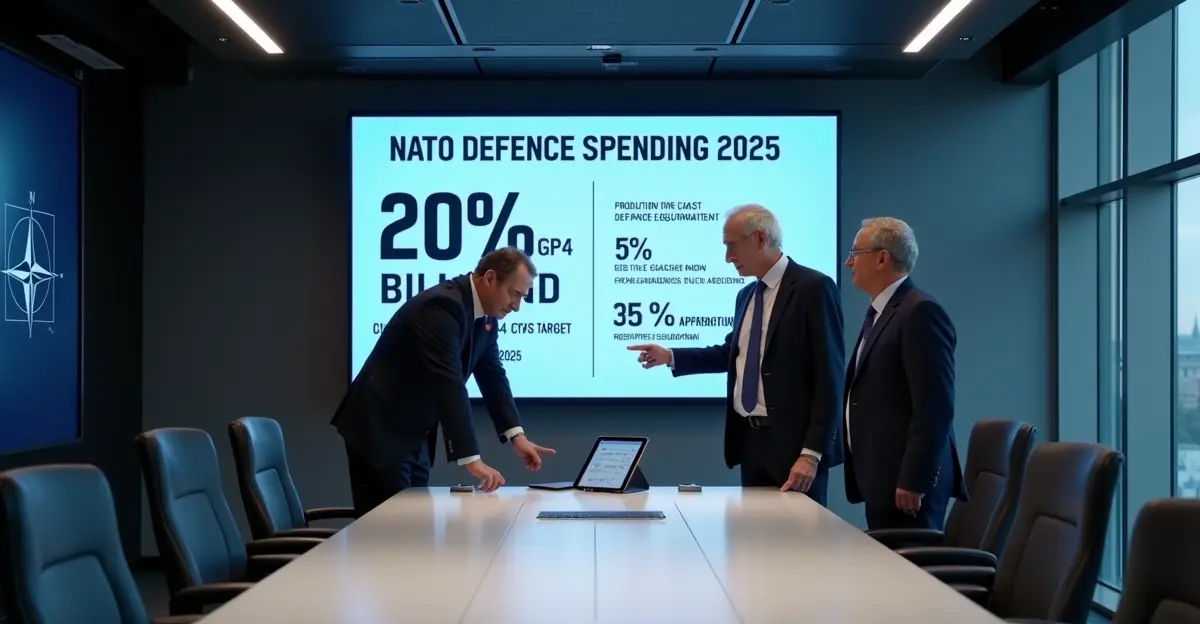
In 2025, European NATO members shattered records by increasing defense spending by 14% to a staggering $864 billion, marking the fastest growth since 1953. For the first time in the alliance's history, all 32 member states met the 2% GDP threshold, a milestone that signals a permanent structural shift in European security posture. At the June 2025 Hague Summit, NATO leaders went further, committing to a 5% of GDP target by 2035, a move that analysts say transforms Europe into a major military spender with profound economic, industrial, and geopolitical consequences.
Record-Breaking Defense Spending in 2025
According to the Stockholm International Peace Research Institute (SIPRI), global military expenditure reached nearly $2.9 trillion in 2025, with Europe accounting for $864 billion. The 14% surge among European NATO members was the fastest annual increase since the Korean War era. Germany crossed the 2% GDP threshold for the first time since 1990, spending $114 billion, while Spain's budget jumped 50% to $40.2 billion. Poland allocated 4.5% of its GDP to defense, the highest burden among all NATO members. The United States, while still the largest spender globally at $954 billion, saw a 7.5% decline due to the absence of new Ukraine supplemental appropriations. Excluding the US, global defense spending rose 9.2%.
The NATO defense spending tracker shows that European allies and Canada increased spending by 20% from the prior year, with Norway surpassing the United States in defense spending per capita for the first time. The Atlantic Council's Transatlantic Security Initiative notes that this surge reflects a "permanent structural shift" in European security priorities.
The Hague Summit: A New 5% GDP Target
At the NATO summit in The Hague on June 25, 2025, all 32 member states except Spain pledged to increase defense spending to 5% of GDP by 2035 under The Hague Investment Plan. The target is split into two tiers: 3.5% of GDP for core military expenditures (personnel, operations, equipment) and 1.5% for security-related spending (cyberdefense, critical infrastructure, civil preparedness, and defense industrial base strengthening). NATO Secretary-General Mark Rutte called it a "transformational leap" for collective defense. National roadmaps must be submitted by mid-2026, with a collective review in 2029.
Critics, however, warn that including security-related items could allow countries to meet targets without enhancing military capability. SIPRI researchers raised concerns about "creative accounting" potentially diluting the target's effectiveness. The Agreement on 5% NATO Defence Spending by 2035 remains a contentious issue, with Spain receiving an exemption citing domestic budget constraints.
Economic Implications: Bond Markets and Fiscal Pressures
The European Central Bank (ECB) analyzed the fiscal implications of the defense spending surge in its Economic Bulletin. For the euro area, new defense measures announced since mid-February 2025 cumulatively amount to 0.6% of GDP over 2025-2027, with the bulk coming from Germany. Over half goes to government consumption (intermediate goods ~40%, personnel ~15%) and ~40% to investment. The ECB projects that the new spending will support euro area GDP growth by approximately 0.1 percentage points annually over 2026-2027, with muted inflation effects. However, risks depend on financing choices—whether through debt or spending cuts—and the import content of defense procurement.
The impact on European bond markets has been notable. Increased defense spending has raised sovereign debt issuance, putting upward pressure on yields, particularly for higher-debt countries like Italy and France. The European bond market response to defense spending has been mixed, with investors weighing the growth benefits against fiscal sustainability concerns. Germany's decision to exempt defense spending from its constitutional debt brake has provided some relief, but the overall trajectory suggests a gradual increase in defense-related borrowing costs across the eurozone.
Industrial Capacity Constraints and Defense Consolidation
Europe's defense industry faces significant capacity constraints as it scrambles to meet surging demand. The European Union announced the ReArm Europe Plan to boost defense spending by €800 billion ($867 billion), including €150 billion in loans for air defenses, artillery, missiles, drones, and cybersecurity. Major defense contractors are racing to expand production: Rheinmetall's stock surged 154% in 2025, while Hanwha Aerospace rose 193% and Mitsubishi Heavy Industries gained 72.7%.
Consolidation is accelerating across the sector. McKinsey's analysis highlights opportunities through cross-border mergers and acquisitions to achieve economies of scale and reduce duplication. Companies like BAE Systems, Thales, Leonardo, and Saab have launched capital programs exceeding €1 billion each over the 2023-2025 period. Private equity and infrastructure funds are increasingly treating defense manufacturing as a long-cycle, asset-heavy industry comparable to energy or transport. However, Europe's fragmented national defense markets remain a barrier, with different procurement systems and export controls hindering integration.
The European defense industry consolidation trend is expected to intensify as governments push for a more unified industrial base. The NATO declaration explicitly calls for eliminating defense trade barriers among allies and expanding transatlantic defense industrial cooperation.
Geopolitical Consequences: Transatlantic Relations and Global Power Shifts
The rearmament of Europe is reshaping transatlantic relations. The Atlantic Council notes that the new spending targets demonstrate allied unity, but tensions persist over issues like Iran, Greenland, and the future of US force deployments in Europe. The Trump administration's approach to the Russia-Ukraine war has accelerated European efforts to build strategic autonomy, even as NATO reaffirms Article 5 commitments.
Russia's military spending rose to $190 billion (7.5% of GDP) in 2025, while Ukraine spent $84.1 billion (40% of GDP). China's defense budget grew 7.4% to an estimated $336 billion. The global balance of power is shifting, with Europe emerging as a third major military pole alongside the US and China. SIPRI projects continued growth through 2026 and beyond, with the US already approving over $1 trillion in defense spending for 2026.
The geopolitical impact of European rearmament extends to NATO's eastern flank, where Poland and the Baltic states strongly support the new targets. The July 2026 Ankara summit will assess progress toward the 5% pledge, with expectations that European allies will continue to outpace previous spending commitments.
Expert Perspectives
"This is a transformational leap for collective defense," said NATO Secretary-General Mark Rutte at the Hague Summit. "Europe is finally taking its security seriously, and the numbers prove it." However, SIPRI researcher Dr. Nan Tian cautioned: "The 5% target risks incentivizing creative accounting unless strict definitions are enforced. Including infrastructure and cyber spending could inflate numbers without improving military readiness."
McKinsey's defense practice lead noted that "consolidation is essential for Europe to compete globally. Without cross-border integration, European firms will struggle to achieve the scale needed for next-generation technologies like AI, cyber, and space."
Frequently Asked Questions
What is the new NATO defense spending target?
At the June 2025 Hague Summit, NATO allies committed to spending 5% of GDP on defense by 2035, split into 3.5% for core military expenditures and 1.5% for security-related spending.
How much did Europe spend on defense in 2025?
European NATO members spent a record $864 billion in 2025, a 14% increase from 2024, the fastest growth since 1953.
Which European countries increased defense spending the most?
Spain's budget jumped 50%, Belgium's rose 59%, and Germany's increased 24%, crossing the 2% GDP threshold for the first time since 1990. Poland spent 4.5% of GDP, the highest among NATO members.
How will increased defense spending affect European bond markets?
The ECB estimates that new defense measures amount to 0.6% of euro area GDP over 2025-2027, with modest growth effects (~0.1 pp annually) but potential upward pressure on sovereign bond yields, especially for higher-debt countries.
What are the main challenges for Europe's defense industry?
Key challenges include fragmented national markets, capacity constraints, supply chain bottlenecks, and the need for cross-border consolidation to achieve economies of scale and compete with US and Chinese firms.
Conclusion: A Permanent Shift in European Security
Europe's $864 billion rearmament marks a historic turning point. With all NATO allies meeting the 2% threshold and a new 5% target on the horizon, the continent is permanently transforming its security posture. The economic implications—from bond markets to industrial consolidation—will unfold over the coming decade, while geopolitical consequences reshape transatlantic relations and global power dynamics. As SIPRI's data and NATO's commitments make clear, Europe is no longer a passive consumer of security but an emerging defense superpower in its own right.




Follow Discussion