


 Deutsch
 English
 Español
 Français
 Nederlands
 Português


 Share
Share




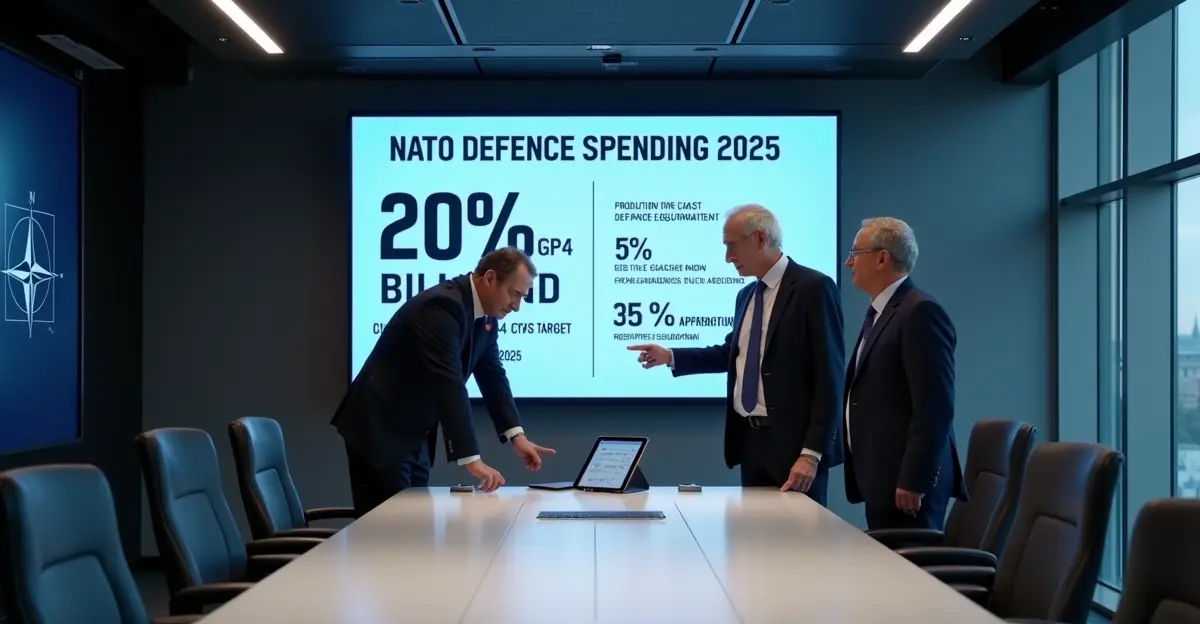
When NATO leaders gathered in The Hague in June 2025 and committed to spending 5% of GDP on defense by 2035, they set in motion the largest peacetime military buildup in European history. With combined allied defense spending surpassing $1.5 trillion in 2026 and European defense budgets growing at 20% annually, the macroeconomic consequences are now coming into sharp focus. The NATO 5% GDP pledge represents a structural shift that touches sovereign debt sustainability, green transition funding, and Europe's industrial base. The IMF's April 2026 World Economic Outlook dedicated a full chapter to this topic, signaling its systemic importance for the global economy.
The Fiscal Arithmetic of Rearmament
The numbers are staggering. Under the Hague Investment Plan, NATO members must allocate at least 3.5% of GDP to core military expenditures and up to 1.5% to security-related investments including cyber defense, critical infrastructure, and civil preparedness. For the euro area, where defense spending averaged just 2.0% of GDP in 2024, reaching 5% means roughly tripling annual outlays. According to the European Central Bank's July 2025 analysis, new defense measures announced since February 2025 amount to 0.6% of GDP cumulatively over 2025-27 for the euro area, with Germany accounting for the bulk. The ECB estimates the spending boost will support euro area GDP growth by close to 0.1 percentage points annually over 2026-27, with muted inflation effects.
Yet the fiscal burden is unevenly distributed. Germany, currently at 2.1% of GDP, would need an additional €120 billion annually — constrained by its constitutional debt brake and limited domestic defense industrial capacity. Italy faces the most acute challenge: it would require €70 billion more each year despite a 137% debt-to-GDP ratio and minimal tax headroom. France, the healthiest case among major economies, would still need €75 billion more annually, pushing its deficit toward 9% of GDP. The EU fiscal rules and defense spending clash is becoming a central policy debate in Brussels.
Crowding Out the Green Transition
Perhaps the most contentious trade-off involves the green transition. EU strategic spending needs have surged to nearly €1,200 billion annually (2025-31), with defense requiring €320 billion more per year, according to an ECB blog post from July 2025. The public financing burden has risen from 24% to 43% of total needs, requiring roughly €510 billion in additional annual public funding. The European Sovereignty Fund, originally designed to boost spending on green technology and cutting-edge innovation, is being reprioritized toward defense. The crowding out of climate spending is already visible in national budgets across the continent.
The ECB proposed a three-level pyramid strategy to manage competing priorities: using existing national fiscal space and EU mechanisms like SAFE (providing up to €404 billion/year); national-level fiscal measures; and deeper EU integration. However, even under optimistic scenarios, a funding gap of at least €106 billion per year remains unaddressed within current frameworks. Social spending is also under pressure, with the IMF warning that defense-driven cuts to welfare programs risk social unrest.
Industrial Base Transformation
The rearmament drive is triggering a structural shift in Europe's industrial base. More than 230 defense tech startups have been founded in Europe since Russia's 2022 invasion of Ukraine, and private investment in defense startups reached an all-time high in 2024. The European Commission's November 2025 Defense Industry Transformation Roadmap outlines plans to broaden the European Defense Technological and Industrial Base (EDTIB), with a focus on dual-use technologies that serve both civilian and military markets.
McKinsey analysis highlights opportunities for consolidation in the fragmented European defense sector, where cross-border mergers and acquisitions could improve economies of scale and enhance R&D efficiency. The European defense industrial consolidation is seen as essential to compete with U.S. defense giants and reduce strategic dependencies. Countries like Poland, already at 4.48% of GDP, and the Baltic states are leading the charge, while Belgium (+59%) and Spain (+50%) recorded the largest single-year spending increases in 2025.
IMF Warning and the Ankara Summit
The IMF's April 2026 World Economic Outlook, titled "Global Economy in the Shadow of War," dedicates its second chapter to analyzing defense spending increases. The Fund finds that while higher military expenditure can boost short-term activity, it worsens fiscal deficits and public debt trajectories. The IMF's language is unusually direct in warning that defense spending crowds out social outlays, risking unrest, and prescribes protecting vulnerable populations and maintaining credible monetary policy.
All eyes are now on the July 7-8, 2026 Ankara Summit, where NATO leaders will assess progress toward the 5% target. Turkey's President Recep Tayyip Erdoğan will host the gathering at the Beştepe Presidential Compound. NATO Secretary General Mark Rutte has described the alliance as "stronger, fairer and more lethal" following the Hague commitments. The NATO Ankara Summit 2026 will be a critical test of whether the 5% pledge translates into real capability improvements or remains an aspirational target.
Expert Perspectives
"The 5% target represents a transformational leap for collective defense, but we must be realistic about the fiscal constraints," said Andrea Presbitero, IMF economist, during an April 2026 outreach event. "Defense spending can boost growth in the short term, but if financed through debt, it raises sustainability concerns, especially for high-debt countries."
European Central Bank analysts noted that the macroeconomic effects depend critically on financing methods. Debt-financed defense spending provides a larger short-term GDP boost but worsens debt dynamics, while spending cuts or tax increases minimize fiscal risks but dampen growth. The ECB's baseline scenario assumes that about half of the new spending is debt-financed, with the remainder coming from reallocated budgets.
FAQ
What is the NATO 5% GDP defense spending pledge?
Adopted at the June 2025 Hague Summit, the pledge commits all 32 NATO members to spend 5% of their GDP on defense by 2035. This includes 3.5% for core military capabilities and 1.5% for security-related investments such as cyber defense, infrastructure, and civil preparedness.
How much is NATO spending on defense in 2026?
Combined allied defense spending surpassed $1.5 trillion in 2026 for the first time. European allies and Canada increased spending by 20% year-over-year in 2025, with all 32 members now exceeding the previous 2% GDP threshold.
Which countries are most affected by the 5% target?
Germany, Italy, and France face the largest absolute increases. Italy is the most fiscally constrained with a 137% debt-to-GDP ratio. Poland and the Baltic states are already closest to the target, while Spain received an exemption capping its commitment at 2.1% of GDP.
How does defense spending affect the green transition?
The ECB estimates that EU strategic spending needs total nearly €1,200 billion annually across defense, green, and digital transitions. Defense's share has risen to €320 billion per year, crowding out climate investments. A funding gap of at least €106 billion per year remains under current frameworks.
What will happen at the July 2026 Ankara Summit?
The Ankara Summit on July 7-8, 2026, will assess progress toward the 5% target, review national roadmaps submitted by member states, and address transatlantic tensions. It will be a key milestone in determining whether the Hague commitments translate into real military capability improvements.
Conclusion
The €800 billion rearmament represents a historic shift in European economic priorities. While the security rationale is clear given Russia's war in Ukraine, the fiscal and economic trade-offs are profound. Sovereign debt sustainability, the crowding out of green and social spending, and the transformation of Europe's industrial base will define the continent's economic trajectory for years to come. The Ankara Summit will provide the first major test of whether NATO's 5% pledge is a credible roadmap or an overreach that strains the alliance's cohesion.





Follow Discussion