


 Deutsch
 English
 Español
 Français
 Nederlands
 Português


 Share
Share




For the first time since the Cold War, all 32 NATO member states have simultaneously met the 2% of GDP defense spending target, pushing combined allied expenditure beyond $1.5 trillion in 2026. This historic rearmament—the fastest since 1953—carries profound macroeconomic consequences, from sovereign debt pressures on European allies to the crowding out of social and climate spending, while reshaping global military-industrial supply chains ahead of the July 2026 Ankara summit.
The $1.5 Trillion Milestone: A New Era of Collective Defense
NATO's combined defense spending exceeded $1.5 trillion for the first time in 2026, driven by Russia's 2022 invasion of Ukraine and the subsequent security reassessment across Europe. European allies and Canada increased spending by 20% in real terms in 2025—the fastest growth rate since the Korean War era—reaching a total of $1.581 trillion. The United States alone spent $954 billion in 2025, with over $1 trillion approved for 2026. Notably, Norway became the first European ally to surpass the U.S. in defense spending per capita, a symbolic shift in transatlantic burden-sharing dynamics.
Poland leads the alliance by percentage of GDP at 4.48%, followed by Lithuania (4.0%) and Latvia (3.73%). The largest single-year increases came from Belgium (+59%), Spain (+50%), and Norway (+49%). The NATO 2026 defense spending tracker from the Atlantic Council provides a detailed country-by-country breakdown of these historic investments.
Macroeconomic Consequences: Debt, Crowding Out, and Fiscal Strain
Sovereign Debt Pressures on European Allies
The synchronized defense buildup is placing unprecedented strain on European sovereign balance sheets. An IMF working paper published in March 2026 finds that while past national defense spending stimulated short-term economic activity with sizable cross-border spillovers, the larger and more synchronized nature of the current buildup means multipliers may fall below historical estimates—especially without accommodative monetary policy.
Italy presents the most acute case. With a debt-to-GDP ratio of 137% and already high taxation, reaching the new 5% target would require an estimated €105 billion annually—a sum analysts describe as structurally impossible without triggering an economic crisis. France, though fiscally healthier, would need €75 billion more each year while already under the EU's Excessive Deficit Procedure. Germany faces constitutional debt brake restrictions and industrial capacity limits, requiring an extra €120 billion annually. The European defense spending fiscal challenges are most pronounced in Southern Europe, where bond markets are already pricing in higher risk premiums.
Crowding Out Social and Climate Spending
NATO's military build-up is increasingly undermining global climate goals, according to a June 2025 analysis by the Transnational Institute, Tipping Point North South, and Stop Wapenhandel. Since 2021, NATO nations have raised defense budgets by 25%, driving the Alliance's carbon footprint up nearly 40% to 273 MtCO2e. A proposed 3.5% GDP core defense target would push NATO spending to $13.4 trillion by 2030—enough to cover nearly three years of developing countries' climate-finance needs. NATO states already spend 52 times more on military than climate finance, with military budgets rising 14.8% in 2023-2024 while aid fell 7.3%.
The European Central Bank's Economic Bulletin from Issue 5/2025 notes that over half of new defense spending goes to government consumption, while 40% targets investment. The new spending is expected to support euro area real GDP growth by close to 0.1 percentage points per year over 2026-27, but this modest boost comes at the cost of reduced fiscal space for healthcare, education, and green transition programs. The NATO climate spending trade-off is becoming a central political battleground in national parliaments across Europe.
Reshaping Global Military-Industrial Supply Chains
Europe is entering the most intense rearmament and industrial restructuring phase since the Cold War, according to a December 2025 outlook by Prima Sidera. Defense budgets are expanding rapidly, and EU-level instruments are evolving toward a more coherent industrial framework. However, unresolved supply-chain bottlenecks and a shifting technological base—driven by dual-use innovation and geopolitical competition—remain critical challenges.
NATO's Defence-Critical Supply Chain Security Roadmap, published in July 2024, outlines strategies to strengthen resilience, identify critical dependencies, and reduce strategic vulnerabilities. The McKinsey Global Institute notes that European defense companies are pursuing consolidation through M&A, partnerships, and joint ventures to build scale, reduce duplication, and create more integrated capabilities. The NATO defense industrial base consolidation is expected to accelerate through 2027 as nations seek to convert political commitments into actual production output.
The 5% GDP Target: Strategic Ambition or Fiscal Fantasy?
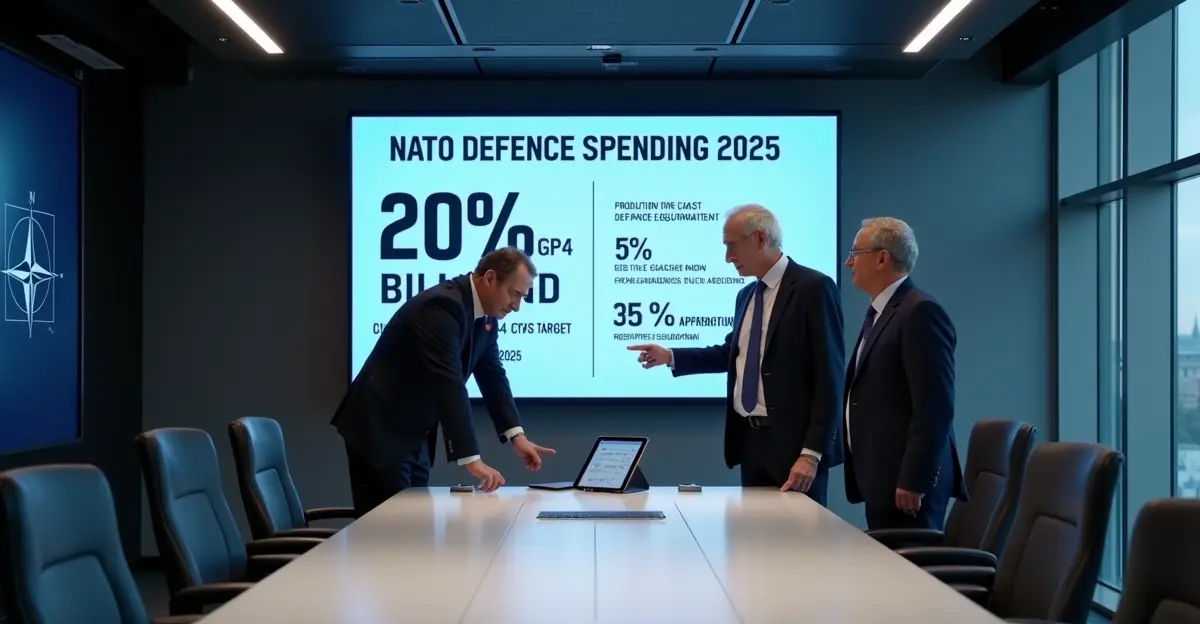
The June 2025 Hague Declaration committed NATO members to invest 5% of GDP on defense and security by 2035—split into 3.5% for core defense and 1.5% for security-related infrastructure. This represents a 150% increase from the current 2% target that many nations only recently achieved. The July 2026 Ankara summit—the 36th NATO summit, hosted by Turkey for the first time since 2004—will serve as the first major checkpoint for national plans to reach this target.
Turkey itself, already exceeding the 2% benchmark, plans to focus investments on layered air defense, long-range missile systems, and unmanned platforms, including the national "Steel Dome" project. Ankara's centralized procurement strategy contrasts sharply with European allies like Spain, who have called the 5% target unreasonable. The Ankara NATO summit 2026 agenda will test whether national commitments represent genuine investment or creative accounting, as analysts warn that reaching the target would require either dismantling European welfare states, massive tax increases, or debt levels that could trigger bond market crises.
Expert Perspectives
"The synchronized nature of this defense buildup is historically unprecedented," says Davide Furceri, lead author of the IMF working paper on macroeconomic impacts. "Past national episodes showed positive multipliers, but when everyone expands simultaneously, the effects may be diluted—especially if monetary policy is not accommodative."
Kristen Taylor of the Atlantic Council's Transatlantic Security Initiative notes: "Norway surpassing the U.S. in defense spending per capita is a watershed moment. It signals that European allies are not just meeting targets but fundamentally rethinking their defense postures. The Ankara summit will reveal whether this momentum is sustainable."
Frequently Asked Questions
What is NATO's new defense spending target?
At the June 2025 Hague Summit, NATO leaders committed to spending 5% of GDP on defense and security by 2035, split into 3.5% for core defense and 1.5% for civil resilience infrastructure.
How much is NATO spending in 2026?
NATO's combined defense spending exceeds $1.5 trillion in 2026, with all 32 member states meeting the 2% of GDP benchmark for the first time in history.
Which NATO country spends the most on defense?
The United States remains the largest absolute spender at over $1 trillion in 2026. By percentage of GDP, Poland leads at 4.48%, followed by Lithuania (4.0%) and Latvia (3.73%). Norway has surpassed the U.S. in defense spending per capita.
How does increased defense spending affect climate goals?
NATO's military carbon footprint has risen nearly 40% since 2021 to 273 MtCO2e. NATO states spend 52 times more on military than climate finance, and the proposed 5% target would push cumulative military emissions to 2,330 MtCO2e by 2030.
What is the significance of the July 2026 Ankara summit?
The 36th NATO summit in Ankara will assess progress on the 5% GDP pledge, evaluate national defense investment plans, and address transatlantic burden-sharing dynamics amid ongoing tensions with Russia and strategic competition with China.
Conclusion: A Defining Moment for Transatlantic Security
The $1.5 trillion defense pivot marks a historic inflection point for NATO. While the alliance has achieved unprecedented spending cohesion, the macroeconomic trade-offs—sovereign debt strain, reduced fiscal space for social and climate programs, and industrial bottlenecks—pose serious challenges. The Ankara summit will be a critical test of whether NATO can sustain this trajectory without undermining the economic stability it seeks to protect. As Secretary General Mark Rutte emphasized in December 2025, the path to 5% requires credible national plans, not just political declarations. The world will be watching Ankara closely.




Follow Discussion