


 Deutsch
 English
 Español
 Français
 Nederlands
 Português


 Share
Share




The global critical minerals landscape is undergoing a seismic shift in 2026 as resource-rich nations across the Global South—from Indonesia and Chile to the Democratic Republic of Congo (DRC) and Zimbabwe—are no longer content to be passive suppliers of lithium, cobalt, nickel, rare earths, and copper. Instead, these countries are aggressively leveraging their geological endowments to demand domestic processing, local beneficiation, and higher revenue shares before granting mining access. This strategic pivot is fundamentally reshaping clean energy supply chains and forcing both Washington and Beijing to compete on infrastructure, technology transfer, and industrial policy terms increasingly set by the resource holders themselves.
The World Economic Forum's Global Risks Report 2026 ranks geoeconomic confrontation as the top global risk, with 18% of surveyed leaders identifying it as the most likely trigger of a global crisis this year. According to S&P Global and LSE analyses, the critical minerals battle has decisively shifted toward producer nations in the Global South, making this the defining resource geopolitics story of the year. As the US-China rivalry intensifies, the balance of power in the clean energy supply chain is being rewritten.
Indonesia's Nickel Downstreaming Model Sets the Template
Indonesia has emerged as the poster child for resource nationalism in critical minerals. The world's largest nickel producer—accounting for 65% of global output—has transformed its economy by banning raw ore exports and mandating domestic processing. Since 2020, this policy has attracted over $30 billion in downstream investment, primarily from Chinese-backed firms, building a sprawling network of smelters and high-pressure acid leach (HPAL) plants. In 2026, Indonesia's nickel production is projected to reach 2.9 million tonnes, up 11.9% from 2025, driven by committed expansions at projects like the Pomalaa HPAL facility targeting 120,000 tonnes per annum of mixed hydroxide precipitate by August 2026.
However, the strategy has faced headwinds. Oversupply has crashed nickel prices, triggering anti-dumping duties from China (20.2%), the EU (10-20%), and the US (50-100%). In response, Indonesia is reintroducing annual RKAB mining approvals from 2026 to tighten oversight. President Prabowo Subianto's administration is also considering production quotas and export tariffs of 10-35% to capture more value. The Indonesia nickel policy has become a template that other resource-rich nations are studying closely.
Chile's Lithium Nationalization Drive
Chile, home to the world's largest lithium reserves, is pursuing a state-led lithium strategy that positions the government as a majority partner in all new projects. The National Lithium Strategy has advanced with the signing of the first Special Lithium Operation Contract (CEOL) between state-owned Enami and Rio Tinto, while the landmark Codelco-SQM joint venture in the Atacama Salt Flat has budgeted $3 billion for direct lithium extraction (DLE) technologies. This partnership aims to move away from traditional evaporation ponds toward cleaner, faster DLE methods, with an environmental impact study expected in June 2026.
Chile's approach reflects a broader trend: producer nations are demanding technology transfer and local value addition. The Chile lithium strategy has attracted global attention, but governance weaknesses persist. Measures rely on presidential decrees rather than legislation, making them vulnerable to political change. Candidates have questioned transparency and market concentration risks, while indigenous consultation and environmental safeguards remain incomplete.
DRC and Zimbabwe: Cobalt and Lithium Leverage
The DRC, which produces over 70% of the world's cobalt, ended an eight-month export ban in October 2025 but replaced it with an annual quota system. For 2026 and 2027, yearly export limits are set at 96,600 metric tons—less than half of the roughly 220,000 tonnes produced globally in 2024. The quotas are allocated on a pro-rata basis based on historical exports. Mining giant Glencore has backed the system, while Chinese miner CMOC Group has opposed it. Since the ban was imposed, cobalt hydroxide prices have more than doubled from their lows, demonstrating the DRC's market power.
Zimbabwe, holding some of Africa's largest lithium deposits, lifted its lithium ore export ban in April 2026 but imposed strict new processing requirements. Miners must now comply with local beneficiation commitments and obtain export permits, balancing the government's desire for industrial transformation with continued revenue from exports. The Zimbabwe lithium export ban underscores how African nations are increasingly acting as strategic players rather than passive suppliers.
The US-China Competition for Global South Partnerships
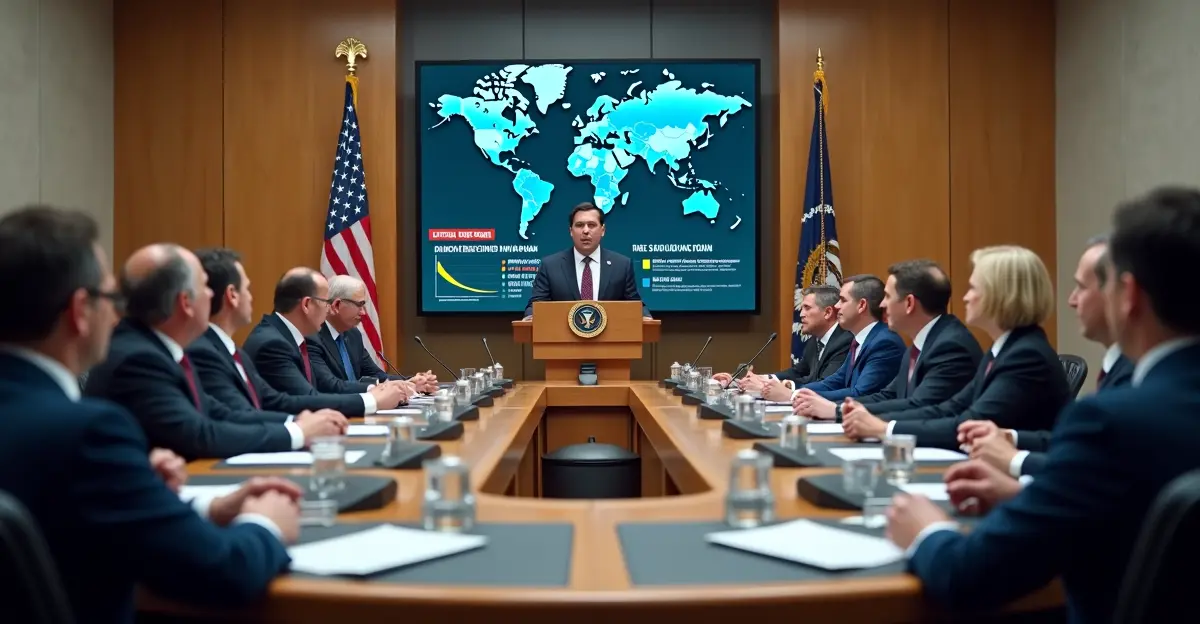
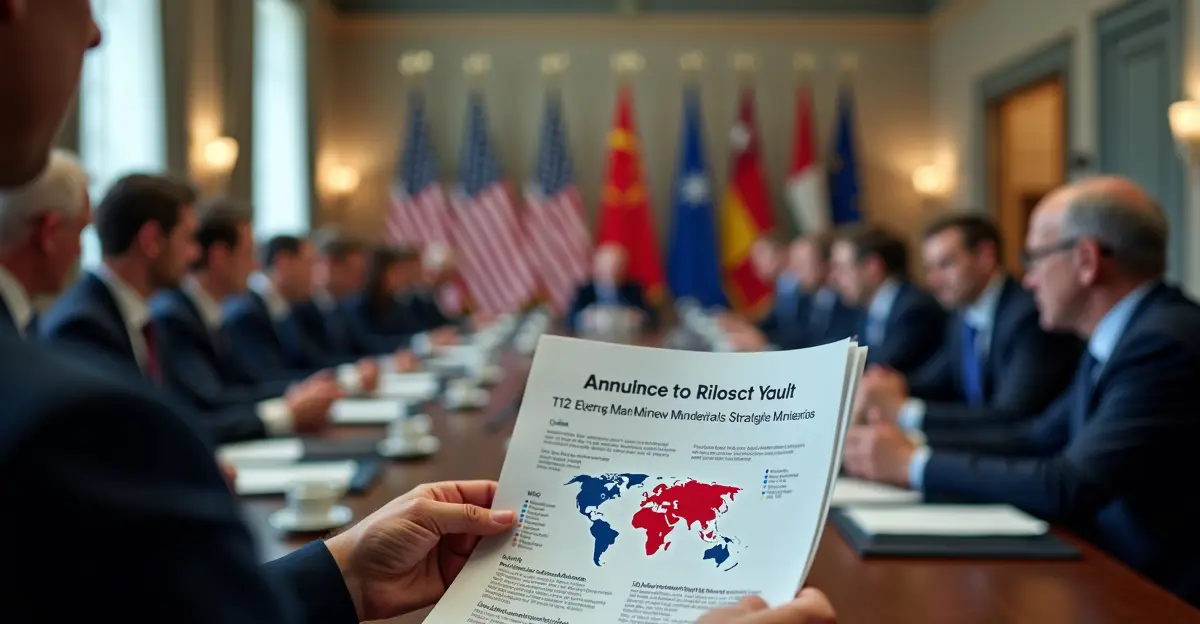
The intensifying rivalry between Washington and Beijing is playing out across the Global South. In February 2026, the United States hosted the 2026 Critical Minerals Ministerial, led by Secretary of State Marco Rubio and Vice President JD Vance, with representatives from 54 countries. The US signed 11 new bilateral critical minerals frameworks with nations including Argentina, Morocco, Peru, and the Philippines. Secretary Rubio announced the creation of FORGE (Forum on Resource Geostrategic Engagement) as the successor to the Minerals Security Partnership, chaired by the Republic of Korea. The US also mobilized over $30 billion in loans and investments for strategic mineral projects, including Project Vault—a $10 billion EXIM initiative to establish a domestic strategic critical minerals reserve.
China, meanwhile, has solidified its dominance through decades of strategic investment. Beijing now controls over half of global critical minerals production, 87% of processing and refining capacity, and nearly 70% of rare earth minerals. Through state-owned enterprises and the Belt and Road Initiative, China has acquired major mining assets across Africa—including Botswana's Khoemacau copper mine, Mali's Goulamina lithium mine, and Tanzania's Ngualla rare earth mine—while investing billions in rail, ports, and power networks. BYD alone secured six African lithium mines. China's 15th Five-Year Plan projects that by 2035, it will supply over 60% of refined lithium and cobalt, around 80% of battery-grade graphite and rare earths, and 70% of battery-grade manganese.
The US-China critical minerals rivalry is increasingly being decided in the Global South, where resource-rich nations are playing both sides to maximize benefits. As one analyst noted, 'The real competition is not about who owns the minerals underground, but who controls processing and refining after extraction.'
Implications for Global Supply Chains
The shift in bargaining power has profound implications. Producer nations are demanding not just higher royalties but entire industrial ecosystems—refineries, battery plants, and technology transfer. This is forcing consuming nations to offer more than cash; they must provide infrastructure, skills development, and long-term industrial partnerships. The critical minerals supply chain risks are multiplying as concentration remains high and geopolitical tensions escalate.
For companies, the new landscape demands 'China-plus-one' strategies—maintaining Chinese operations while expanding to Southeast Asia, India, or Mexico. Firms must navigate export controls, tariffs, ESG expectations, and shifting regulatory frameworks. The EU's Critical Raw Materials Act has selected 60 Strategic Projects but struggles with financing, while the UK's Critical Minerals Strategy (Vision 2035) focuses on midstream processing and recycling.
Expert Perspectives
According to Hany Besada of LSE, 'Resource-rich countries in Africa are increasingly acting as strategic players, diversifying partnerships and leveraging mineral wealth for industrial transformation rather than simple extraction.' The Africa Center for Strategic Studies notes that despite Africa's vast mineral wealth, the continent remains at the bottom of the value chain—a dynamic that producer nations are now determined to change.
However, risks remain. Overinvestment in processing capacity, as seen in Indonesia's nickel sector, can lead to price collapses and trade disputes. Governance gaps in Chile and the DRC create uncertainty for investors. And China's deep integration into Global South mining economies gives it structural advantages that are hard to dislodge.
FAQ
What is resource nationalism in critical minerals?
Resource nationalism refers to policies where mineral-rich countries assert greater state control over their natural resources, including export bans, mandatory domestic processing, royalty increases, and state ownership stakes. In 2026, this trend is accelerating across the Global South.
Which countries are leading the critical minerals leverage shift?
Indonesia (nickel), Chile (lithium), the DRC (cobalt), and Zimbabwe (lithium) are at the forefront. Other notable players include Mexico (lithium nationalization), Namibia, and Guinea.
How is the US responding to China's dominance in critical minerals?
The US is pursuing bilateral partnerships (11 new frameworks signed in 2026), launching FORGE as a successor to the Minerals Security Partnership, and mobilizing $30 billion+ for strategic projects including a $10 billion domestic reserve (Project Vault).
What are the risks for companies operating in this environment?
Companies face export controls, tariffs, contract renegotiations, ESG compliance costs, and supply chain disruptions. The 'China-plus-one' strategy is becoming standard to balance cost efficiency with resilience.
Will the Global South's leverage last?
While producer nations have gained short-term bargaining power, long-term sustainability depends on governance, investment climates, and the pace of technological substitution (e.g., cobalt-free batteries, rare-earth-free magnets).
Conclusion
The great resource rebalancing of 2026 marks a historic inflection point. The Global South is no longer a passive supplier of raw materials but an active shaper of the clean energy transition's industrial geography. Whether this leads to genuine economic transformation or a new cycle of conflict and dependency will depend on the policies adopted by both producer and consumer nations in the years ahead.

Follow Discussion