


 Deutsch
 English
 Español
 Français
 Nederlands
 Português


 Share
Share




The February 2026 U.S.-Israeli strikes on Iran and the subsequent closure of the Strait of Hormuz have triggered the largest oil supply disruption in history, removing nearly 20% of global oil supplies and sending Brent crude surging past $120 per barrel. As of mid-2026, the strait remains effectively closed, with the World Bank and Dallas Federal Reserve documenting the largest oil market shock in real time. This analysis examines the cascading macroeconomic effects—from soaring fertilizer prices threatening global food security to Asian economies facing stagflation—and explores how this crisis is accelerating structural shifts in energy policy, including emergency stockpile strategies, alternative supply routes, and renewed investment in non-fossil energy independence across Europe and Asia.
Context: The Largest Oil Supply Disruption in History
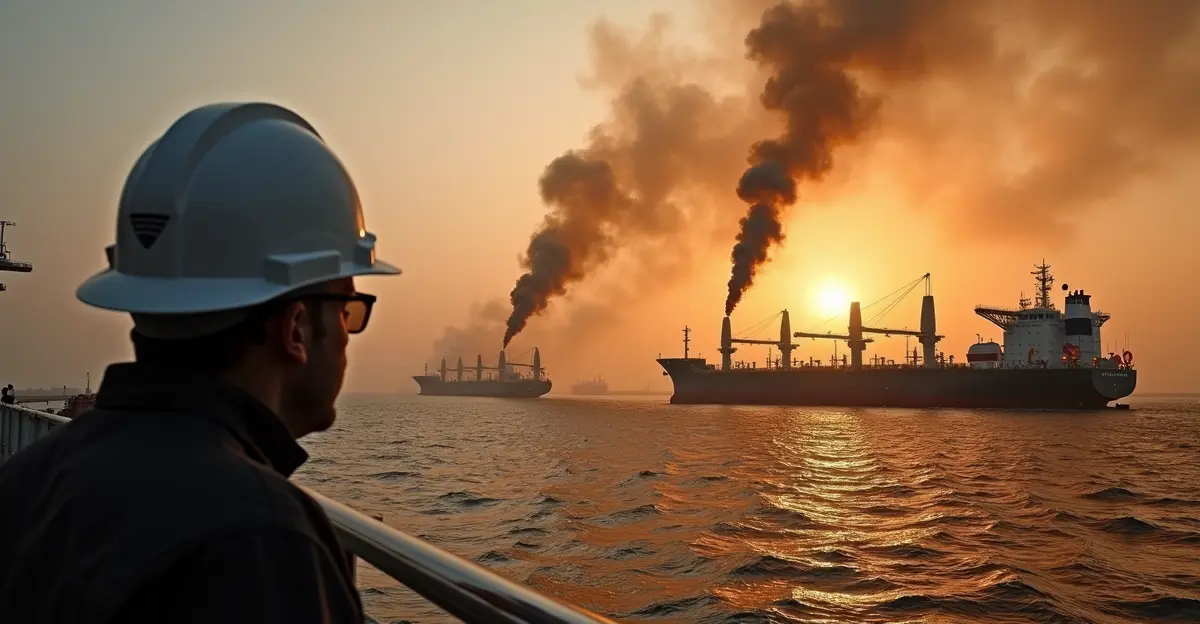
On February 28, 2026, the United States and Israel launched a coordinated air campaign—codenamed "Operation Epic Fury"—against Iranian nuclear and military facilities. In retaliation, Iran declared the Strait of Hormuz closed to all maritime traffic on March 4, 2026. The strait, a 33-kilometer-wide chokepoint between the Persian Gulf and the Gulf of Oman, handles approximately 20 million barrels per day (bpd) of crude oil and petroleum products—roughly 20% of global consumption—as well as about 20% of the world's liquefied natural gas (LNG) supply from Qatar.
According to the Dallas Federal Reserve, the disruption is three to five times larger than previous geopolitical oil shocks, such as the 1973 Yom Kippur War (6% supply loss) or the 1979 Iranian Revolution (4% supply loss). The World Bank's Commodity Markets Outlook for April 2026 reports that global oil supply crashed by 10.1 million bpd in March 2026 alone—the steepest monthly decline ever recorded. Brent crude, which traded at roughly $72 per barrel before the conflict, spiked to an intraday high of $144 per barrel in mid-March and was trading near $109 per barrel as of early April 2026.
The 2026 oil price shock has been compounded by attacks on Qatar's LNG facilities, stranding roughly 20% of global LNG supply. A temporary ceasefire on April 8 collapsed within days as Iran began charging tolls exceeding $1 million per vessel to transit the strait, effectively maintaining the blockade.
Macroeconomic Fallout: Stagflation Fears and Food Security
Soaring Energy Prices and Inflation
The Dallas Fed's model estimates that the closure would raise WTI oil prices to around $98 per barrel and lower global real GDP growth by an annualized 2.9 percentage points in Q2 2026. If the strait reopens after one quarter, oil prices could drop to $68 per barrel and growth recover 2.2 percentage points, though GDP would remain 0.2% below pre-closure levels by year-end. Longer closures drive oil prices as high as $132 per barrel with prolonged negative growth impacts.
Goldman Sachs revised its full-year 2026 Brent average forecast to $85 per barrel, with tail-risk scenarios of $135–150 per barrel if the strait remains closed into mid-May. Cumulative lost barrels could exceed 800 million, according to industry estimates. The International Energy Agency (IEA) coordinated a record release of 400 million barrels from strategic petroleum reserves across 30 nations, but this has only partially offset the supply deficit.
Fertilizer Prices and Global Food Security
One of the most alarming secondary effects is the surge in natural gas and fertilizer prices. Natural gas is the primary feedstock for ammonia-based nitrogen fertilizers, and the disruption of LNG supplies from Qatar—combined with higher energy costs for European and Asian producers—has sent fertilizer prices soaring by over 60% since February 2026. The global food security crisis is deepening as farmers in developing nations, particularly in Sub-Saharan Africa and South Asia, face fertilizer costs that are 2–3 times higher than pre-crisis levels.
The World Bank warns that this could trigger a food price crisis reminiscent of 2007–2008, with the added complication that many nations have already depleted fiscal buffers due to the COVID-19 pandemic and the 2022 Russia-Ukraine war. The UN Food and Agriculture Organization (FAO) has issued an alert that 45 countries are at risk of food insecurity due to the combined effects of high energy and fertilizer costs.
Asian Economies Face Stagflation
Approximately 80% of Gulf oil is shipped to Asia, making the region the most exposed to the Hormuz closure. Japan, South Korea, India, and China—which together account for over 60% of global oil imports from the Persian Gulf—are facing severe economic headwinds. India's wholesale price index surged to 9.2% in March 2026, while Japan's import-dependent economy slipped into a technical recession in Q1 2026. South Korea's export-driven growth model is under strain as container shipping costs have tripled due to rerouting around the Cape of Good Hope.
The Asian stagflation risk 2026 is prompting central banks to walk a tightrope between containing inflation and supporting growth. The Reserve Bank of India has raised interest rates by 150 basis points since March, while the Bank of Japan has intervened in currency markets to stabilize the yen, which fell to a 35-year low against the U.S. dollar.
Strategic Responses: Stockpiles, Alternative Routes, and Energy Transition
Emergency Stockpile Releases and Demand Destruction
The IEA's coordinated release of 400 million barrels from strategic reserves—the largest in history—has provided temporary relief, but the agency acknowledges that reserves cannot sustain a prolonged closure. The U.S. Strategic Petroleum Reserve (SPR) has been drawn down to its lowest level since 1983, raising concerns about future emergency preparedness. Demand destruction is already emerging, with global oil consumption falling 0.8 million bpd in March 2026, according to the World Bank. Higher prices are curbing discretionary driving and industrial activity, particularly in emerging markets.
Alternative Supply Routes and Infrastructure
The crisis has accelerated investment in alternative oil transit routes. The Abu Dhabi Crude Oil Pipeline, which bypasses the Strait of Hormuz with a capacity of 1.5 million bpd, is operating at full capacity. Saudi Arabia and the UAE are fast-tracking expansions of their east-west pipelines. However, these alternatives can replace only a fraction of Hormuz throughput. The energy infrastructure investment 2026 boom is also focused on floating storage and regasification units (FSRUs) for LNG, as European nations scramble to secure non-Russian gas supplies.
Renewed Push for Energy Independence
The crisis is providing a powerful impetus for structural shifts in energy policy. The European Union has announced a "Hormuz Response Package" that includes €50 billion in accelerated funding for renewable energy, energy efficiency, and grid interconnection projects. Germany has brought forward its target for 100% renewable electricity from 2035 to 2030, while France is doubling down on nuclear power. Japan and South Korea are reviving plans for small modular reactors (SMRs) and expanding offshore wind capacity.
In the United States, the Biden administration has invoked the Defense Production Act to boost domestic critical mineral processing for batteries and solar panels, aiming to reduce reliance on imported energy. The crisis has also reignited debate about electric vehicle (EV) adoption, with several countries introducing new subsidies and accelerating internal combustion engine phase-out targets.
Expert Perspectives
"This is the most severe energy supply disruption since the founding of the modern oil market," said Dr. Fatih Birol, Executive Director of the IEA, in a March 2026 press conference. "The scale of the shock is unprecedented, and the global economy is facing a stress test that will reshape energy policy for decades."
Economist and Nobel laureate Joseph Stiglitz warned that the crisis could trigger a global recession if the strait remains closed through Q3 2026. "We are seeing the convergence of energy insecurity, food price inflation, and financial instability. The policy response must be swift and coordinated, or we risk a repeat of the 1970s stagflation—but on a larger scale."
Frequently Asked Questions
What caused the Strait of Hormuz closure in 2026?
The closure was triggered by U.S.-Israeli air strikes on Iran on February 28, 2026 (Operation Epic Fury), followed by Iran's declaration of a maritime blockade on March 4, 2026, in retaliation.
How much oil supply has been lost?
Approximately 20 million barrels per day (20% of global consumption) has been removed from the market, making it the largest oil supply disruption in history—three to five times larger than the 1973 oil shock.
What is the impact on oil prices?
Brent crude surged from ~$72 per barrel pre-conflict to a peak above $144 per barrel in mid-March 2026. As of early April, Brent was trading near $109 per barrel, with forecasts ranging from $68 to $132 per barrel depending on the duration of the closure.
How is this affecting global food security?
Natural gas prices have surged, driving up fertilizer costs by over 60%. This threatens crop yields in developing nations, with the FAO warning that 45 countries are at risk of food insecurity.
What are the long-term implications for energy policy?
The crisis is accelerating investment in renewable energy, nuclear power, alternative transit routes, and strategic stockpile management. The EU, Japan, South Korea, and the U.S. have all announced major new energy independence initiatives.
Conclusion and Future Outlook
The Strait of Hormuz closure of 2026 is not merely a temporary disruption—it is a watershed moment for global energy security. Even if the strait reopens in the coming months, the economic damage will be felt for years. The crisis has exposed the fragility of the global energy system and the acute vulnerability of economies dependent on a single chokepoint. The future of global energy security will likely involve greater diversification of supply routes, accelerated deployment of renewable energy, and a renewed emphasis on strategic reserves and demand-side management. As the world grapples with the fallout, one thing is clear: the era of cheap, secure oil from the Persian Gulf is over.
Follow Discussion