


 Deutsch
 English
 Español
 Français
 Nederlands
 Português


 Share
Share




In 2026, European NATO members are undertaking their largest military buildup since the Cold War, agreeing to a historic defense spending benchmark of at least 3.5% of GDP and pushing collective expenditure toward €800 billion annually. This unprecedented ramp-up, driven by the war in Ukraine, Russia's persistent threat, and deepening uncertainty about U.S. security guarantees under the second Trump administration, marks a defining moment for transatlantic security. The strategic implications are profound: Europe is racing to fill a deterrence gap as Washington plans troop reductions, while the upcoming NATO summit in Ankara will test whether the alliance can sustain unity amid growing friction.
Context: A Historic Shift in European Defense
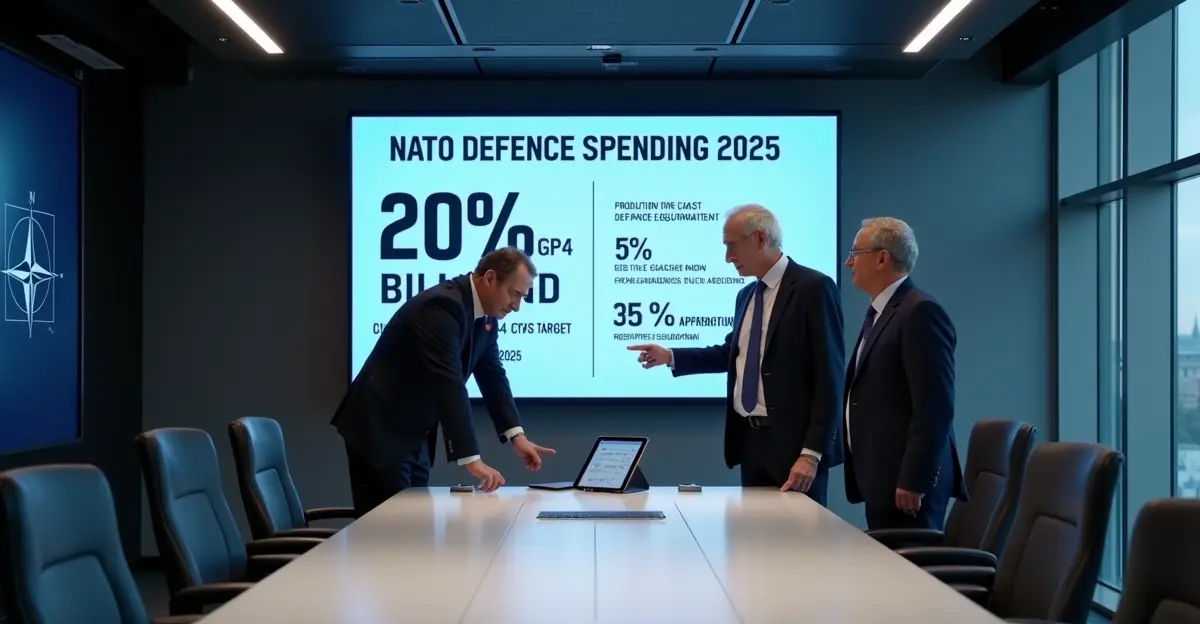
At the June 2025 NATO Summit in The Hague, all 32 member states committed to a two-tiered defense investment formula: at least 3.5% of GDP for core military requirements and NATO Capability Targets, plus up to 1.5% for broader security-related investments such as critical infrastructure protection, civil preparedness, and defense industrial base strengthening. The full target of 5% of GDP is to be achieved by 2035, with a review in 2029. This commitment represents the most significant peacetime military buildup in European history, according to defense analysts. The NATO 2025 summit decisions set the stage for the current acceleration.
European defense budgets surged nearly 20% in real terms in 2025 compared to 2024, the largest annual increase since 1953, according to NATO data. Combined European and Canadian defense spending exceeded USD 571 billion in 2025, up from just 1.4% of combined GDP in 2014. The WEF Global Risks Report 2026 ranks geoeconomic confrontation and interstate conflict as the top short-term risks, underscoring the urgency behind this rearmament.
The €800 Billion Target and National Contributions
European defense expenditure is projected to approach €800 billion annually by the end of the decade. Germany leads with a €108.2 billion defense budget for 2026 — a 25% year-on-year increase — funding major procurements including Leopard 2A8 tanks, Boxer armored vehicles, and new air-defense systems. Poland allocates 4.5% of GDP, the highest percentage among NATO members. The Baltic states, Romania, Finland, and Sweden are also early borrowers under the EU's SAFE program, which provides up to €150 billion in EU-backed loans for joint defense procurement.
The ReArm Europe initiative, launched by the European Commission in March 2025, mobilizes up to €800 billion over four years. It includes the SAFE mechanism and activation of the 'national escape clause,' allowing member states to exceed normal deficit limits for defense spending. Germany's historic debt brake reform, exempting defense spending above 1% of GDP from constitutional constraints, was a key enabler, with Berlin now targeting 3.5% of GDP on defense by 2027, up from 1.6%.
Drivers: Ukraine, Russia, and U.S. Uncertainty
The primary catalyst for Europe's rearmament is Russia's full-scale invasion of Ukraine, which shattered decades of relative peace on the continent. However, the acceleration in 2025-2026 is also fueled by deepening doubts about the reliability of U.S. security guarantees. The second Trump administration has signaled plans for troop reductions in Europe and has repeatedly questioned the value of NATO, prompting European leaders to prepare for a scenario where Washington's commitment is no longer guaranteed. The transatlantic security guarantee crisis has forced Europe to confront its dependence on American military power.
The political catalyst for the ReArm Europe plan was the February 2025 Oval Office confrontation between President Trump and Ukrainian President Zelensky, which highlighted the fragility of U.S. support for European security. Since then, European leaders have accelerated efforts to build a more autonomous defense capability, while still working within the NATO framework.
Industrial and Economic Implications
The rearmament is reshaping Europe's defense industrial base. European defense contractors are booming: Rheinmetall shares rose 154% and Hanwha Aerospace surged 193% in 2025. However, the buildup faces critical bottlenecks, including fragmentation across more than 150 weapon systems, supply chain vulnerabilities, and a severe talent crisis with 25% of defense engineers nearing retirement. The European defense industrial bottlenecks threaten to slow the pace of rearmament.
Fiscally, the spending surge creates acute tensions. EU countries like France (114% debt-to-GDP) and Italy (135%) face conflicts between NATO demands and EU fiscal rules. Solutions being debated include joint Defense Bonds and off-balance-sheet Special Purpose Vehicles. SIPRI data confirms global military spending hit a record $2.89 trillion in 2025, with European spending surging 14% to $864 billion.
The Ankara Summit: A Test of Alliance Unity
The upcoming NATO summit in Ankara, scheduled for July 7, 2026, will be a critical test for the alliance. The NATO Summit Defence Industry Forum (NSDIF26) will focus on transatlantic defense production, investment, and innovation. Key issues on the agenda include burden-sharing, the future of U.S. troop deployments in Europe, and how to sustain unity amid growing transatlantic friction. The NATO Ankara summit 2026 agenda will likely dominate headlines as allies seek to reconcile differing visions for the alliance's future.
European leaders are pushing for greater strategic autonomy, while the U.S. administration demands that allies take more responsibility for their own defense. The summit's outcome will signal whether NATO can adapt to the new geopolitical reality or whether transatlantic divisions will deepen.
Expert Perspectives
Defense analysts describe the current buildup as a multi-decade structural shift rather than a temporary spike. "This is the most significant peacetime military buildup in European history," said a senior fellow at the European Council on Foreign Relations. "Europe is finally taking its security seriously, but the question is whether it can sustain the political will and fiscal resources needed."
Others warn that the rearmament could exacerbate tensions with Russia and trigger a new arms race. "The risk of escalation is real," noted a former NATO official. "Europe must balance deterrence with diplomacy."
Frequently Asked Questions
What is the new NATO defense spending target?
NATO allies committed to a minimum of 3.5% of GDP for core defense spending, with a broader target of 5% of GDP by 2035, including investments in resilience, infrastructure, and the defense industrial base.
Why is Europe increasing defense spending now?
The increase is driven by Russia's war in Ukraine, the persistent threat from Moscow, and growing uncertainty about U.S. security guarantees under the second Trump administration, which has signaled possible troop reductions in Europe.
How much will Europe spend on defense?
Combined European defense budgets are projected to approach €800 billion annually by the end of the decade, with the ReArm Europe initiative mobilizing up to €800 billion over four years.
What are the main challenges to this rearmament?
Key challenges include fragmentation of Europe's defense industrial base, supply chain vulnerabilities, a talent crisis in the defense sector, and fiscal tensions as countries balance NATO demands with EU budget rules.
What is the significance of the 2026 NATO summit in Ankara?
The Ankara summit will test alliance unity amid transatlantic friction, with key issues including burden-sharing, U.S. troop deployments, and Europe's push for greater strategic autonomy. It will also host the NATO Defence Industry Forum.
Conclusion and Future Outlook
Europe's great rearmament represents a historic shift in the continent's security posture. With defense budgets soaring, new procurement programs underway, and a renewed commitment to collective defense, Europe is building a military capability not seen since the Cold War. However, the success of this endeavor depends on overcoming industrial bottlenecks, managing fiscal pressures, and maintaining transatlantic unity. The Ankara summit will be a pivotal moment, determining whether NATO can adapt to the new geopolitical landscape or whether the alliance will face increasing internal divisions. As the future of European defense autonomy unfolds, the world will be watching closely.

Follow Discussion