


 Deutsch
 English
 Español
 Français
 Nederlands
 Português


 Share
Share




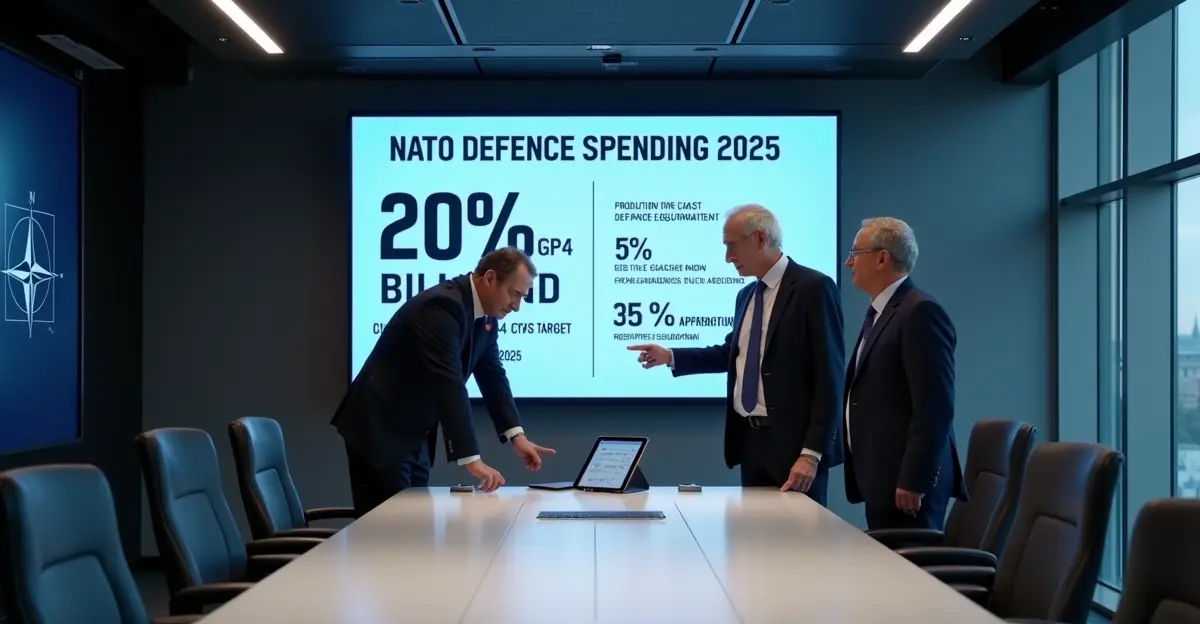
In 2026, NATO's combined defense spending surpassed $1.5 trillion for the first time, marking a historic milestone in the alliance's 77-year history. All 32 member states have met the 2% of GDP benchmark for the first time since the Cold War, driven by Russia's war on Ukraine and a continent-wide industrial mobilization. European allies and Canada increased spending by 20% in real terms in 2025 alone—the fastest annual growth since 1953—propelling a rearmament effort that touches aerospace, munitions, cybersecurity, and energy infrastructure. This article examines the macroeconomic consequences, industrial bottlenecks, and strategic choices facing European capitals as they balance rearmament with fiscal discipline and social spending.
Context: From 2% to 5%—A New Benchmark
At the June 2025 Hague Summit, NATO leaders adopted The Hague Investment Plan, committing to a new target of 5% of GDP on defense by 2035. The target is split into two categories: at least 3.5% of GDP for core military capabilities (forces, equipment, readiness) and up to 1.5% for broader security-related investments, including cybersecurity, infrastructure, and energy resilience. This represents a dramatic escalation from the 2% target set at the 2014 Wales Summit, which itself was considered ambitious at the time. The 2025 NATO summit in The Hague marked the first hosted by the Netherlands and the first for Secretary General Mark Rutte, a former Dutch prime minister.
Poland leads the alliance with 4.48% of GDP on defense, followed by Lithuania (4.0%) and Latvia (3.73%). The United States remains the largest absolute spender at $954 billion in 2025, with over $1 trillion approved for 2026. However, the U.S. share of total NATO expenditure has dropped from 64% to 59% as European allies ramp up their contributions. Norway has surpassed the U.S. in defense spending per capita for the first time, a symbolic shift in transatlantic burden-sharing.
Industrial Mobilization: Bottlenecks and Breakthroughs
The spending surge has triggered a continent-wide industrial mobilization, but supply chains are struggling to keep pace. NATO's Defense Production Action Plan, updated in February 2025, aims to address critical gaps in munitions, artillery shells, and advanced weaponry. The alliance's target of producing 267,000 artillery shells per month by 2026 would only achieve parity with Russia's estimated output of 250,000 rounds monthly—insufficient for credible deterrence, according to analysts. European defense companies are ramping up production lines, but labor shortages, raw material constraints, and fragmented national procurement systems remain significant obstacles.
Aerospace and Cyber: New Frontiers
The European Defence Fund (EDF) 2026 is channeling billions into collaborative research and development across AI, cybersecurity, space technologies, and advanced materials. The EU's European Defence Technological and Industrial Base (EDTIB) strategy aims to reduce reliance on non-European suppliers, particularly in critical areas like microelectronics and propulsion systems. Cybersecurity spending has become a priority, with NATO establishing the Baltic Sentry mission to protect undersea infrastructure and Eastern Sentry to strengthen deterrence along the eastern flank.
Munitions and Conventional Forces
Artillery shell production remains the most visible bottleneck. European manufacturers have tripled output since 2022, but demand from Ukraine and NATO stockpile replenishment continues to outstrip supply. The NATO Support and Procurement Agency (NSPA) has placed multi-year contracts worth billions of euros, but delivery timelines stretch into 2027 and beyond. Germany, which doubled its defense spending to 2.39% of GDP, is investing €120 billion annually to meet the 5% target, with significant allocations for Leopard 2 tank production and IRIS-T air defense systems.
Macroeconomic Consequences: Crowding Out and Debt Pressures
The rearmament carries significant macroeconomic implications. According to the IMF's April 2026 World Economic Outlook, sustained defense investment at current levels could crowd out social and climate spending across European economies. NATO states now spend 52 times more on military than on climate finance, while the alliance's carbon footprint has risen 40% since 2021. The OECD's 2026 Economic Outlook warns that higher defense spending could exacerbate sovereign debt pressures, particularly in high-debt economies like Italy (which needs €105 billion annually to meet the 5% target), Germany (€120 billion), and France (€75 billion).
The macroeconomic effects of defense spending are complex. Defense investments can stimulate domestic industries, create high-skilled jobs, and drive innovation in dual-use technologies. However, the OECD notes that sustained increases without corresponding tax reforms or spending cuts risk triggering bond market crises, especially in the eurozone's more indebted members. The European Commission has proposed a new EU-wide defense fund to pool resources and reduce duplication, but negotiations remain contentious.
Strategic Choices: Balancing Guns and Butter
European capitals face a trilemma: maintain social welfare systems, meet NATO's 5% target, and preserve fiscal credibility. Analysts warn that achieving the 5% goal by 2035 could require dismantling parts of the welfare state or accepting significantly higher taxes. Poland, the Baltic states, and Nordic countries have shown that high defense spending is compatible with strong social outcomes, but their starting positions—low debt, high growth, and strong public support—are not universal.
Italy and Spain, which have historically spent below 1.5% of GDP on defense, face the steepest adjustment. Spain was granted a temporary exemption at the Hague Summit, capping its target at 2.1%, but pressure is mounting for Madrid to accelerate its timeline. The July 2026 Ankara Summit will test whether members can deliver credible national plans toward the 5% target, with Secretary General Rutte warning that "the era of free-riding is over. Every ally must contribute its fair share."
Expert Perspectives
Defense economists are divided on the sustainability of the current trajectory. Dr. Sophia Müller of the Kiel Institute for the World Economy argues that "the 5% target is politically symbolic rather than militarily necessary. The real challenge is not the amount spent, but how effectively it is allocated across capabilities and allied nations." Conversely, General (Ret.) James Hartley, former NATO Supreme Allied Commander Transformation, contends that "the threat from Russia requires nothing less than a full-scale industrial mobilization. We are in a race to rebuild deterrence, and the cost of underinvestment far exceeds the cost of overinvestment."
The Atlantic Council's NATO Defense Spending Tracker, updated in April 2026, notes that European allies have made genuine progress but warns that sustaining 20% annual real-term growth is unlikely. The tracker highlights that the NATO defense spending tracker shows per-capita spending in Europe has doubled since 2014, but equipment modernization remains uneven.
FAQ
What is NATO's new defense spending target?
At the June 2025 Hague Summit, NATO members committed to spending 5% of GDP on defense by 2035, with at least 3.5% for core military capabilities and up to 1.5% for broader security investments.
How much did NATO spend on defense in 2026?
NATO's combined defense spending exceeded $1.5 trillion in 2026, with all 32 members meeting the 2% GDP benchmark for the first time.
Which NATO countries spend the most on defense as a share of GDP?
Poland leads at 4.48% of GDP, followed by Lithuania (4.0%) and Latvia (3.73%). The United States remains the largest absolute spender at over $1 trillion.
What are the main industrial bottlenecks in NATO's rearmament?
Key bottlenecks include artillery shell production, labor shortages, raw material constraints, and fragmented national procurement systems. NATO aims to produce 267,000 shells monthly by 2026.
How does increased defense spending affect social programs?
Higher defense spending risks crowding out social and climate investments. NATO states spend 52 times more on military than climate finance, and the alliance's carbon footprint has risen 40% since 2021.
Conclusion: The Ankara Test
The July 2026 Ankara Summit will be a critical moment for NATO's defense transformation. Allies are expected to present national roadmaps toward the 5% target, and failure to deliver credible plans could undermine the alliance's credibility. The rearmament represents the most significant shift in European defense posture since the Cold War, but its success depends on industrial capacity, fiscal sustainability, and political will. As Secretary General Rutte has stated, "We have the money. Now we need the capabilities, the coordination, and the courage to see this through."



Follow Discussion