


 Deutsch
 English
 Español
 Français
 Nederlands
 Português


 Share
Share




In a historic shift that marks the dawn of a new European rearmament era, NATO has formally adopted a 3.5% of GDP defense spending benchmark, driving European military expenditure toward an estimated €800 billion annually by the end of the decade. This structural shift — fueled by Russia's war in Ukraine and fears of a broader European conflict — is reshaping defense supply chains, boosting European industrial champions like Rheinmetall and Hanwha Aerospace, and forcing hard trade-offs between fiscal consolidation and military readiness across EU member states.
The Hague Summit and the 3.5% Target
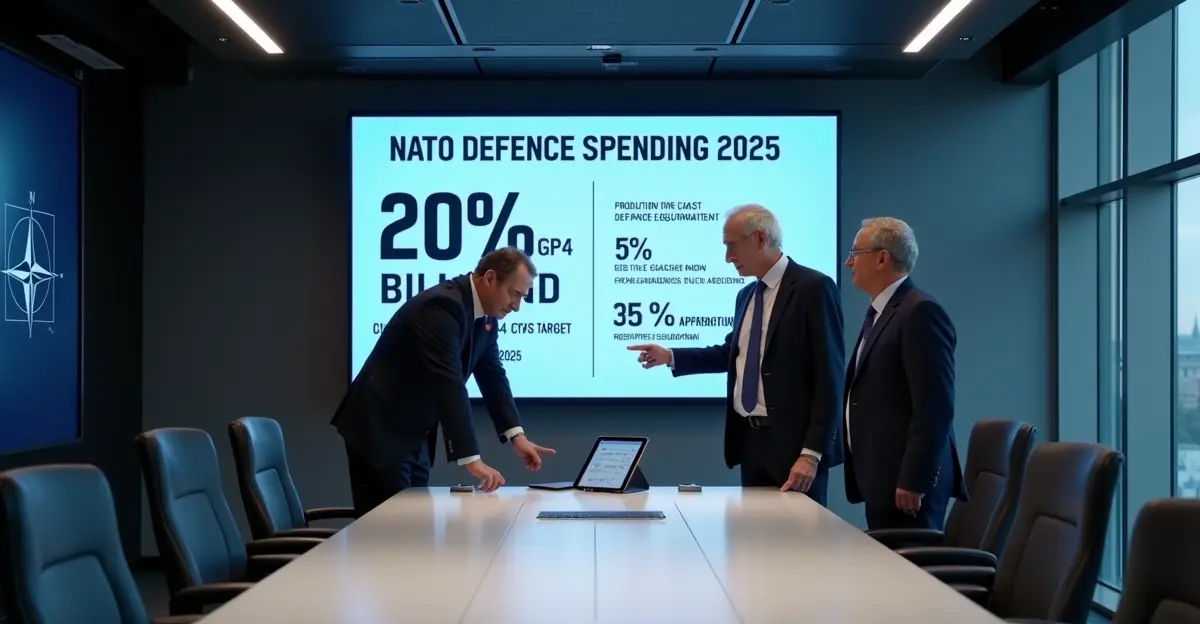
At the June 2025 NATO Summit in The Hague, all 32 member states committed to a two-tiered spending formula: at least 3.5% of GDP for core military expenditures — personnel, operations, equipment, and maintenance — and up to 1.5% for security-related spending including cyberdefense, critical infrastructure, and defense innovation. The full 5% target must be met by 2035, with national roadmaps due by mid-2026 and a collective progress review scheduled for 2029. This represents a dramatic escalation from the previous 2% guideline that many allies struggled to meet for years.
According to the Atlantic Council's NATO Defense Spending Tracker, European allies and Canada increased defense spending by 20% in real terms in 2025 alone — the fastest growth since 1953. For the first time, all 32 NATO members simultaneously met the 2% threshold, up from just three in 2014. Poland leads at 4.48% of GDP, followed by Lithuania at 4.0% and Latvia at 3.73%. The NATO burden-sharing debate has shifted from whether allies will pay more to how they will manage the fiscal consequences.
SIPRI 2026 Data: Global Military Spending Hits Record $2.89 Trillion
The Stockholm International Peace Research Institute (SIPRI) confirmed in April 2026 that global military spending reached a record $2.89 trillion in 2025, marking the 11th consecutive annual increase. European spending surged 14% to $864 billion, the primary driver of global growth. Germany's military budget rose 24% to $114 billion, reaching 2.3% of GDP for the first time since 1990. Spain's spending jumped 50% to $40.2 billion, while Norway, Denmark, and Belgium posted increases of 49%, 46%, and 59% respectively.
The United States remained the world's top spender at $954 billion, though spending declined 7.5% year-on-year due to the absence of new Ukraine aid packages. However, congressional spending approved for 2026 is expected to push U.S. defense outlays above $1 trillion, potentially reaching $1.5 trillion by 2027 under the Trump administration's budget proposal. China increased spending 7.4% to an estimated $336 billion, while Asia and Oceania saw their largest regional year-on-year increase since 2009, growing 8.1% to $681 billion. Russia spent $190 billion (up 5.9%) and Ukraine $84.1 billion (up 20%).
"This is not a temporary spike but a multi-decade structural shift," said a senior SIPRI researcher. "The combination of NATO's new targets, the war in Ukraine, and broader geopolitical competition means defense spending will remain elevated for the foreseeable future."
European Industrial Champions Surge
The rearmament boom has supercharged European defense contractors. Rheinmetall, the German tank and ammunition manufacturer, saw its shares climb 154% in 2025, with a record order backlog driven by demand for Panther KF51 tanks, air defense systems, and artillery shells. Hanwha Aerospace, the South Korean defense giant that has expanded aggressively into European markets, surged 193%. Mitsubishi Heavy Industries rose 72.7% as Asian allies also ramped up spending.
The EU's ReArm Europe Plan — now branded Readiness 2030 — aims to mobilize €800 billion through increased fiscal flexibility, a €150 billion loan instrument (SAFE) for missile defense, drones, and cybersecurity, and expanded European Investment Bank lending. In a historic shift, Germany awarded €540 million in drone contracts not to legacy primes like Lockheed Martin but to European startups Helsing and Stark Defence — software-first companies that epitomize the defense technology startup ecosystem transformation. Defense-tech venture capital funding in Europe surged 13x from 2022 to 2025, reaching €2.6 billion.
Key Defense Contractors Benefiting from European Rearmament
- Rheinmetall (Germany): €8.83B revenue — Panther KF51 tanks, air defense, artillery
- BAE Systems (UK): €26.3B revenue — Eurofighter Typhoon, F-35, combat vehicles
- Thales (France): €20.58B revenue — aerospace, sensors, underwater warfare
- Leonardo (Italy): €20.9B revenue — helicopters, GCAP fighter program, UAVs
- Saab (Sweden): $6B revenue — Gripen jets, submarines
- Hanwha Aerospace (South Korea): expanding European presence with K9 howitzers and armored vehicles
Fiscal Trade-Offs: Debt, Deficits, and Defense
The collision between Europe's need to rearm and its reinstated fiscal rules is creating acute tension. With the Stability and Growth Pact back in force, countries like France (114% debt-to-GDP), Italy (135%), and Belgium (103%) face a direct conflict between NATO's rising defense spending demands and Maastricht deficit and debt caps. The EU faces an estimated €75–€100 billion annual defense investment gap.
Three solutions are being debated: joint "Defense Bonds" (Eurobonds for security) led by France but opposed by Germany and the Netherlands; off-balance-sheet Special Purpose Vehicles that could exempt defense investments from deficit calculations — a "golden rule" gaining traction; and expanding the European Investment Bank's mandate to fund defense. Analysts predict a modified compromise by mid-2026 that acknowledges security as a prerequisite for fiscal stability. The EU fiscal rules reform debate is now inextricably linked to defense spending trajectories.
Implications for Global Security Architecture
The rearmament wave is reshaping transatlantic burden-sharing. For the first time in 2025, Norway surpassed the United States in defense spending per capita. European allies are increasingly investing in sovereign capabilities — from satellite technology to naval shipbuilding — reducing reliance on U.S. systems. However, the Hague Summit declaration also stressed expanding transatlantic defense industrial cooperation and eliminating trade barriers, suggesting NATO seeks integration rather than decoupling.
The shift has profound implications for global finance. Sovereign debt markets are pricing in higher defense spending as a structural factor, with yields on European government bonds under upward pressure. Defense stocks have become a new defensive sector for investors, with the MSCI Europe Aerospace & Defense index outperforming broader markets by a wide margin. The defense industry investment outlook remains bullish as order backlogs stretch years into the future.
Expert Perspectives
"We are witnessing the most significant peacetime military buildup in European history," said Dr. Sophia Klein, defense economist at the German Institute for International and Security Affairs. "The 3.5% target is not just a number — it represents a fundamental reorientation of European states toward security as the primary public good."
Mark Rutte, NATO Secretary-General, stated at the Hague Summit: "We must shift to a wartime mindset and turbocharge our defense production and defense spending. This is a marathon, not a sprint."
Frequently Asked Questions
What is NATO's new 3.5% GDP defense spending target?
Adopted at the June 2025 Hague Summit, NATO allies committed to spending at least 3.5% of GDP on core military expenditures by 2035, with an additional 1.5% for security-related spending, for a total of 5% of GDP.
How much is Europe spending on defense in 2026?
European military expenditure is estimated at approximately €800 billion annually, driven by NATO's new targets and the EU's Readiness 2030 plan. SIPRI reported European spending of $864 billion in 2025.
Which countries are leading NATO defense spending?
Poland leads at 4.48% of GDP, followed by Lithuania (4.0%), Latvia (3.73%), and Estonia. The U.S. remains the largest spender in absolute terms at over $1 trillion approved for 2026.
How does rearmament affect EU fiscal rules?
Countries face tension between NATO spending demands and Maastricht deficit/debt limits. Proposed solutions include joint Defense Bonds, a "golden rule" exempting defense investments, and expanded EIB lending.
Which defense companies benefit most?
Rheinmetall (Germany), BAE Systems (UK), Thales (France), Leonardo (Italy), Saab (Sweden), and Hanwha Aerospace (South Korea) are major beneficiaries, with defense stocks surging in 2025-2026.
Conclusion: A Multi-Decade Structural Shift
The 3.5% NATO target and Europe's rearmament represent a generational transformation of global defense economics. With SIPRI data confirming record spending and order backlogs extending for years, the defense industrial base is scaling up for a prolonged period of elevated investment. The key question remains whether Europe can balance fiscal discipline with military readiness — and whether the transatlantic alliance will emerge stronger or more fragmented as a result. The 2029 NATO progress review will be a critical milestone in assessing whether the Hague commitments translate into real capability gains.



Follow Discussion