


 Deutsch
 English
 Español
 Français
 Nederlands
 Português


 Share
Share




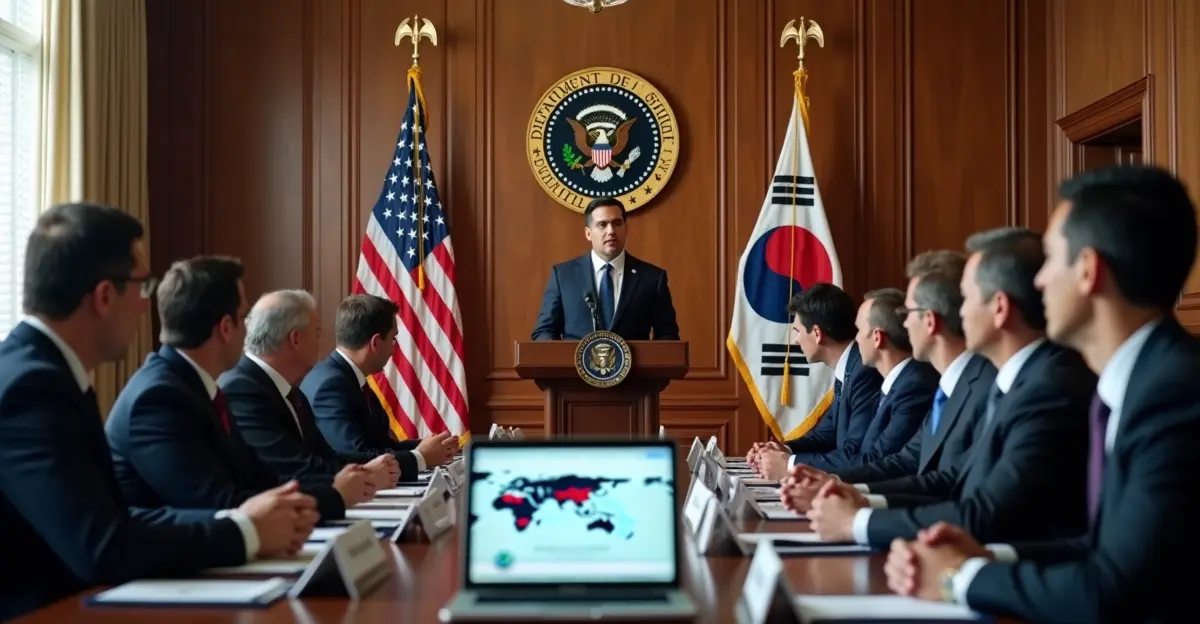
In February 2026, the United States launched the Forum on Resource Geostrategic Engagement (FORGE) at a State Department Critical Minerals Ministerial hosted by Secretary of State Marco Rubio and Vice President JD Vance, convening representatives from 54 nations. The initiative replaces the Biden-era Minerals Security Partnership (MSP) and mobilizes over $30 billion in financing, including a $10 billion Strategic Critical Minerals Reserve called Project Vault managed by the Export-Import Bank. The central question: can FORGE meaningfully challenge China's stranglehold on rare earth processing, where Beijing controls over 90% of global refining capacity?
What Is FORGE and Why Does It Matter?
FORGE — the Forum on Resource Geostrategic Engagement — is a plurilateral coalition designed to create a preferential trade-and-investment zone for critical minerals. Chaired by the Republic of Korea through June 2026, it aims to coordinate price floors, enforce trade rules through adjustable tariffs, and link bilateral agreements into a unified system. The initiative reflects a shift from 'America First' to 'America First not American alone,' as the Trump administration recognized that supply chain security requires broad international coordination. The Minerals Security Partnership replacement marks a significant escalation in Western efforts to counter Chinese dominance.
At the February 4 ministerial, the U.S. signed 11 new bilateral critical minerals framework agreements in a single day, bringing the total to 21 deals in five months. Partner nations include Argentina, Morocco, the Philippines, the United Arab Emirates, the United Kingdom, Australia (with an $8.5 billion deal), and Ukraine. These frameworks cover joint investment, technology transfer, and coordinated export policies.
China's Stranglehold: The Scale of the Challenge
China's dominance in rare earths is staggering. According to Mining Technology, China accounted for 69.2% of global rare earth output in 2025 and processes nearly 90% of the world's rare earths. The country also controls 80% of tungsten refining and 60% of antimony production. This control extends across the entire value chain — from mining to magnet manufacturing.
Beijing has weaponized this leverage. Export controls introduced in 2025 and tightened in January 2026 triggered price surges of up to sixfold for neodymium-praseodymium (NdPr) oxide outside China. Licensing approvals for European firms fell below 25% in some sectors. Over 80% of European companies depend on Chinese supply chains for materials essential to defense, electric vehicles, and renewable energy. A multi-institutional analysis published by Rare Earth Exchanges warns that rebuilding independent supply chains could take 20-30 years, far exceeding the current geopolitical window. Analysts estimate a narrow 12-to-18-month window before Western dependencies become structurally entrenched.
FORGE's Mechanisms: Price Floors and Project Vault
FORGE introduces two key mechanisms to counter Chinese market manipulation. First, coordinated price floors set reference prices at each production stage — for example, cobalt at $25.20 per pound and lithium at $15,200 per tonne. These floors are enforced through adjustable tariffs on imports from non-member countries, aiming to prevent Chinese dumping that has historically undercut Western producers.
Second, Project Vault establishes a $10 billion (later expanded to $12 billion) strategic critical minerals reserve managed by the Export-Import Bank. This public-private stockpile is designed to buffer supply disruptions and stabilize prices, similar to the Strategic Petroleum Reserve but for minerals essential to AI hardware, defense manufacturing, and the energy transition. The U.S. Strategic Critical Minerals Reserve represents the most ambitious government intervention in mineral markets since the Cold War.
However, implementation challenges remain significant. The Atlantic Council notes that transforming bilateral leverage into genuine plurilateral coordination is a major hurdle. Many partner nations are quietly hedging — signing deals among themselves that exclude the U.S. — raising questions about FORGE's long-term cohesion.
The Gulf States: New Players in the Critical Minerals Race
A key subplot in the critical minerals competition is the growing role of Gulf state sovereign wealth funds. Saudi Arabia has upgraded its mineral wealth estimate to $2.5 trillion under Vision 2030, aiming to mobilize $100 billion in mining investments by 2035 through Manara Minerals, a joint venture between the Public Investment Fund (PIF) and Ma'aden. The UAE has taken a complementary approach via funds like ADQ and Mubadala, launching the $1.8 billion Orion Critical Mineral Consortium with the U.S. Development Finance Corporation.
Both Gulf states are targeting lithium, copper, rare earths, and battery metals through global acquisitions and domestic processing capabilities. Saudi Arabia's Ma'aden is investing $4 billion in domestic refining capacity, positioning the kingdom as a potential Middle Eastern processing hub. The Gulf sovereign wealth funds critical minerals pivot carries geopolitical implications, as these nations navigate ties with both China (their largest oil customer) and Western partners seeking to de-risk from Beijing. The International Institute for Strategic Studies notes that their patient capital, strategic geography, and diplomatic agility give them a unique advantage in resource competition.
Can FORGE Succeed? Expert Perspectives
Analysts remain divided on FORGE's prospects. Supporters point to the unprecedented scale of mobilization — over $30 billion in letters of interest, investments, and loans — and the breadth of 54 participating nations. The World Economic Forum's Global Risks Report 2026 ranks geoeconomic confrontation as the top global risk, underscoring the urgency of coordinated action.
Skeptics, however, highlight structural obstacles. Building new processing capacity outside China will take 5-7 years and $15-25 billion, according to industry estimates. China's 15th Five-Year Plan (2026-2030) will reinforce its processing dominance through state-directed investments. Moreover, FORGE's price floor mechanism lacks enforcement precedents and could trigger retaliatory trade measures from Beijing. As one analyst from The Fuse noted, 'The crowded multilateral landscape — including the G7's Production Alliance and various critical minerals action plans — risks fragmentation rather than coordination.'
The credibility gap is another concern. Many of Washington's partners are quietly hedging, and the mechanisms for linking bilateral agreements into a plurilateral system covering two-thirds of the global economy remain aspirational.
FAQ
What is FORGE in critical minerals?
FORGE (Forum on Resource Geostrategic Engagement) is a plurilateral coalition launched by the U.S. in February 2026 to replace the Minerals Security Partnership. It aims to create a preferential trade-and-investment zone for critical minerals with coordinated price floors, chaired by South Korea.
How much rare earth processing does China control?
China controls approximately 90% of global rare earth processing capacity, along with 80% of tungsten and 60% of antimony refining.
What is Project Vault?
Project Vault is a $10-12 billion U.S. Strategic Critical Minerals Reserve managed by the Export-Import Bank, designed to stockpile critical minerals and buffer supply disruptions.
Can FORGE break China's rare earth dominance?
Analysts are divided. While FORGE mobilizes significant resources and diplomatic capital, rebuilding independent processing capacity could take 20-30 years, and China's 2026-2030 Five-Year Plan will reinforce its dominance. The 12-18 month window for decisive action is narrowing.
What role do Gulf states play in critical minerals?
Saudi Arabia and the UAE are emerging as key players, leveraging sovereign wealth funds to invest in global mining and domestic processing. Their strategic geography and patient capital make them attractive partners for Western nations seeking to diversify supply chains.
Conclusion: A Defining Geopolitical Struggle
The FORGE ministerial represents the most ambitious Western countermove yet on critical minerals supply chains — a defining geopolitical struggle intersecting energy transition, AI hardware, and defense manufacturing. With the World Economic Forum ranking geoeconomic confrontation as the top global risk for 2026, the stakes could not be higher. Whether FORGE can transform bilateral leverage into genuine plurilateral coordination, enforce price floors effectively, and attract sufficient private investment will determine if the West can break China's rare earth grip — or whether the 12-18 month window closes, entrenching dependencies for a generation.




Follow Discussion