


 Deutsch
 English
 Español
 Français
 Nederlands
 Português


 Share
Share




The global scramble for critical minerals has reached a pivotal inflection point in 2026. With demand for lithium, cobalt, rare earths, and copper projected to surge 4–6 times by 2040—driven by the energy transition and artificial intelligence infrastructure buildout—nations are racing to secure supply chains that have become the new battlegrounds of geopolitical competition. China's dominance over 60–80% of global refining capacity, and a projected 80–90% control over rare earth processing by 2035, has triggered an unprecedented strategic realignment by Western economies. The January 2026 Critical Minerals Ministerial produced 11 new bilateral agreements, marking the most significant restructuring of global mineral supply chains in decades, while the US and EU simultaneously rolled out major strategic frameworks to counter Beijing's tightening grip.
The Strategic Context: Why Critical Minerals Matter Now
Critical minerals—including lithium, cobalt, nickel, rare earth elements, copper, and graphite—are the essential inputs for electric vehicle batteries, wind turbines, solar panels, semiconductors, and advanced defense systems. The International Energy Agency's Global Critical Minerals Outlook 2025 projects that under the Stated Policies Scenario, lithium demand will grow fivefold by 2040, while graphite and nickel demand will double. Copper demand is expected to rise 30%, with a projected 30% supply deficit by 2035. The World Economic Forum notes that demand for critical minerals could rise more than 3.4 times by 2040 under a net-zero pathway, with AI and digitalization adding further pressure.
Yet supply remains dangerously concentrated. China controls roughly 90% of global rare earth processing, 80% of tungsten, and 60% of antimony—materials essential for defense, EVs, and renewable energy. The critical minerals supply chain concentration has created strategic vulnerabilities that Beijing has shown willingness to exploit. In 2025–2026, China's export controls triggered sixfold price spikes outside China, with licensing approval rates for European firms dropping below 25%. Over 80% of European companies remain dependent on Chinese supply chains.
The US Response: FORGE and Project Vault
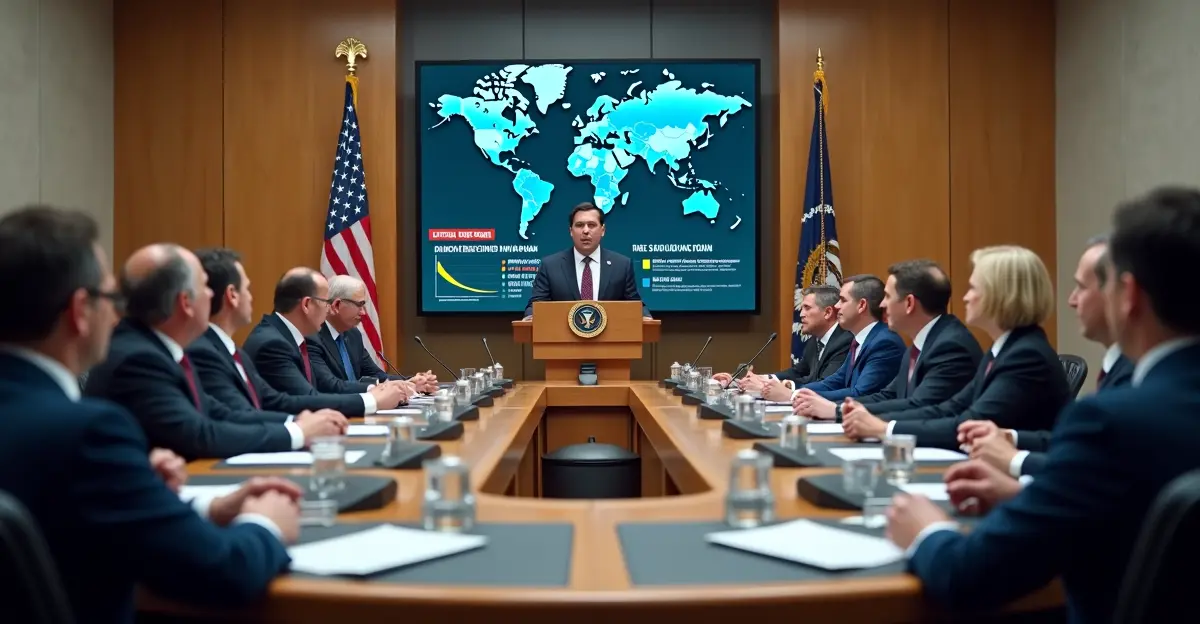
On February 4, 2026, the US Department of State hosted the Critical Minerals Ministerial, bringing together representatives from 54 countries and the European Commission. Secretary of State Marco Rubio and Vice President JD Vance led the proceedings, which produced two landmark initiatives.
FORGE: A Preferential Trade-and-Investment Zone
The Forum on Resource Geostrategic Engagement (FORGE), chaired by South Korea, succeeds the Minerals Security Partnership as a plurilateral coalition creating a preferential trade-and-investment zone for critical minerals. According to the Atlantic Council, FORGE includes coordinated price floors designed to counter adversarial market manipulation. Vice President Vance stated that reference prices would be maintained through adjustable tariffs for member nations. The initiative aims to align trade policy, price signals, and market access across partner economies—a significant departure from previous approaches that focused primarily on project financing.
Project Vault: A $12 Billion Strategic Reserve
Alongside FORGE, the US announced Project Vault, a $12 billion public-private partnership creating a strategic minerals stockpile. The Export-Import Bank committed $10 billion, with $2 billion in private capital, allowing companies to lock in fixed prices for minerals to hedge against supply disruptions and price volatility. The Bipartisan Policy Center notes that while physical stockpiles can help stabilize markets, challenges include storage infrastructure needs and potential market destabilization without accompanying procurement contracts.
The ministerial also produced 11 new bilateral critical minerals frameworks—with Argentina, Cook Islands, Ecuador, Guinea, Morocco, Paraguay, Peru, Philippines, UAE, UK, and Uzbekistan—bringing the total to 21 deals in five months. The US has mobilized over $30 billion in financing and support for strategic minerals projects. The US critical minerals strategy 2026 represents the most aggressive Western push to counter China's dominance in decades.
The European Union's Critical Raw Materials Act
The EU has pursued its own parallel track under the Critical Raw Materials Act (CRMA). In 2025, the European Commission selected 60 Strategic Projects targeting lithium, graphite, cobalt, nickel, and rare earths. These projects benefit from faster permitting, easier access to financing, and coordinated support from member states. In 2026, the Commission announced up to €3 billion ($3.5 billion) under the ReSourceEU Action Plan to reduce import dependency on battery, rare earth, and defense-related minerals.
Key EU initiatives include export restrictions on scrapped permanent magnets and aluminum, a ban on waste lithium-ion battery exports to non-OECD countries from September 2026, and the establishment of a European Critical Raw Materials Centre modeled on Japan's JOGMEC to jointly purchase and stockpile CRMs. However, analysts note that EU financing remains insufficient compared to US and Chinese efforts. The EU Critical Raw Materials Act strategic projects represent a significant step, but implementation gaps persist.
China's Strategic Consolidation
Beijing shows no signs of relinquishing its grip. The 15th Five-Year Plan (2026–2030) explicitly identifies rare earths as providing 'competitive advantages' and calls for strengthening export controls on critical minerals. Provincial governments in Guangxi, Jiangxi, Guizhou, and Yunnan have prioritized critical minerals in their local plans, while the central government targets a shift from raw material exports to higher-value-added products.
China's strategy, according to a multi-institutional analysis, weaponizes control rather than scarcity—using temporary, reversible restrictions to maintain pricing power and extract strategic concessions while discouraging large-scale Western alternative investment. Rebuilding independent processing capacity would take 20–30 years, far exceeding the current geopolitical window. Western nations face a narrowing 12–18 month window to act decisively before China's grip tightens further.
Resource Nationalism and New Players
The critical minerals race has also fueled a wave of resource nationalism. In April 2026, Canadian Prime Minister Mark Carney announced the Canada Strong Fund, a $25 billion sovereign wealth fund to invest in critical minerals, clean energy, and infrastructure. Canada also launched a $3.6 billion critical minerals program, including a $1.5 billion First and Last Mile Fund for mining infrastructure and a $2 billion Critical Minerals Sovereign Fund for strategic federal investments.
Emerging players like Saudi Arabia and the UAE are entering the market, increasing competitive pressure. The resource nationalism critical minerals 2026 trend is reshaping investment dynamics, with host countries demanding greater domestic processing, equity stakes, and value addition before allowing mineral exports.
Expert Perspectives
"The international market for critical minerals is currently failing," Vice President JD Vance stated at the February ministerial. "We have brittle supply chains, depressed commodity prices, and investment projects dying due to erratic pricing. Nearly two-thirds of global GDP is represented here today, and we need greater cooperation among allies to build more self-reliant and secure supply chains."
Analysts at the ODI Institute identify four key dynamics: US bilateral partnerships and domestic production incentives; EU strategic projects with financing gaps; China's persistent dominance; and the entry of new players. The report underscores that supply chain security remains central to energy transition, digital infrastructure, and national security agendas worldwide.
FAQ: Critical Minerals Geopolitics in 2026
What are critical minerals and why do they matter?
Critical minerals are raw materials essential for clean energy technologies, AI infrastructure, defense systems, and electronics. They include lithium, cobalt, nickel, rare earth elements, copper, and graphite. Their supply concentration creates strategic vulnerabilities for importing nations.
How much of global rare earth processing does China control?
China controls approximately 90% of global rare earth processing, 80% of tungsten, and 60% of antimony. This dominance is projected to reach 80–90% for rare earth refining by 2035 under current trends.
What is FORGE and how does it work?
The Forum on Resource Geostrategic Engagement (FORGE) is a 54-nation plurilateral alliance launched in February 2026. It creates a preferential trade-and-investment zone for critical minerals with coordinated price floors maintained through adjustable tariffs, aiming to counter China's market manipulation.
How much is the US investing in critical minerals?
The US has mobilized over $30 billion in financing and support for strategic minerals projects, including $10 billion through EXIM Bank's Project Vault for a domestic strategic reserve, plus bilateral frameworks with 21 partner nations.
What is the EU doing to secure critical minerals?
The EU selected 60 Strategic Projects under the Critical Raw Materials Act, launched the €3 billion ReSourceEU Action Plan, and will establish a European Critical Raw Materials Centre for joint purchasing and stockpiling. Export restrictions on scrap magnets and battery waste are also being implemented.
Conclusion: A Narrowing Window
The critical minerals landscape in 2026 is defined by intensifying competition, strategic realignment, and persistent vulnerabilities. While the US and EU have launched ambitious frameworks—FORGE, Project Vault, and the CRMA—analysts warn that rebuilding independent processing capacity will take decades. China's 15th Five-Year Plan signals a deepening of its strategic advantage, and the window for Western nations to act decisively may be as short as 12–18 months. The outcome of this competition will shape not only the energy transition and AI revolution but also the broader geopolitical order for decades to come.
Follow Discussion