


 Deutsch
 English
 Español
 Français
 Nederlands
 Português


 Share
Share




Introduction: The New Geopolitical Chessboard
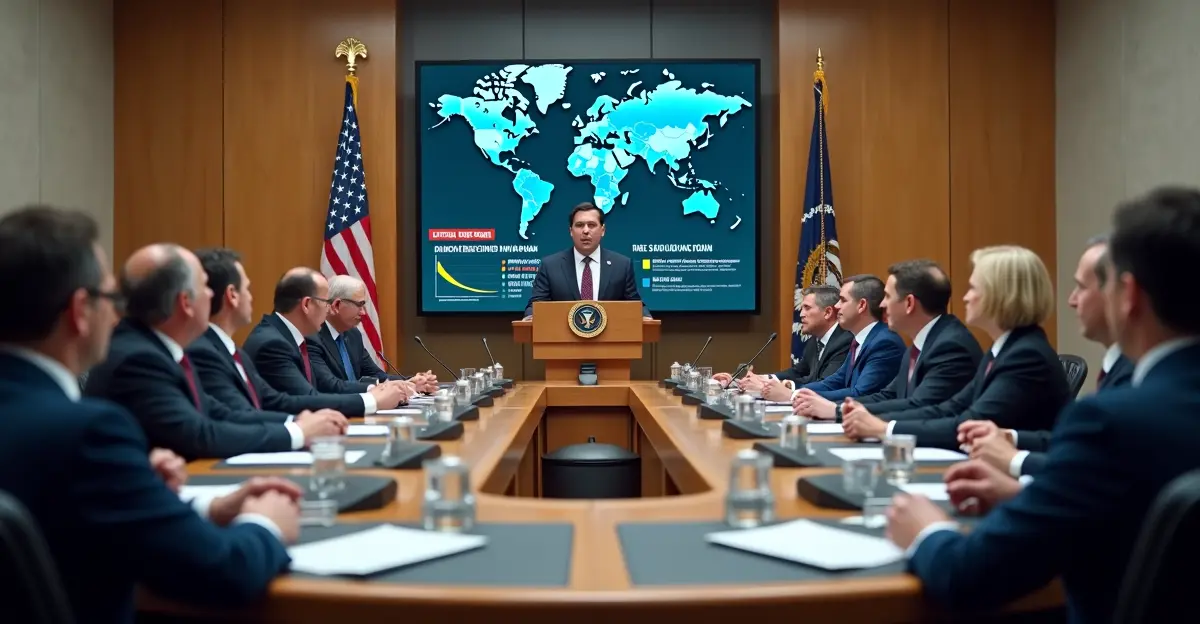
In February 2026, the United States hosted the inaugural Critical Minerals Ministerial in Washington, D.C., bringing together representatives from 54 countries and the European Commission. The event marked a pivotal moment in the global scramble for critical minerals—lithium, cobalt, nickel, graphite, and rare earth elements—that underpin the energy transition, AI hardware, and defense manufacturing. With China projected to control over 60% of refined lithium and cobalt and roughly 80% of battery-grade graphite and rare earths by 2035, the ministerial launched a strategic counteroffensive to diversify supply chains and reduce dependence on Beijing. This article analyzes the key outcomes, the new FORGE initiative, and the monumental challenges ahead.
Context: China's Dominance and the Western Response
China's stranglehold on critical mineral processing is decades in the making. Through strategic investments, state-owned enterprises, and export controls, Beijing has built an almost unassailable position. In 2025, China's Ministry of Commerce issued Notice 2025 No. 61, tightening export controls on rare earth elements, gallium, germanium, and antimony—materials essential for semiconductors, lasers, and military hardware. A temporary suspension of some restrictions in November 2025, following a trade truce between Presidents Trump and Xi, underscored how Beijing can weaponize supply chains at will. The US-China trade war has only accelerated the urgency for Western nations to build alternative processing capacity.
Beyond rare earths, five minerals—graphite, lithium, cobalt, high-purity manganese, and tungsten—sit at the center of EV batteries, aerospace alloys, and defense manufacturing. China controls roughly 70% of global cobalt refining, 60% of lithium chemical processing, and over 80% of graphite production for battery anodes. This concentration poses a direct threat to national security, as highlighted by the critical minerals and national security nexus in recent Pentagon assessments.
The 2026 Critical Minerals Ministerial: Key Outcomes
FORGE: The Forum on Resource Geostrategic Engagement
The most significant announcement was the launch of FORGE (Forum on Resource Geostrategic Engagement), the successor to the Minerals Security Partnership (MSP). Chaired by South Korea, FORGE is designed as a plurilateral coalition creating a preferential trade-and-investment zone for critical minerals, with coordinated price floors to counter adversarial market manipulation. Secretary of State Marco Rubio described FORGE as a mechanism to "align trade policy, price signals, and market access across partner economies to ensure secure and resilient supply chains." The initiative aims to translate bilateral deals into genuine plurilateral coordination—a challenge that has historically plagued Western mineral diplomacy.
11 New Bilateral Frameworks and $30 Billion in Financing
The ministerial produced 11 new bilateral critical minerals frameworks or MOUs with countries including Argentina, Morocco, the Philippines, the UAE, Peru, Ecuador, and Uzbekistan. These agreements cover exploration, processing, and investment facilitation. Crucially, the U.S. government mobilized over $30 billion in letters of interest, investments, and loans to support critical mineral supply chains. This includes a $10 billion Export-Import Bank loan for Project Vault, aimed at establishing a U.S. Strategic Critical Minerals Reserve. The US critical minerals financing push represents the largest single government commitment to date, but industry experts caution that building processing capacity will require sustained investment over a decade or more.
Challenges: Cost, Timelines, and Technical Hurdles
Despite the diplomatic momentum, the road to non-Chinese processing capacity is fraught with obstacles. Building a lithium hydroxide processing plant takes 5–7 years and costs $500 million to $1 billion. Rare earth separation facilities are even more complex, requiring specialized expertise that is largely concentrated in China. The rare earth processing challenges are compounded by environmental permitting, community opposition, and the lack of a skilled workforce in Western countries.
Moreover, China's 15th Five-Year Plan (2026–2030) is expected to double down on critical mineral dominance, with state subsidies for overseas mining acquisitions and advanced processing technologies. Beijing has also invested heavily in recycling and substitution research, which could further tighten its grip on supply chains. The temporary suspension of export controls in 2025 was a tactical move; analysts expect China to reimpose restrictions when geopolitical tensions rise again.
Impact on AI Hardware and Defense Manufacturing
The intersection of critical minerals with AI and defense is perhaps the most urgent dimension. Rare earths are essential for permanent magnets used in advanced radar systems, missile guidance, and electric vehicle motors. Lithium and cobalt are critical for batteries powering drones, naval vessels, and next-generation soldier systems. Without secure access to these materials, the Pentagon's modernization timelines could slip by years. The AI hardware supply chain also depends on gallium and germanium for semiconductor substrates, which China controls at over 80% of global supply.
Vice President JD Vance, speaking at the ministerial, emphasized that "critical minerals are not just an economic issue—they are a national security imperative. We cannot allow our military readiness to be held hostage by a single supplier." The FORGE initiative includes a dedicated working group on defense minerals, tasked with mapping vulnerabilities and accelerating stockpiling.
Expert Perspectives
Analysts are cautiously optimistic but warn of implementation risks. Morgan Bazilian, a critical minerals expert at the Payne Institute, noted: "The ministerial produced impressive numbers—54 countries, 11 deals, $30 billion. But the real test is whether these translate into actual processing plants. We've seen many MOUs before that never materialized." Others point to the success of the Minerals Security Partnership predecessor, which struggled to move beyond agreements to tangible projects.
On the industry side, executives from Albemarle, Lynas Rare Earths, and Pilbara Minerals welcomed the policy signals but stressed the need for faster permitting and more risk-sharing mechanisms. The $10 billion Project Vault is a start, but private capital will need to fill the gap—and investors remain wary of the long payback periods and geopolitical risks.
FAQ
What is the 2026 Critical Minerals Ministerial?
It was a summit hosted by the U.S. State Department on February 4, 2026, bringing together 54 countries and the European Commission to address supply chain vulnerabilities in critical minerals like lithium, cobalt, and rare earths. Key outcomes included the launch of FORGE and over $30 billion in financing commitments.
What is FORGE?
FORGE (Forum on Resource Geostrategic Engagement) is a plurilateral coalition chaired by South Korea that succeeds the Minerals Security Partnership. It aims to create a preferential trade-and-investment zone for critical minerals with coordinated price floors to counter Chinese market manipulation.
How much does China control critical mineral processing?
By 2035, China is projected to control over 60% of refined lithium and cobalt, roughly 80% of battery-grade graphite and rare earths, and over 80% of gallium and germanium production. This dominance stems from decades of strategic state investment and export controls.
What is Project Vault?
Project Vault is a $10 billion initiative by the U.S. Export-Import Bank to establish a Strategic Critical Minerals Reserve, stockpiling lithium, rare earths, and other materials to buffer against supply disruptions.
Why are critical minerals important for national security?
Critical minerals are essential for defense technologies such as radar systems, missile guidance, drone batteries, and advanced semiconductors. Supply chain dependence on a single country like China creates strategic vulnerabilities that can be exploited during geopolitical crises.
Conclusion: A Marathon, Not a Sprint
The 2026 Critical Minerals Ministerial and the launch of FORGE represent a significant step forward in the West's effort to secure critical mineral supply chains. However, the gap between diplomatic ambition and industrial reality remains vast. Building non-Chinese processing capacity will require sustained political will, massive capital investment, and a decade or more of execution. As China's 15th Five-Year Plan unfolds and the energy transition accelerates, the battle for critical minerals will define the geopolitical landscape for years to come. The global energy transition geopolitics are now inextricably linked with trade, technology, and military readiness.


Follow Discussion