


 Deutsch
 English
 Español
 Français
 Nederlands
 Português


 Share
Share




In 2026, the world's five largest hyperscalers—Amazon, Microsoft, Alphabet, Meta, and Oracle—are projected to invest a combined $725 billion in AI infrastructure, a 64% year-over-year surge confirmed by Q1 2026 earnings. Yet power availability has overtaken land and capital as the primary constraint on data center expansion. With global data center capacity needing to nearly double to 200 GW by 2030 and North American colocation vacancy at a historic 1.4%, the energy demands of AI training and inference are reshaping electricity grids, driving a resurgence in nuclear and renewable Power Purchase Agreements (PPAs), and creating systemic risks for both the tech sector and energy markets. This article analyzes how power scarcity is becoming the strategic chokepoint of the AI revolution, the geopolitical implications for energy-rich regions, and what it means for investors and policymakers.
The Scale of the Problem: $162 Billion in Stalled Projects
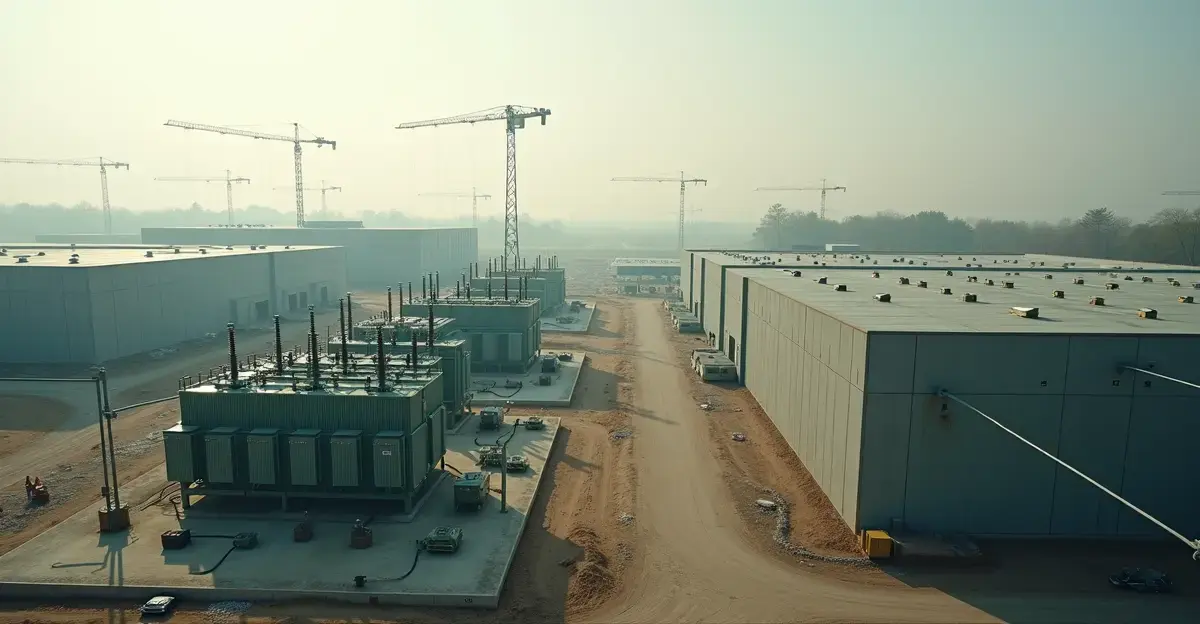
According to industry data from early 2026, over $162 billion in data center projects remain stalled due to power constraints. Of roughly 12 GW of planned U.S. data center capacity for 2026, only about 5 GW—one-third—is under active construction. Nearly half of all U.S. data center projects are expected to be delayed or canceled. The bottleneck has shifted decisively from GPU and chip shortages to physical power infrastructure: transformers, switchgear, batteries, and utility interconnection delays now dominate, with lead times for electrical gear stretching up to five years.
The global data center capacity is projected to grow from 103 GW in 2025 to 200 GW by 2030, according to JLL's 2026 Global Data Center Outlook. This represents a 14% compound annual growth rate and requires roughly $3 trillion in total digital infrastructure investment, including $1.2 trillion in real estate asset value creation and $1–2 trillion in tenant IT fit-out costs. However, the physical layer to absorb this capital is years behind schedule.
Why Power Became the Primary Constraint
Grid Interconnection Crisis
The U.S. interconnection queue has ballooned to over 2,600 GW with wait times approaching five years. Utilities like AEP Ohio have paused new interconnections for large loads. The average wait time for a grid connection in primary North American markets is now four years. This has created a 7 GW gap bottlenecking $650 billion in hyperscaler capital expenditure. Wholesale power prices near hyperscale facilities have surged 267% since 2020.
AI's Insatiable Appetite for Electricity
Data centers currently consume about 415 TWh of electricity globally (1.5% of total consumption), growing at 12% annually, with projections of 945 TWh by 2030. AI workloads are expected to represent half of all data center workloads by 2030, up from 25% today. Training a single large language model like GPT-3 uses approximately 1,287 MWh. By 2028, AI could consume over half of all data center electricity. The shift from training to inference—expected around 2027—will redistribute demand from centralized clusters to distributed regional hubs, further straining local grids.
The Nuclear Renaissance: Big Tech's Answer to Baseload Power
Every major hyperscaler has now signed at least one nuclear power deal. A total of 13 announced projects commit over 9.8 GW of nuclear capacity. Key deals include:
- Microsoft: A $16 billion, 20-year PPA for the Three Mile Island Unit 1 restart (835 MW, targeted 2027)—the first nuclear-powered AI data center.
- Amazon: $700 million investment in X-energy for up to 12 Xe-100 HTGRs, plus 1.92 GW from Susquehanna.
- Google: 500 MW from Kairos Power's KP-FHR reactors, the first corporate small modular reactor (SMR) deal.
- Meta: Up to 6.6 GW across partnerships with TerraPower, Oklo, Vistra, and Constellation.
Nuclear's >90% capacity factor makes it preferable over intermittent renewables (~25% solar, ~35% wind) for powering 24/7 AI workloads. The strategy involves two phases: restarting existing commercial reactors for immediate needs while developing SMRs for deployment by 2030. This pivot is reshaping the nuclear power purchase agreement landscape, with long-term contracts providing the financial certainty needed to restart shuttered plants and fund new reactor development.
Geopolitical Implications: Energy-Rich Regions Gain Leverage
Energy access has become a geopolitical weapon. AI infrastructure is now treated as critical national infrastructure comparable to electricity grids and ports. The U.S., China, and Europe remain the largest consumers, but energy-rich Middle Eastern nations are leveraging power generation to attract AI investments. Countries with abundant natural gas, nuclear capacity, or renewable resources are positioning themselves as AI hubs. The geopolitical implications of AI energy demand are profound: nations that control energy supply chains gain strategic advantage in the AI race.
Supply chain shortages affect 68% of providers for specialized hardware, 62% for cooling systems, and 44% for transformers. The U.S. faces a 49 GW generation shortfall by 2028, according to Goldman Sachs. Northern Virginia's "Data Center Alley" faces predicted rolling blackouts within 3–5 years, creating strategic vulnerabilities for the world's largest data center market.
Expert Perspectives
"Power availability, not capital, is now the primary gating factor for AI data center expansion. The industry is supply-constrained rather than demand-constrained, with massive order backlogs that cannot be filled until the grid catches up," notes a senior analyst at a leading infrastructure research firm.
"The AI capex cycle represents the largest coordinated infrastructure investment in history. But the physical layer—transformers, switchgear, grid connections—is years behind. We are seeing the widest gap on record between announced AI capital expenditure and actually energized megawatts," comments an energy infrastructure specialist.
Frequently Asked Questions
What is a Power Purchase Agreement (PPA)?
A Power Purchase Agreement is a long-term contract between an electricity generator and a customer to buy energy at a pre-negotiated price. PPAs typically last 5–20 years and play a key role in financing independently owned electricity generators, especially renewable energy projects and, increasingly, nuclear facilities for AI data centers.
How much electricity do AI data centers consume?
Global data center electricity consumption was approximately 415 TWh in 2024, projected to reach 945 TWh by 2030. AI workloads could represent over half of all data center electricity use by 2028. In the U.S., data centers may consume 6–12% of total electricity by 2026.
Why are hyperscalers turning to nuclear power?
Nuclear power offers >90% capacity factor—meaning it runs nearly continuously—compared to ~25% for solar and ~35% for wind. AI training clusters require 24/7 carbon-free baseload power at a scale only nuclear can deliver. Nuclear also helps tech companies meet 2030 net-zero goals while bypassing congested public grids.
What is the difference between AI training and inference in energy terms?
Training involves building a model and is extremely compute-intensive, often requiring weeks on thousands of GPUs. Inference is when a trained model generates responses. While training consumes more energy per task, inference now accounts for over 80% of compute usage overall, making per-task energy efficiency a critical optimization target.
Which regions are best positioned to benefit from the AI energy crisis?
Energy-rich regions with available power generation capacity—such as the Middle East, parts of the U.S. with nuclear or natural gas capacity, and areas with strong renewable resources—are attracting AI data center investments. Countries that can offer fast grid connections and stable power prices gain a competitive advantage in the AI infrastructure race.
Conclusion: The New Bottleneck of the AI Supercycle
The $725 billion AI infrastructure investment cycle is unprecedented in scale, but its success hinges on solving the power problem. With over $162 billion in projects stalled, grid interconnection queues at record levels, and colocation vacancy at 1.4%, energy scarcity has become the defining strategic tension of the AI supercycle. The pivot to nuclear PPAs, the geopolitical realignment around energy-rich regions, and the urgent need for grid modernization will shape the next phase of AI infrastructure development. For investors and policymakers, the message is clear: in the AI era, power is the ultimate strategic asset.

Follow Discussion