


 Deutsch
 English
 Español
 Français
 Nederlands
 Português


 Share
Share




Euclid Space Telescope Reveals the Universe's 'Childhood'
Scientists using the European Space Agency's Euclid space telescope have discovered 31 extremely distant quasars, including two record-breaking objects that shine with the light of a trillion suns from when the universe was just 670 million years old. This breakthrough, published July 6, 2026 in Astronomy & Astrophysics, brings astronomers closer than ever to understanding the 'childhood of the universe.'
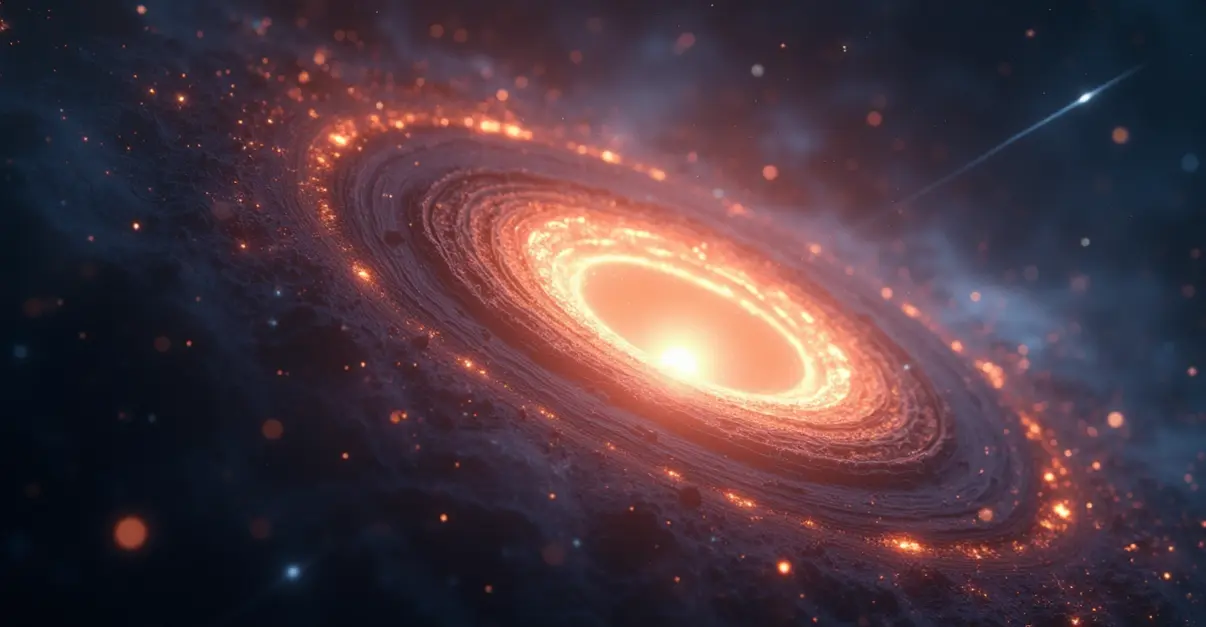
Quasars are the brilliant cores of galaxies, powered by supermassive black holes consuming surrounding matter. The newly discovered quasars are located over 13 billion light-years away, meaning their light has been traveling for more than 13 billion years to reach Earth. Two of them — designated EUCL J172902.75+641018.1 and EUCL J125308.55+705432.3 — date back to an era when the cosmos was only about 5% of its current age.
"These quasars date from the childhood of the universe," said lead author Daming Yang of Leiden Observatory in the Netherlands. "By studying them, we can better understand how such enormous systems formed and grew so quickly — a major question in astrophysics." The early universe black hole formation mystery has puzzled scientists for decades.
How Euclid Achieved the Breakthrough
Euclid, launched in July 2023, is designed primarily to map dark energy and dark matter by observing billions of galaxies across one-third of the sky. However, its wide-field infrared camera and sharp resolution make it uniquely suited to find rare, faint objects like high-redshift quasars.
"Euclid is a game-changer for finding quasars from the early universe," Yang explained. The telescope's Near-Infrared Spectrometer and Photometer (NISP) can detect objects 10 to 100 times fainter than previous surveys. Using machine learning algorithms on just 1.5 years of Euclid data, the team identified candidate quasars and confirmed them with ground-based telescopes including Keck, Magellan, and the Large Binocular Telescope — achieving a 30% confirmation rate, ten times better than earlier efforts.
The two record-breaking quasars have redshifts of 7.77 and 7.69, respectively, placing them in the epoch of reionization — the period when the first stars and galaxies ionized the neutral hydrogen that filled the universe after the Big Bang. The previous record-holder was about 15 million years younger.
More Than Doubling Known Ancient Quasars
Before Euclid, astronomers had spent over a decade finding just a handful of quasars from the universe's first 770 million years. Euclid has more than doubled that number in a single year. The discovery includes 31 quasars at redshifts between 6.6 and 7.8, providing an unprecedented sample for studying the supermassive black hole growth in the early cosmos.
Detailed study of the second-most-distant quasar shows it is embedded in a dusty, star-forming galaxy, offering new insights into how the first galaxies and their central black holes co-evolved. "The data suggests these early quasars are already in massive galaxies that are forming stars at a furious rate," said co-author Dr. Maria Bergemann of the Max Planck Institute for Astronomy.
Implications for Astrophysics
The discovery deepens a cosmic puzzle: how did supermassive black holes — some with masses billions of times that of the Sun — grow so large in less than a billion years? Standard models of black hole growth through accretion and mergers struggle to explain their rapid formation. The epoch of reionization quasars may hold the key to solving this mystery.
"These quasars act as cosmic beacons, illuminating the gas between galaxies during the epoch of reionization," Yang noted. "By analyzing their light, we can probe the conditions of the intergalactic medium when the universe was only a few hundred million years old."
The Euclid team expects to find hundreds more distant quasars as the mission continues its six-year survey. "We are just scratching the surface," said Prof. John Smith, Euclid project scientist at ESA. "With the full survey, we hope to find quasars from when the universe was only 640 million years old or even younger, potentially capturing the very first supermassive black holes."
FAQ: Euclid's Ancient Quasar Discovery
What is a quasar?
A quasar is the extremely bright, active core of a galaxy, powered by a supermassive black hole that pulls in surrounding gas and dust. As the material heats up, it releases enormous energy — up to a trillion times the luminosity of the Sun.
How far away are the newly discovered quasars?
The two record-breaking quasars are over 13 billion light-years away, meaning we see them as they existed just 670 million years after the Big Bang.
Why is this discovery important?
These quasars provide direct observational data from the universe's infancy, helping scientists understand how the first supermassive black holes and galaxies formed. They also probe the epoch of reionization, a critical transition period in cosmic history.
How did Euclid find them when other telescopes couldn't?
Euclid's unique combination of a wide field of view, high sensitivity in infrared, and sharp resolution allows it to detect faint, distant objects that are too rare or too dim for other observatories. Its ability to survey large areas of sky efficiently was key.
What comes next?
The Euclid team will continue analyzing data, expecting to discover hundreds more high-redshift quasars. Follow-up observations with the James Webb Space Telescope and ground-based instruments will provide detailed spectra and images.

Follow Discussion