


 Deutsch
 English
 Español
 Français
 Nederlands
 Português


 Share
Share




What Are Little Red Dots?
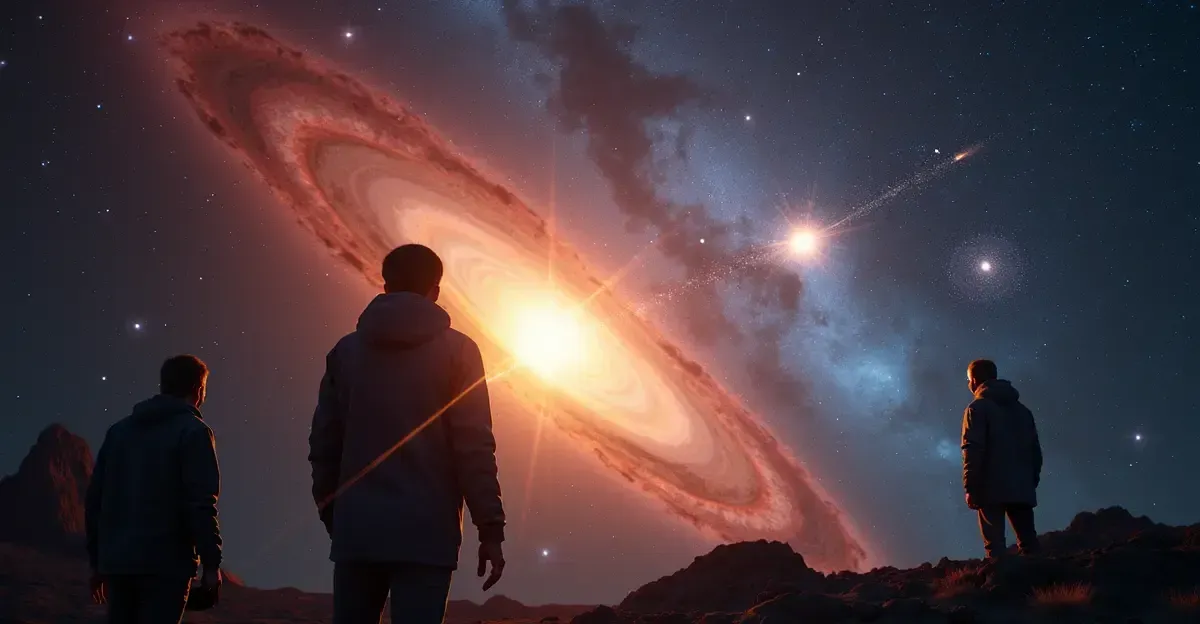
Since the James Webb Space Telescope (JWST) began operations in 2022, astronomers have been captivated by hundreds of small, crimson objects appearing in deep-space images of the early universe. Known as 'little red dots' (LRDs), these enigmatic sources existed between 600 million and 1.6 billion years after the Big Bang — roughly 12 to 13 billion years ago. They appear as compact red pixels, measuring just a few hundred light-years across, yet they shine with surprising brightness. As of 2025, over 340 LRDs have been cataloged, and their true nature has become one of the most debated topics in modern astrophysics.
Now, a groundbreaking discovery using NASA's Chandra X-ray Observatory may finally provide the missing link. Astronomers have identified an LRD that emits X-rays — something that should not happen if they are what most scientists suspect. This 'X-ray dot,' officially named 3DHST-AEGIS-12014, could be the key to understanding what powers these mysterious objects.
The X-Ray Dot Discovery
Located approximately 11.8 billion light-years from Earth, 3DHST-AEGIS-12014 was first spotted by JWST as a typical little red dot. But when the Chandra X-ray Observatory trained its instruments on the object, it detected a clear X-ray signal — a first for any LRD. The findings were published in The Astrophysical Journal Letters in April 2026.
'Astronomers have been trying to figure out what LRDs are for years. This one X-ray object could — simply put — be the thing that connects all the dots,' said co-author Raphael Hviding of the Max Planck Institute for Astronomy in a NASA press release.
The X-ray emission resembles the high-energy radiation typically seen from supermassive black holes at the centers of distant galaxies. But most LRDs are not supposed to emit X-rays — they are thought to be buried under gas so dense that X-ray light cannot escape.
Black Hole Stars: The Leading Theory
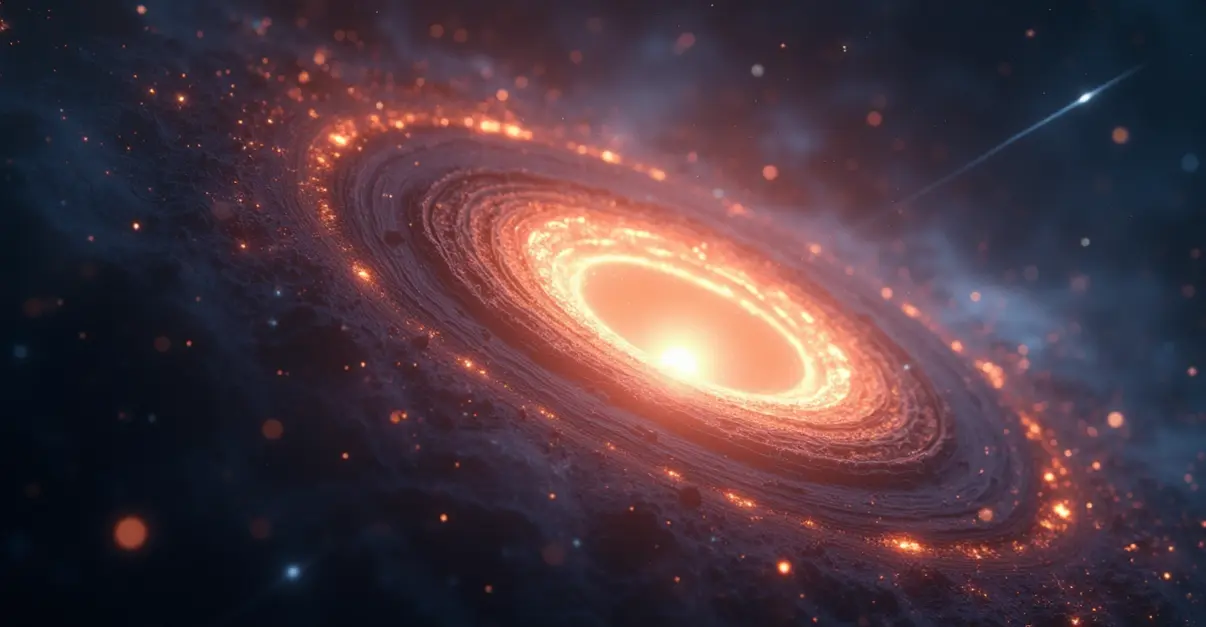
The discovery has pushed a dramatic explanation to the forefront: LRDs may be giant gas clouds with a growing supermassive black hole at their center, slowly consuming its way outward from the inside. Researchers from the Harvard-Smithsonian Center for Astrophysics describe these objects as 'cosmic eggs' — glowing spheres where the black hole's energy makes the gas shine red while the hole's activity gradually evolves.
In this model, the X-ray signal represents the first direct glimpse of the central engine. As the black hole consumes surrounding gas, patchy holes develop in the obscuring clouds, allowing X-rays to escape. The Chandra data even showed hints of brightness variations, supporting the idea of partial obscuration.
If confirmed, this would be the first LRD caught in a transition phase — from a hidden 'black hole star' to a freely growing supermassive black hole that later drives entire galaxies. The supermassive black hole formation process has long puzzled astronomers, and LRDs may represent the infancy stage of these cosmic giants.
Why This Matters for Cosmology
Little red dots challenge existing models of galaxy and black hole evolution. They appear to be 'overmassive' — their black holes are too large relative to their host galaxies compared to what we see in the nearby universe. This suggests that black holes may have grown faster than their galaxies in the early cosmos.
Alternative theories have proposed that LRDs could be Population III stars — the first generation of stars, perhaps a million times the mass of the Sun, in the last thousands of years of their lives. Others suggest they are direct-collapse black holes formed from primordial gas clouds. However, the X-ray detection strongly favors the black hole star scenario.
'Finding an LRD that looks different from the others provides important new insights into what might be powering them,' said Anna de Graaff of Harvard & Smithsonian, a co-author of the study.
The discovery also relates to the James Webb early universe findings that have revolutionized astronomy, showing that supermassive black holes formed much earlier than previously thought.
What Comes Next
Researchers caution that the black hole star explanation is not yet definitively proven. The object could also be a common black hole veiled in an exotic, previously unseen type of dust. Future observations with Chandra, JWST, and other telescopes are planned to investigate further.
If the transition-phase model holds, it would provide the strongest evidence yet that supermassive black hole growth powers at least some — and possibly all — little red dots. This would mark a major step forward in understanding how the universe's most massive black holes formed in the first billion years after the Big Bang.
The study of early universe black holes continues to yield surprises, and LRDs remain one of the most promising avenues for unraveling the cosmic dawn.
Frequently Asked Questions
What are little red dots?
Little red dots (LRDs) are small, red-tinted objects discovered by the James Webb Space Telescope in the early universe, dating to 600 million to 1.6 billion years after the Big Bang. They appear as compact red pixels in deep-space images.
Why is the X-ray detection important?
Most LRDs are thought to be buried in dense gas that blocks X-rays. The detection of X-rays from 3DHST-AEGIS-12014 suggests we are seeing a transitional phase where the black hole's energy is breaking through the gas cocoon.
How many little red dots have been found?
As of 2025, more than 340 LRDs have been identified with JWST, with hundreds more being studied.
Could LRDs be something other than black holes?
Yes. Alternative theories include supermassive Population III stars, direct-collapse black holes, or compact star-forming regions. However, the X-ray data strongly supports the black hole star model.
What is a 'black hole star'?
A black hole star is a theoretical object consisting of a supermassive black hole surrounded by a dense gaseous envelope. The black hole's energy heats the gas, making it glow, while the envelope obscures the central engine.




Follow Discussion