


 Deutsch
 English
 Español
 Français
 Nederlands
 Português


 Share
Share




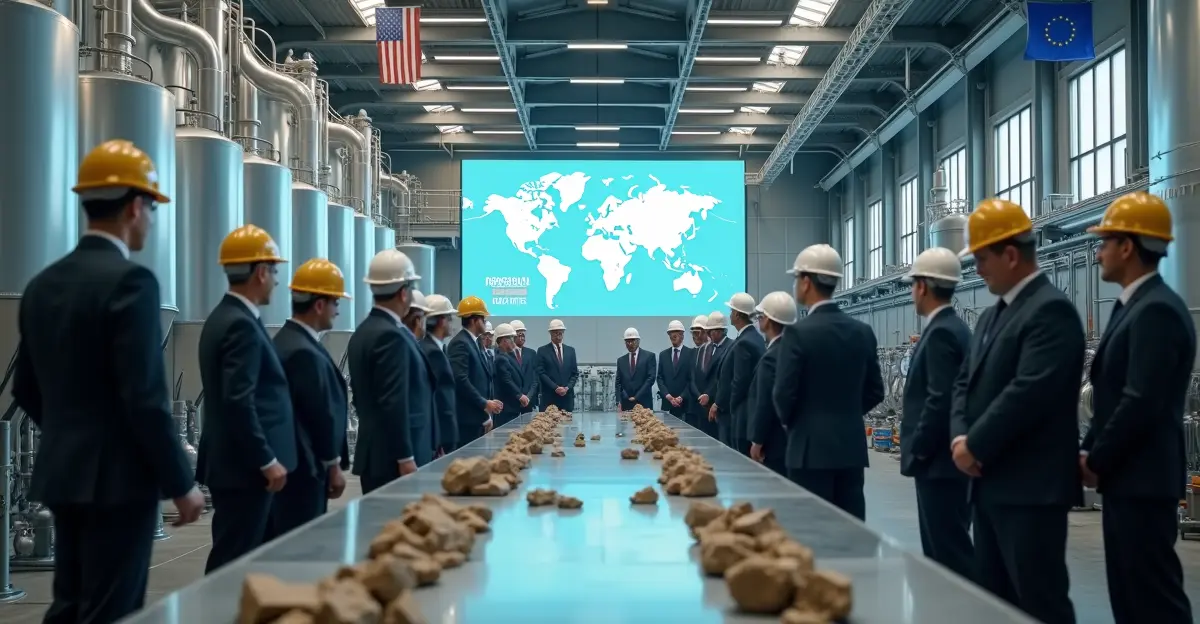
On April 24, 2026, the European Union and the United States launched a landmark strategic partnership on critical minerals, signing a Memorandum of Understanding (MoU) and an accompanying Action Plan in Washington's Colin L. Powell Treaty Room. The EU-US Critical Minerals Partnership represents the most ambitious transatlantic effort yet to reduce dependence on Chinese-dominated supply chains across the full minerals value chain — from mining and processing to recycling — with direct implications for defense, electric vehicle (EV) supply chains, and the architecture of a Western-aligned critical minerals bloc.
Context: Why the EU-US Critical Minerals Partnership Matters
The partnership formalizes cooperation that has been building since the June 2022 launch of the Minerals Security Partnership, a 14-country plus EU grouping now succeeded by the Forum on Resource Geostrategic Engagement (FORGE). It also builds on a temporary US-EU critical minerals agreement from 2025, which had been widely criticized as insufficient. According to European Commission officials, the MoU foresees bilateral cooperation spanning the entire value chain.
China's dominance is stark: roughly 90% of global rare earth refining, 60% of lithium processing, and 70% of cobalt refining. US Secretary of State Marco Rubio warned that over-concentration of critical mineral resources “poses an unacceptable risk to economies and national security.”
What the EU-US Critical Minerals Action Plan Does
The Action Plan, announced by US Trade Representative Ambassador Jamieson Greer, serves as the primary mechanism for coordinating trade policies on critical minerals supply chains. It aims to conclude a binding plurilateral agreement on trade in critical minerals. Crucially, the two sides committed to exploring border-adjusted price floors and other trade measures to counter non-market policies and practices that have distorted supply chains.
Mining, Processing, and Recycling Coordination
The partnership covers the full value chain: joint investment in mining projects, shared processing capacity, and coordinated recycling and stockpiling initiatives. This mirrors the EU Critical Raw Materials Act, which set domestic benchmarks for extraction, processing, and recycling, and now gains a transatlantic counterpart.
Impact on Defense and EV Supply Chains
Both sides have identified critical minerals as essential for defense systems, advanced manufacturing, and the energy transition. The agreement comes just weeks after the 2026 Critical Minerals Ministerial in Washington, where 54 countries signed 11 new bilateral frameworks and launched FORGE with over $30 billion in US financing support, including EXIM's $10 billion Project Vault.
For EV manufacturers and defense contractors, the partnership promises diversified sourcing for lithium, cobalt, rare earths, and graphite. Analysts note that execution will be the real test, as translating the agreement into concrete, tangible projects remains challenging.
Geopolitical Implications: A Western-Aligned Minerals Bloc
The EU-US pact cements an emerging Western-aligned critical minerals bloc that includes FORGE partners and bilateral framework signatories such as Argentina, the Philippines, the UK, and Uzbekistan. This bloc seeks to counter China's rare earth dominance by creating preferential trade-and-investment zones with coordinated price floors and shared ESG standards.
Critics, however, raise concerns about resource imperialism and ESG loopholes, while some US domestic miners worry that the partnership may prioritize overseas projects over domestic development.
Expert Perspectives
EU Trade Commissioner Maroš Šefčovič said the agreement “strengthens the US-EU relationship” and “opens new possibilities for cooperation,” while Ambassador Greer emphasized that both parties are committed to addressing the non-market practices that have distorted critical minerals supply chains. Rubio stressed the extraordinary combined buying power and economic productivity of the two economies.
FAQ: EU-US Critical Minerals Partnership
What is the EU-US Critical Minerals Partnership?
It is a strategic agreement signed on April 24, 2026 between the EU and US to coordinate critical minerals supply chains across mining, processing, and recycling, reducing dependence on China.
Why was the partnership created?
China controls roughly 90% of rare earth refining, 60% of lithium processing, and 70% of cobalt refining, posing risks to defense, EV, and advanced manufacturing supply chains.
What are border-adjusted price floors?
These are trade measures under exploration that would set minimum prices on critical minerals to protect domestic industries from artificially cheap, subsidized imports.
How does this differ from the Minerals Security Partnership?
The MSP was a multilateral forum; the EU-US pact is a binding bilateral mechanism aimed at a plurilateral trade agreement, coordinated with FORGE, the MSP's successor.
What is FORGE?
The Forum on Resource Geostrategic Engagement (FORGE) is the successor to the Minerals Security Partnership, launched at the February 2026 Critical Minerals Ministerial to coordinate policy and project-level action.
Conclusion and Future Outlook
The EU-US Critical Minerals Partnership marks a decisive step toward a transatlantic minerals bloc. While the MoU and Action Plan set ambitious goals, the coming months will test whether border-adjusted price floors, joint investment, and recycling coordination can translate into resilient supply chains. With the 2026 deadline for a binding plurilateral agreement approaching, the partnership's execution will determine whether it reshapes global resource geopolitics or remains a symbolic gesture.



Follow Discussion