


 Deutsch
 English
 Español
 Français
 Nederlands
 Português


 Share
Share




The Critical Minerals Chessboard: A New Geopolitical Order
In 2026, the global scramble for critical minerals—lithium, rare earths, copper, and cobalt—has become the defining strategic contest of the energy transition. China's stranglehold on processing, controlling roughly 90% of rare earth refining and over 60% of lithium conversion, has triggered an unprecedented wave of Western countermeasures. The U.S.-led FORGE partnership, the EU's Critical Raw Materials Act, and a surge of resource nationalism from Chile to Indonesia are redrawing geopolitical alliances and creating new supply chain bottlenecks. With the UN Conference on Trade and Development (UNCTAD) warning of a narrow 12-to-18-month window for Western nations to diversify before dependencies become entrenched, the stakes have never been higher.
China's Dominance and the 15th Five-Year Plan
China's 15th Five-Year Plan (2026–2030) explicitly prioritizes global leadership in rare earth elements, strengthening technological capabilities and upgrading export controls. Beijing has already demonstrated its leverage: in 2025, it imposed export restrictions on rare earths, triggering sixfold price spikes that rippled through global markets. The plan also calls for expanded domestic exploration of industrial metals like copper and aluminium, reducing import reliance while maintaining coal as a 'bottom-line guarantee' for energy security. According to Carbon Brief, China targets non-fossil energy to account for 50% of power generation by 2030, but its grip on critical mineral supply chains remains the key lever of geopolitical power.
The Western Response: FORGE and the EU Critical Raw Materials Act
FORGE: A Plurilateral Coalition
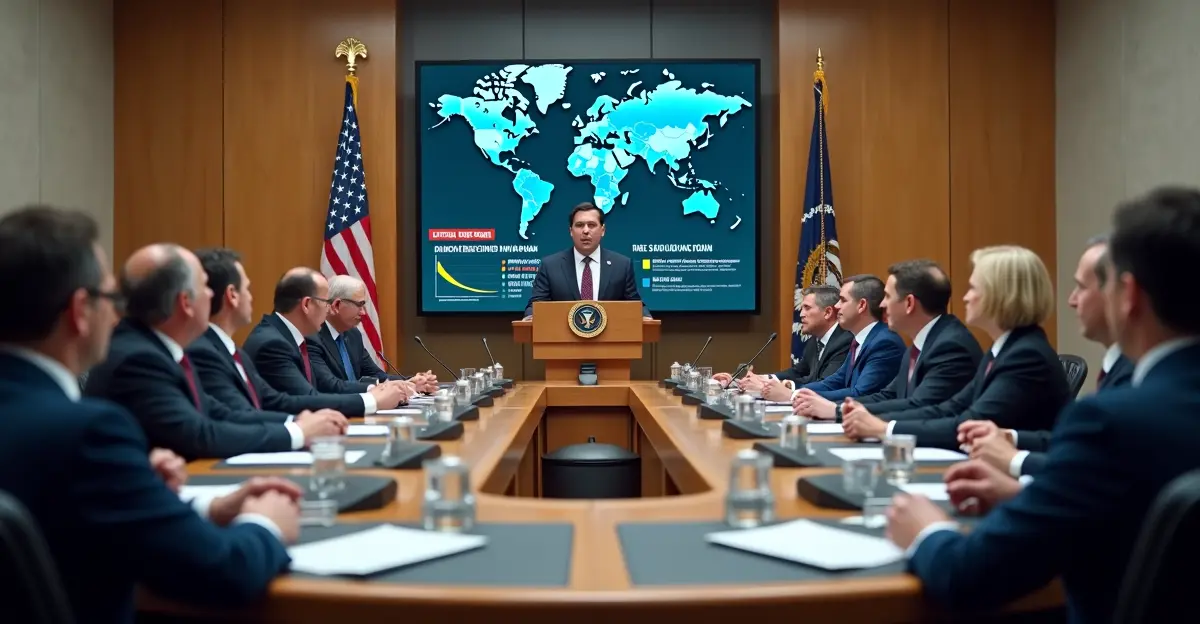
In February 2026, U.S. Secretary of State Marco Rubio announced the Forum on Resource Geostrategic Engagement (FORGE) at the inaugural Critical Minerals Ministerial in Washington, D.C. Succeeding the Minerals Security Partnership, FORGE is a plurilateral coalition of 54 countries and the European Commission, creating a preferential trade-and-investment zone for critical minerals with coordinated price floors to counter adversarial market manipulation. The U.S. has mobilized over $30 billion in letters of interest, investments, and loans for critical mineral supply chain projects, including the Export-Import Bank's $10 billion Project Vault to establish a domestic strategic critical minerals reserve. South Korea chaired FORGE initially, with the U.S. assuming the chairmanship in July 2026. The initiative has signed 21 bilateral framework agreements with nations including Argentina, Morocco, Peru, the Philippines, the UAE, and the UK.
EU's Critical Raw Materials Act
The European Union's Critical Raw Materials Act, adopted in 2024 and reinforced in 2026, sets ambitious 2030 benchmarks: 10% of annual consumption from domestic extraction, 40% from domestic processing, and 25% from recycling. In March 2026, the Council of the EU adopted a position reinforcing security of supply and circularity, focusing on domestic mining, processing, and reducing dependencies on third-country suppliers. However, the EU faces significant financing gaps compared to U.S. and Chinese investments, and its reliance on Chinese rare earth processing remains a critical vulnerability.
Resource Nationalism: Producer Nations Strike Back
Resource-rich nations are no longer passive suppliers. From Indonesia to Chile, governments are weaponizing their mineral wealth, demanding domestic processing and higher revenue shares.
Indonesia's Nickel Quota Shock
Indonesia, the world's largest nickel producer, slashed its 2026 ore quota to 270 million wet metric tonnes, down from 375 million in 2025—well below expected demand of 345 million tonnes. This tightening drove LME nickel prices to an 18-month high of $18,950/tonne, with Goldman Sachs raising its 2026 price forecast by 16%. The policy, part of President Prabowo Subianto's resource nationalism agenda, includes higher tiered royalty rates (14–19%) and compulsory local divestment. While Chinese firms control 40% of operations, the rapidly evolving regulatory environment creates significant uncertainty for multinational investors.
Chile and Peru: Copper's Strategic Pivot
Chile and Peru together account for roughly 40% of global copper mine supply—a concentration that poses systemic risk. The IEA forecasts global copper demand could nearly double by 2035, facing a 30% supply shortfall. China controls over 50% of global copper refining capacity, creating a critical bottleneck. In response, Chile launched seven new copper projects worth $7.1 billion in 2026, while the U.S. pursues a 'friendshoring' strategy, investing over $1 billion in critical mineral companies since January 2025. However, declining ore grades, water scarcity, and political instability in the region complicate expansion plans.
Other Fronts: DRC Cobalt and Vietnam Rare Earths
The Democratic Republic of Congo shifted from a cobalt export ban to an annual quota system, now studied as a global template. Vietnam prohibited rare earth exports entirely, allowing only government-approved mining. These moves reflect a broader trend: resource nationalism in critical minerals is reshaping investment risk profiles across the board.
Supply Chain Bottlenecks and the Race for Processing Capacity
The most acute bottleneck lies in processing. China's dominance in refining—over 90% of rare earths, 60% of lithium, 50% of copper, and 70% of cobalt—means that even if mining is diversified, the material must still pass through Chinese facilities. The U.S. FORGE initiative and EU Act aim to build alternative capacity, but new refineries take 5–10 years to come online. UNCTAD's June 2026 Global Trade Update warns that critical-mineral-rich developing countries are seeking stronger provisions on local processing, technology transfer, and skills development, which could further slow Western diversification efforts.
Gulf States Enter the Fray
Gulf states are deploying over $100 billion in sovereign wealth investments to secure critical mineral supply chains. Saudi Arabia's Public Investment Fund and UAE's Mubadala are actively investing in lithium, copper, and rare earth projects in Africa, Latin America, and Australia. This new capital is reshaping traditional alliances and providing alternative financing for resource-rich nations seeking to bypass Western and Chinese dominance.
Expert Perspectives
"The next 12 to 18 months are decisive," says a senior UNCTAD official. "If Western nations fail to establish diversified processing capacity by 2028, China's structural advantage will become nearly impossible to overcome." Analysts at the Atlantic Council note that FORGE represents the Trump administration's clearest attempt to translate critical minerals ambitions into functional architecture, but operational details remain sparse. Meanwhile, Gibson Dunn's June 2026 client alert on resource nationalism warns that companies face overlapping U.S.-China export control regimes, investment treaty risks, and rapidly changing local regulations.
Frequently Asked Questions
What are critical minerals?
Critical minerals are raw materials essential for the energy transition, defense, and high-tech industries. They include lithium (batteries), rare earths (magnets, electronics), copper (electrification), cobalt (batteries), and nickel (batteries, stainless steel).
Why does China dominate critical mineral processing?
China invested decades ago in building refining capacity, supported by state-owned enterprises, low labor costs, and lax environmental regulations. It now controls 90% of rare earth processing, 60% of lithium refining, and over 50% of copper smelting.
What is the FORGE partnership?
FORGE (Forum on Resource Geostrategic Engagement) is a U.S.-led coalition of 54 countries launched in February 2026 to create a preferential trade-and-investment zone for critical minerals, with coordinated price floors and $30 billion in mobilized investments.
How is resource nationalism affecting supply chains?
Producer nations like Indonesia, Chile, and the DRC are imposing export restrictions, mandatory domestic processing, higher royalties, and local ownership requirements. This increases costs and delays for Western companies while giving producer nations greater bargaining power.
What is the timeline for Western diversification?
UNCTAD warns of a 12-to-18-month window (through mid-2028) for Western nations to establish alternative processing capacity before China's dominance becomes structurally entrenched. New refineries typically take 5–10 years to build.
Conclusion: The New Geopolitical Chessboard
The critical minerals race is reshaping global power in real time. China's processing monopoly, Western countermeasures through FORGE and the EU Act, and the rise of resource nationalism are creating a multipolar, fragmented supply chain landscape. The nations that secure processing capacity, forge stable partnerships with resource-rich countries, and navigate the legal complexities of critical minerals investment risks will lead the energy transition. The next 18 months will determine whether the West can break China's grip—or whether the energy transition will run through Beijing.




Follow Discussion