


 Deutsch
 English
 Español
 Français
 Nederlands
 Português


 Share
Share




In April 2025, China imposed export licensing controls on four heavy rare earth elements—dysprosium, terbium, samarium, and yttrium—where it holds over 80% of global supply. The impact was immediate: dysprosium oxide prices doubled from ~$90/kg to over $189/kg by early 2026, and terbium surged from ~$600/kg to ~$840/kg. This move, widely seen as a targeted response to U.S. tech trade restrictions, has triggered a global scramble for critical mineral supply chains, redefining alliances, defense strategies, and industrial policy worldwide. As China tightens its grip on rare earth processing—controlling 90% of global capacity—the United States and European Union are racing to build alternative supply chains through bilateral deals, the newly launched FORGE coalition, and massive financing commitments. This article analyzes the emerging network of competing mineral blocs, the strategic vulnerabilities they expose, and what the rupture means for global supply chain security.
China's Strategic Leverage: Export Controls as a Weapon
China's dominance in critical minerals is not new, but its willingness to weaponize that control has escalated dramatically. Beyond rare earths, China controls approximately 80% of global tungsten refining and 60% of antimony production. In the lithium-ion battery supply chain, China's refining capacity for lithium, cobalt, and graphite is projected to dominate through 2035, according to the International Energy Agency (IEA). The April 2025 export controls, formalized under Announcement No. 18 by China's Ministry of Commerce, require exporters to obtain licenses for a broad range of medium and heavy rare earth items, including metals, alloys, oxides, and permanent magnet materials. The licensing approval rate for European firms has fallen below 25% in some sectors, according to a multi-institutional analysis published in early 2026. Over 80% of European companies depend on Chinese supply chains for critical minerals essential to defense, EVs, and renewable energy. The geopolitical implications of rare earth dependency are now front and center for Western policymakers.
The U.S. Response: FORGE and Project Vault
The 2026 Critical Minerals Ministerial
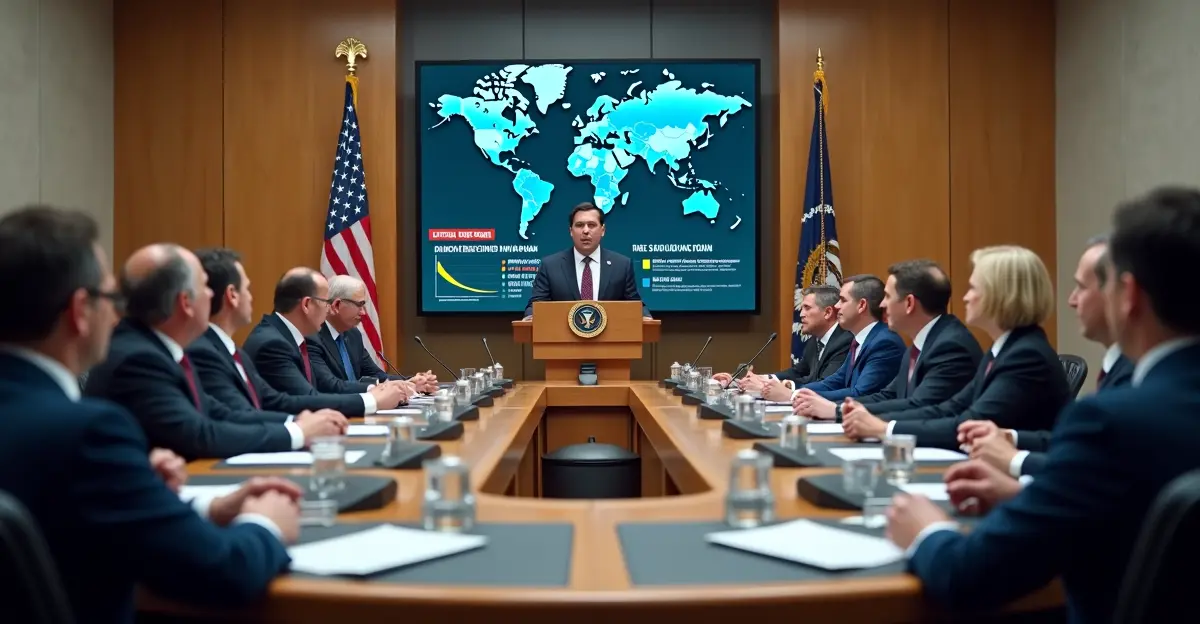
On February 4, 2026, the United States hosted the inaugural Critical Minerals Ministerial in Washington, D.C., led by Secretary of State Marco Rubio and Vice President JD Vance, with representatives from 54 countries and the European Commission. The event marked a decisive shift toward bloc-based resource competition. Secretary Rubio announced the creation of FORGE (Forum on Resource Geostrategic Engagement) as the successor to the Minerals Security Partnership, chaired by South Korea through June 2026. FORGE establishes a preferential trade-and-investment zone with coordinated price floors—for example, cobalt at $25.20/lb and lithium at $15,200/tonne—aimed at stabilizing markets and incentivizing new production outside China.
Project Vault: A $10 Billion Strategic Reserve
Just two days before the Ministerial, the U.S. Export-Import Bank (EXIM) announced Project Vault, a $10 billion public-private partnership to create the U.S. Strategic Critical Minerals Reserve. The initiative partners original equipment manufacturers including Clarios, GE Vernova, Western Digital, and Boeing with private capital providers such as Hartree Partners and Mercuria Americas. Companies can request specific minerals for storage at fixed prices, protecting against supply disruptions and price volatility. The U.S. has mobilized over $30 billion in letters of interest, loans, and investments for critical mineral projects over the past six months, according to the State Department. This critical minerals supply chain strategy represents the most aggressive U.S. effort to date to break China's stranglehold.
Bilateral Frameworks: 11 New MOUs
At the Ministerial, the U.S. signed 11 new bilateral critical minerals frameworks or Memorandums of Understanding with Argentina, the Cook Islands, Ecuador, Guinea, Morocco, Paraguay, Peru, the Philippines, the United Arab Emirates, the United Kingdom, and Uzbekistan. These agreements aim to promote investment, cooperation, and secure access to lithium, cobalt, rare earth elements, and other minerals deemed vital for economic and national security. Argentina, with its vast lithium reserves in the Salar de Atacama-like basins, and the Philippines, with significant nickel deposits, are particularly strategic partners.
The EU's Critical Raw Materials Act: 60 Strategic Projects
The European Union has been equally active. The Critical Raw Materials Act (CRMA), in effect since May 2024, aims to secure the EU's raw material supply through accelerated permitting and easier access to funding. In the first call for Strategic Projects under the CRMA, the European Commission selected 60 projects out of 170 applications on March 25, 2025. A second call, with a cut-off date of January 15, 2026, received over 160 applications, with 75 focusing on the battery value chain, 21 on rare earths for permanent magnets, and several linked to defense applications. The projects cover extraction, processing, recycling, and substitution across 14 critical raw materials, including lithium, cobalt, rare earth elements, tungsten, and graphite. In April 2026, the U.S. and EU signed a joint Critical Minerals Action Plan, focusing on reducing strategic dependencies and building a Western-led supply chain bloc. However, the EU Critical Raw Materials Act implementation challenges remain significant, as building new processing capacity takes years.
Impact and Implications: A Fracturing Global Supply Chain
The rupture in critical mineral supply chains is already reshaping global trade patterns. European magnet prices have reached six times Chinese levels, according to industry data. The IEA warns that up to $6.5 trillion of economic activity outside China could be at risk annually if export controls are fully implemented. A temporary suspension of the most restrictive measures, agreed during the Trump-Xi summit in October 2025, expires on November 10, 2026, creating a ticking clock for Western diversification efforts.
Analysts warn that achieving genuine strategic autonomy could take 5-7 years for meaningful scale, and new dependencies on partner nations with limited processing capacity pose risks. Less than 5% of rare earths are currently recycled, despite over 90% technical recovery potential. The critical mineral recycling and substitution technologies will be crucial to long-term supply security.
Expert Perspectives
"China is weaponizing control—not scarcity—using temporary, reversible restrictions to maintain pricing power and extract strategic concessions," notes a multi-institutional analysis published in early 2026 by Rare Earth Exchanges, drawing on data from over 50 institutions including the European Parliament Research Service, OECD, and CSIS. "Rebuilding independent alternatives would take 20-30 years, far exceeding the current geopolitical window."
Ellen Kim, a Korea expert at the Korea Economic Institute of America, writes that South Korea, as FORGE chair, must develop a more refined multilateral strategy to enhance global supply chain stability beyond domestic measures. "South Korea has pursued import diversification, strategic stockpiles, recycling, and partnerships with resource-rich countries, but these efforts remain insufficient," she argues.
FAQ
What are critical minerals and why do they matter?
Critical minerals are raw materials essential for high-tech manufacturing, renewable energy technologies, defense systems, and electronics, for which there are no viable substitutes and whose supply is dominated by one or a few producers. They include rare earth elements, lithium, cobalt, graphite, and tungsten.
What is FORGE?
FORGE (Forum on Resource Geostrategic Engagement) is a U.S.-led multinational initiative launched in February 2026 to strengthen critical mineral supply chains, replacing the Minerals Security Partnership. It is chaired by South Korea and includes 54 countries plus the European Commission.
How much has the U.S. committed to critical mineral projects?
The U.S. has mobilized over $30 billion in letters of interest, loans, and investments for critical mineral projects over the past six months, including the $10 billion Project Vault strategic reserve initiative.
What is the EU's Critical Raw Materials Act?
The Critical Raw Materials Act (CRMA) is an EU regulation in effect since May 2024 that aims to secure the EU's raw material supply through accelerated permitting, easier access to funding, and the selection of Strategic Projects for extraction, processing, recycling, and substitution of critical raw materials.
When does the temporary suspension of China's export controls expire?
The temporary suspension agreed during the Trump-Xi summit in October 2025 expires on November 10, 2026, creating a narrow window for Western nations to diversify supply chains.
Conclusion: The Race Against Time
The scramble for critical minerals is redefining global alliances and industrial policy. While FORGE, Project Vault, and the EU's Strategic Projects represent significant steps, the timeline for building independent supply chains is measured in years, not months. With China's export controls potentially resuming in November 2026, the West faces a narrowing window to act decisively. The future of global supply chain security will depend on whether these initiatives can deliver tangible results before the next crisis hits.

Follow Discussion