


 Deutsch
 English
 Español
 Français
 Nederlands
 Português


 Share
Share




In early 2026, the global critical minerals landscape underwent its most dramatic transformation in decades. With China controlling roughly 90% of rare-earth processing and over 60% of refined lithium and cobalt capacity, export controls imposed in 2025-2026 triggered rare-earth price spikes of up to sixfold outside China. The United States responded by launching FORGE (Forum on Resource Geostrategic Engagement) with 54 partner nations mobilizing over $30 billion, while the EU designated 60 Strategic Projects under the Critical Raw Materials Act. This article analyzes how critical mineral supply chains are reshaping global alliances, the strategic emergence of Saudi Arabia and the UAE as swing players, and whether the West's 12-to-18-month window to diversify is realistic given typical mine-to-processing timelines of 10-15 years.
China's Export Controls and Price Shock
Beginning in 2025, Beijing imposed a series of export controls on rare earths, tungsten, and antimony—materials essential for defense, electric vehicles, and renewable energy. By early 2026, heavy rare earth elements like terbium and dysprosium had surged over 100% on international markets, while light rare earths such as neodymium rose 37-40%. A stark dual pricing structure emerged: dysprosium traded at roughly $200/kg inside China versus $931/kg globally, reflecting Beijing's use of supply chain dominance as geopolitical leverage. Licensing approvals for European firms fell below 25%, and over 80% of European companies remain dependent on Chinese supply chains for these minerals. The China export controls 2025 have been described as weaponizing control rather than scarcity, using temporary reversible restrictions to maintain pricing power and extract strategic concessions.
The U.S. Response: FORGE and Project Vault
FORGE: A New Plurilateral Coalition
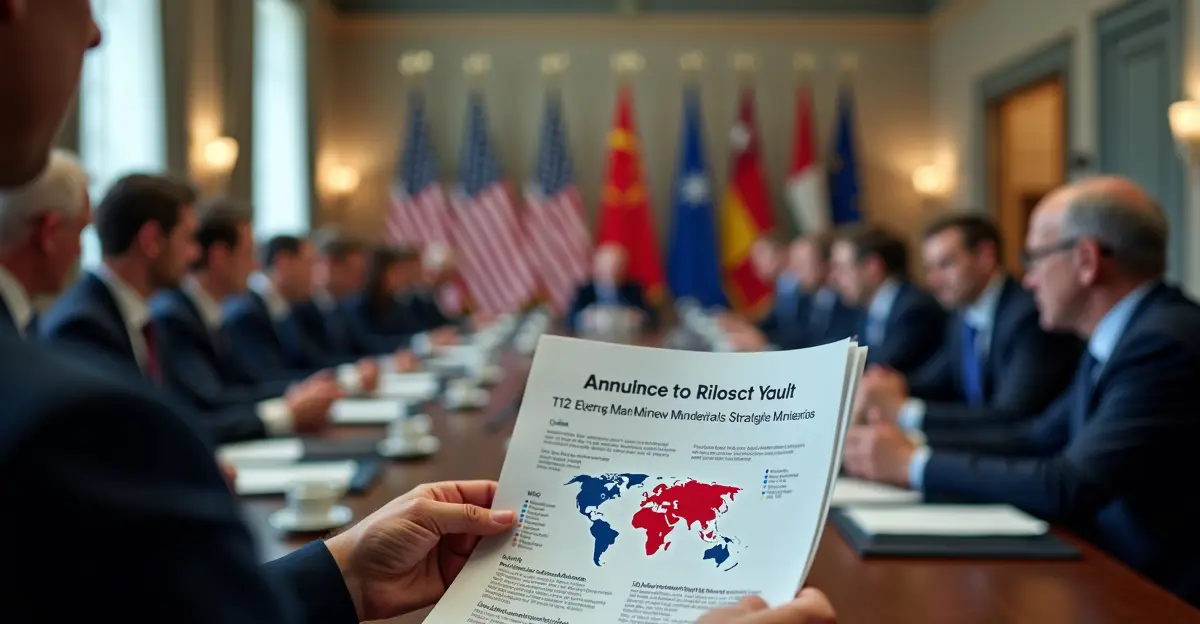
On February 4, 2026, the U.S. Department of State hosted the Critical Minerals Ministerial, led by Secretary of State Marco Rubio and Vice President JD Vance, with representatives from 54 countries and the European Commission. The centerpiece was the launch of FORGE (Forum on Resource Geostrategic Engagement), succeeding the Minerals Security Partnership. FORGE is designed as a plurilateral coalition creating a preferential trade-and-investment zone for critical minerals with coordinated price floors to counter adversarial market manipulation. Key outcomes included signing 11 new bilateral critical minerals frameworks or MOUs with countries such as Argentina, Morocco, the Philippines, and the UAE. The administration mobilized over $30 billion in U.S. government financing for strategic minerals projects over the past six months. Vice President Vance outlined reference prices at each production stage maintained through adjustable tariffs. The forum will be chaired by the Republic of Korea until June 2026.
Project Vault: A $12 Billion Strategic Reserve
Alongside FORGE, the Export-Import Bank of the United States (EXIM) launched Project Vault on February 2, 2026—a $12 billion public-private partnership (backed by $10 billion in EXIM loans and nearly $2 billion in private investment) to establish the U.S. Strategic Critical Minerals Reserve. Unlike the traditional National Defense Stockpile, Project Vault is an OEM-driven, demand-led commercial stockpile designed to store 60 critical minerals for civilian industries. Manufacturers identify critical materials, commit financially, and pay a commitment fee in exchange for access during market disruptions. The Federal Reserve will store materials across U.S. facilities. Support came from leaders at GE Vernova, Mercuria Energy Americas, Traxys, Hartree, Clarios, and Boeing. President Trump stated the reserve ensures American businesses and workers are never harmed by mineral shortages.
The EU's Strategic Projects Under the Critical Raw Materials Act
The European Union has been equally active. Under the Critical Raw Materials Act (CRM Act), which entered into force on 23 May 2024, the EU designated its first 60 Strategic Projects—47 within the EU and 13 in third countries—covering extraction, processing, recycling, or substitution stages. These projects span 14 raw materials including rare earths, lithium, cobalt, nickel, graphite, and copper. Notably, only ten recycling projects were selected in the first round, located in Italy, France, Finland, Poland, Spain, and Sweden. In 2026, the European Commission announced funding of up to €3 billion ($3.5 billion) and regulatory fast-tracking for strategic projects under the ReSourceEU Action Plan. Commission Executive Vice-President Stéphane Séjourné called this "another key step towards European sovereignty." The EU Critical Raw Materials Act aims to reduce Europe's dependence on China, which previously supplied 98% of its rare-earth needs, 97% of its lithium, and 93% of its magnesium.
Saudi Arabia and the UAE: The New Swing Players
As the U.S.-China rivalry intensifies, Gulf states are emerging as pivotal swing players. Saudi Arabia and the UAE are deploying over $100 billion in investments to secure lithium, copper, and rare earths, pivoting from oil to mineral leverage. Saudi Arabia's Vision 2030 and the UAE's economic diversification strategies position them as critical intermediaries. The UAE signed a bilateral critical minerals framework with the U.S. at the February 2026 Ministerial. These nations offer not only capital but also strategic geographic positioning and energy resources for processing. However, their alignment remains fluid—both maintain close economic ties with China while deepening security partnerships with the West. The Gulf critical minerals pivot could reshape global supply chains, but questions remain about whether these investments will translate into actual processing capacity within the West's narrow diversification window.
The 12-to-18-Month Window: Realistic or Wishful?
Western policymakers speak of a 12-to-18-month window to diversify critical mineral supply chains. Yet industry realities tell a different story. Typical mine-to-processing timelines range from 10 to 15 years due to permitting, construction, and technical challenges. Even with streamlined regulations and massive investment, building new rare-earth processing capacity outside China is a multi-year endeavor. The U.S. has not had a domestic rare-earth processing supply chain since the 1990s. Australia's Lynas Rare Earths, the world's largest non-Chinese producer, took over a decade to reach current capacity. The critical minerals supply chain diversification challenge is compounded by a shortage of skilled labor, environmental regulations, and the technical complexity of separating rare-earth elements. The 12-18 month window may be more about political urgency than operational feasibility—a deadline to secure funding, sign agreements, and begin construction, not to achieve self-sufficiency.
Impact on Defense, Energy Transition, and Global Trade
The critical minerals crisis has direct implications across multiple domains. Defense systems—from F-35 fighter jets to missile guidance systems—rely on rare-earth magnets. The energy transition requires massive quantities of lithium, cobalt, nickel, and rare earths for batteries, wind turbines, and electric vehicles. Global trade architecture is being reshaped as countries impose export controls, form preferential blocs, and subsidize domestic production. China's 15th Five-Year Plan (2026-2030), unveiled in March 2026, emphasizes enhancing energy and resource supply security, targeting 5.8 billion tons of standard coal in comprehensive energy production capacity and advancing rare earth and rare metal competitiveness. The IEA projects global critical mineral demand will nearly triple by 2030 and quadruple by 2050. The energy transition critical minerals race is intensifying competition for resources, with potential for both cooperation and conflict.
Expert Perspectives
"FORGE represents an ambitious attempt to practice statecraft through markets rather than around them," noted an Atlantic Council analysis. "The initiative's success will depend on transforming bilateral deals into genuine plurilateral coordination and designing effective price mechanisms without creating perverse incentives." CSIS analysts highlighted that Project Vault is "an OEM-driven, demand-led commercial stockpile" that differs fundamentally from traditional defense stockpiles. Meanwhile, a multi-institutional analysis of China's export controls concluded that Beijing is "weaponizing control rather than scarcity," using temporary restrictions to maintain pricing power while preventing large-scale Western alternative investment.
FAQ
What is FORGE?
FORGE (Forum on Resource Geostrategic Engagement) is a plurilateral coalition launched by the United States in February 2026 to create a preferential trade-and-investment zone for critical minerals, with coordinated price floors to counter market manipulation by adversarial nations. It succeeds the Minerals Security Partnership and includes 54 partner nations.
What is Project Vault?
Project Vault is a $12 billion public-private partnership backed by the U.S. Export-Import Bank to establish a Strategic Critical Minerals Reserve. It will store 60 critical minerals in secure facilities across the United States, providing manufacturers access during supply disruptions.
Why did rare-earth prices spike sixfold?
China's export controls on rare earths, tungsten, and antimony, imposed in 2025-2026, restricted supply to international markets. With China controlling 90% of rare-earth processing, prices outside China surged up to sixfold, while domestic Chinese prices remained far lower, creating a dual pricing structure.
Can the West diversify supply chains within 18 months?
Industry experts consider the 12-to-18-month window unrealistic for full diversification. Typical mine-to-processing timelines are 10-15 years. The window is better understood as a political deadline to secure funding, sign agreements, and begin construction, rather than achieve self-sufficiency.
What role will Saudi Arabia and the UAE play?
Saudi Arabia and the UAE are emerging as swing players, deploying over $100 billion in critical mineral investments. They offer capital, strategic geography, and energy resources, but their alignment remains fluid between China and the West, making them pivotal but unpredictable partners.
Conclusion
The critical minerals landscape of 2026 is defined by a race against time. China's export controls have exposed deep vulnerabilities in Western supply chains, triggering unprecedented policy responses from the U.S. and EU. FORGE and Project Vault represent ambitious attempts to build alternative frameworks, while the Gulf states position themselves as potential kingmakers. Yet the fundamental challenge remains: building new processing capacity takes years, not months. The next 12-18 months will determine whether the West can lay the groundwork for genuine diversification—or whether China's dominance becomes permanently entrenched. As the critical minerals geopolitical fault line deepens, the stakes for global security, energy transition, and economic stability have never been higher.

Follow Discussion