


 Deutsch
 English
 Español
 Français
 Nederlands
 Português


 Share
Share




China's tightened export controls on rare earths, tungsten, and antimony have triggered sixfold price spikes and exposed acute Western supply chain fragility, making critical mineral leverage the defining geopolitical and economic story of 2026. With Beijing controlling 90% of global rare earth processing and European license approvals falling below 25%, the defense sector and energy transition face a strategic narrowing window. The F-35 fighter jet, for example, requires approximately 418 kilograms of rare earth elements per airframe for magnets, radar systems, stealth coatings, and missile guidance. As China temporarily suspended export controls until November 10, 2026, the West faces a critical 12-18 month window to build alternatives or accept prolonged dependency.
China's Dominance and the Weaponization of Supply
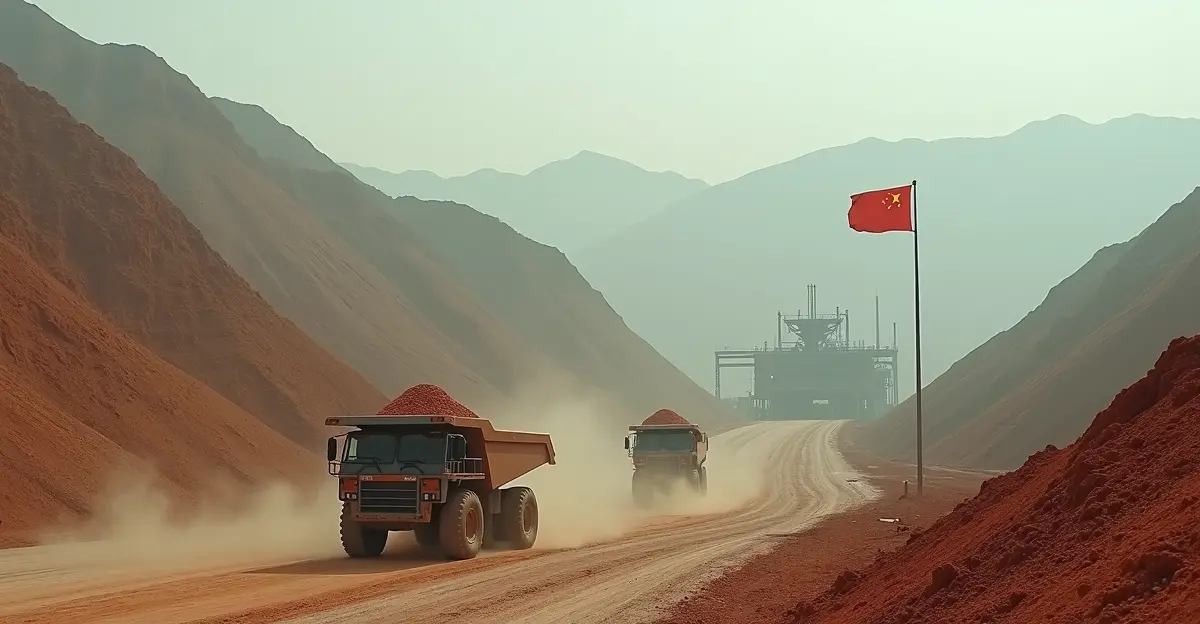
China's stranglehold on critical minerals is not accidental but the result of decades of strategic investment. The country controls roughly 90% of global rare earth processing, 80% of tungsten refining, and 60% of antimony production. In late 2025 and early 2026, Beijing escalated export controls on these materials, triggering dramatic price spikes: antimony surged from $1,400 to $51,500 per metric ton, while rare earth prices rose sixfold. The EU depends on China for 98-99% of its rare earth supply, and over 80% of European companies rely on Chinese supply chains for materials essential to defense, electric vehicles, and renewable energy.
The EU Critical Raw Materials Act has designated 47 Strategic Projects to boost domestic capacity, but these remain in early stages. Licensing approval rates for European firms seeking Chinese export permits have fallen below 25%, effectively creating a non-tariff barrier that threatens industrial output across the Atlantic alliance.
The FORGE Alliance: A $30 Billion Counter-Effort
In February 2026, the United States launched the FORGE Alliance (Forum on Resource Geostrategic Engagement) in Washington, D.C., convening 54 nations and the European Commission. Chaired by South Korea through June 2026, FORGE succeeds the Minerals Security Partnership and directly targets China's near-monopoly on rare earths. The alliance mobilizes over $30 billion in financing, including the Export-Import Bank's Project Vault — a $10-12 billion public-private partnership establishing the U.S. Strategic Critical Minerals Reserve.
Key outcomes include 11 new bilateral critical minerals framework agreements signed with countries including Argentina, Morocco, Peru, the Philippines, the UAE, and the United Kingdom, bringing the total to 21 deals. FORGE creates a preferential trade-and-investment zone with coordinated price floors backed by adjustable tariffs to counter adversarial market manipulation. The Minerals Security Partnership successor represents the most coordinated Western effort to rewire strategic supply chains since the Cold War.
Project Vault and Domestic Processing
The U.S. has committed over $7.3 billion across government agencies, including a $400 million equity investment in MP Materials with a $110/kg price floor for neodymium-praseodymium. Project Vault aims to stockpile critical minerals while domestic processing capacity is built. However, analysts warn that rebuilding independent Western processing capacity would take 20-30 years, far exceeding the current geopolitical window.
The Gulf Pivot: Saudi Arabia and UAE Enter the Race
Saudi Arabia and the United Arab Emirates are emerging as pivotal players in the critical minerals landscape, pivoting from oil dependency to mineral resource leverage. Saudi Arabia, under Vision 2030, has upgraded its mineral wealth estimate to $2.5 trillion and aims to mobilize $100 billion in mining investments by 2035. Manara Minerals, a joint venture between the Public Investment Fund and Ma'aden, is pursuing global acquisitions, while partnerships with MP Materials and Lynas Rare Earths target domestic rare earth processing.
The UAE, through sovereign funds ADQ and Mubadala, has committed over $3 billion to critical mineral consortia targeting lithium, copper, and rare earths. The $1.8 billion Orion Critical Mineral Consortium, backed by the U.S. International Development Finance Corporation, exemplifies the Gulf's strategy of leveraging financial capital and strategic geography to offer Western markets alternative supply chains. However, these states must balance ties with China — their largest oil customer — with Western de-risking efforts. The Gulf critical minerals strategy could reshape global supply dynamics if executed successfully.
Defense and Energy Transition at Risk
The implications for defense readiness are stark. Each F-35 fighter jet requires approximately 418 kg of rare earth elements, including neodymium, samarium, dysprosium, terbium, and yttrium, used in powerful magnets, radar systems, and missile guidance. Lockheed Martin uses roughly 22.6 kg of samarium per aircraft. The F-35 Block 4 upgrade has been delayed from 2026 to possibly 2031 and is over budget by $6 billion, partly due to supply chain vulnerabilities. Beyond defense, the energy transition depends on rare earths for electric vehicle motors and wind turbine generators. China's control over processing means that any disruption directly impacts the pace of renewable energy deployment worldwide.
The F-35 rare earth dependency illustrates a broader vulnerability: Western militaries and green industries alike are exposed to a single point of failure in Chinese-controlled supply chains.
Expert Perspectives
"China is weaponizing control — not scarcity — by using temporary, reversible restrictions to maintain pricing power and extract concessions while discouraging Western alternatives," notes a multi-institutional analysis published in early 2026. "The suspension of export controls until November 2026 is a calibrated regulatory pause, not a structural policy reversal."
Analysts at the Center for Strategic and International Studies (CSIS) observe that while U.S. imports of rare earths have never recovered to pre-restriction levels, European shipments have partially rebounded. The CSIS report concludes that "true supply chain resilience requires sustained domestic output and diversified supply chains outside of China."
FAQ
What are China's critical mineral export controls?
China has imposed export controls on rare earths, tungsten, antimony, gallium, and other critical minerals since 2025, requiring licenses for overseas shipments. In April 2026, China temporarily suspended these controls until November 10, 2026, but the underlying regulatory framework remains in place.
Why are rare earths important for defense?
Rare earths are essential for permanent magnets in missile guidance systems, radar, stealth coatings, and electric motors. The F-35 fighter jet requires about 418 kg of rare earth elements per aircraft, making supply chain security a national security priority.
What is the FORGE Alliance?
The Forum on Resource Geostrategic Engagement (FORGE) is a U.S.-led alliance of 54 nations launched in February 2026 to counter China's dominance in critical minerals. It mobilizes over $30 billion in financing for mining, processing, and stockpiling projects outside China.
Can the West build independent supply chains quickly?
Analysts estimate that rebuilding independent Western rare earth processing capacity would take 20-30 years. The current 12-18 month window before China potentially reimposes controls is considered critical for making strategic investments.
How are Gulf states involved?
Saudi Arabia and the UAE are investing heavily in critical minerals, with Saudi Arabia targeting $100 billion in mining investments by 2035 and the UAE committing over $3 billion to consortia targeting lithium, copper, and rare earths. They aim to become alternative suppliers to Western markets.
Conclusion: A Narrowing Window
The temporary suspension of China's export controls until November 2026 offers a breathing space, but not a solution. The West faces a strategic choice: invest heavily in domestic and allied processing capacity within a narrowing 12-18 month window, or accept managed dependence on Chinese supply chains with all the geopolitical leverage that entails. The FORGE alliance, Gulf investments, and European strategic projects represent the beginning of a response, but the scale of investment required — estimated at $400 billion by 2035 for full independence — dwarfs current commitments. As the November 2026 deadline approaches, the critical mineral question will determine not just industrial competitiveness, but the strategic autonomy of the Western alliance.



Follow Discussion