


 Deutsch
 English
 Español
 Français
 Nederlands
 Português


 Share
Share




China's 2026 export controls on rare earths, tungsten, and antimony have triggered up to sixfold price spikes outside China, with European licensing approvals falling below 25% in key sectors. This analysis examines how Beijing is weaponizing its 90% control of global rare earth processing to extract geopolitical concessions, forcing Western governments to confront a strategic vulnerability that could take 20-30 years to resolve.
Background: China's Dominance in Critical Minerals
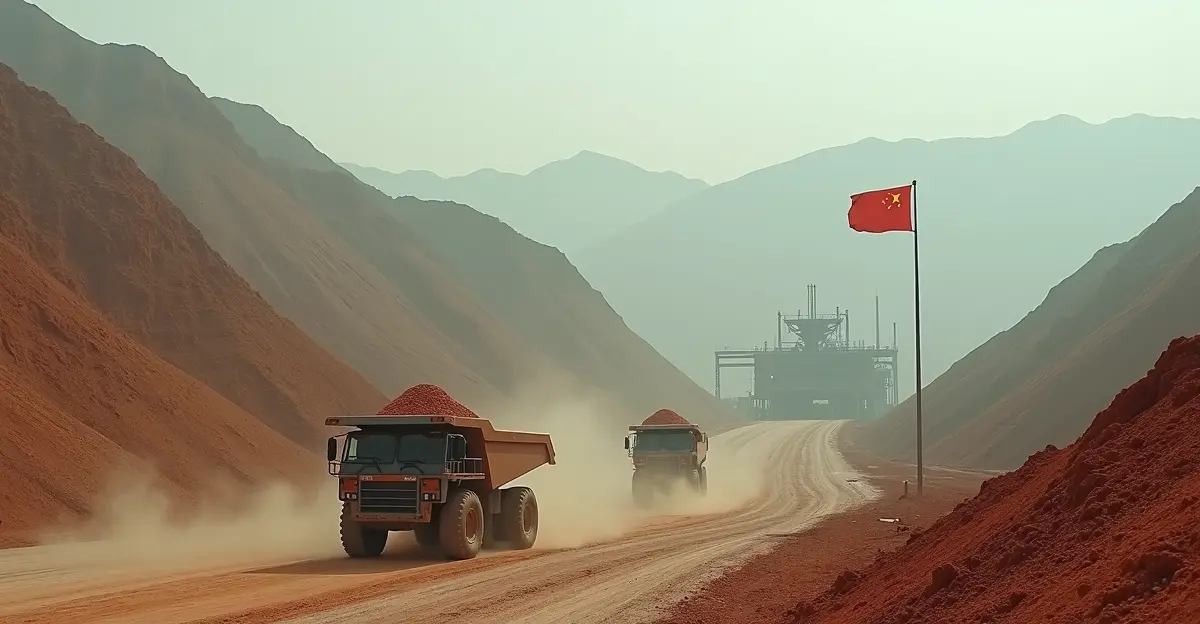
China controls approximately 90% of global rare earth processing, 80% of tungsten, and 60% of antimony, according to a multi-institutional analysis drawing on data from the European Parliament Research Service, OECD, and CSIS. The International Energy Agency estimated that China accounted for about 91% of global separation and refining production and 94% of sintered permanent magnet production in 2024. The United States Geological Survey reported China's reserves at 44 million tonnes (rare-earth-oxide equivalent) in its February 2026 Mineral Commodity Summaries.
Since 2016, China has implemented export controls on certain rare-earth elements and processing technology. In 2025, it introduced two waves of export controls covering rare-earth elements and related products and technologies, with the second wave later suspended for one year. In 2026, automatized real-time controls and penalties were introduced in the rare-earth industry, further tightening Beijing's grip on global supply chains.
How 2025-2026 Export Controls Are Reshaping Markets
Price Spikes and Licensing Bottlenecks
The export controls introduced in 2025-2026 triggered dramatic price surges. Dysprosium oxide rose 212% year-on-year, while samarium saw sixfold price increases. Tungsten and antimony prices also spiked sharply. Over 80% of European companies depend on Chinese supply chains for critical minerals essential to defense, EVs, and renewable energy, while licensing approval rates for European firms have fallen below 25%.
Beijing's Strategy: Weaponizing Control, Not Scarcity
Analysts argue that China is weaponizing control rather than scarcity—using temporary, reversible restrictions to maintain pricing power and extract strategic concessions while preventing large-scale Western alternative investment. The European Critical Raw Materials Act and similar initiatives aim to reduce dependence, but rebuilding independent supply chains could take 20-30 years, far exceeding the current geopolitical window. Western nations face a narrowing 12-18 month window to act decisively or face prolonged structural dependency.
Western Diversification Efforts: FORGE, Project Vault, and Beyond
The FORGE Alliance
On February 4, 2026, the U.S. State Department launched FORGE (Forum on Resource Geostrategic Engagement), a plurilateral coalition of 54 nations and the European Commission, succeeding the Minerals Security Partnership. Backed by over $30 billion in U.S. financing, FORGE creates a preferential trade-and-investment zone with coordinated price floors. The initiative includes 21 bilateral framework agreements signed in five months, covering two-thirds of the global economy. Secretary of State Marco Rubio emphasized addressing opaque pricing and coercive supply chain leverage.
Project Vault and U.S. Strategic Reserve
The Export-Import Bank of the United States announced Project Vault on February 2, 2026—a $12 billion initiative to establish the U.S. Strategic Critical Minerals Reserve. Funded by a $10 billion EXIM loan and nearly $2 billion in private-sector investment, the reserve will store essential raw materials in secure facilities across the country. Unlike the Strategic Petroleum Reserve, Project Vault uses a hybrid model where private firms pay subscription fees for access during disruptions.
Australia-U.S. Framework and New Mining Projects
Australia and the United States signed the 'United States–Australia Framework for Securing of Supply in the Mining and Processing of Critical Minerals and Rare Earths' in October 2025, committing at least US$1 billion each within six months within a project pipeline valued at approximately US$8.5 billion. Two initial priority projects include the Alcoa–Sojitz Gallium Recovery Project in Western Australia and the Arafura Rare Earths Nolans Project in the Northern Territory. Western Australia's Mines and Petroleum Minister David Michael led a delegation of critical minerals companies to Canada and the U.S. in February 2026 to strengthen strategic partnerships.
Can the West Build Alternatives Within the 12-18 Month Window?
Three strategic paths exist for the West: managed dependence, costly independence, or a hybrid resilience model combining stockpiles, diversified sourcing, recycling, and material substitution. The hybrid model is increasingly favored as it can be implemented within the critical window. However, challenges remain significant. The Peterson Institute for International Economics identified key obstacles: voluntary participation risks excluding small firms, storing 60 differentiated minerals is more complex than oil stockpiling, and processing capacity remains heavily concentrated in China.
If current projects succeed according to bullish estimates, China's market share could drop from ~90% to ~75% by 2028, but industrial policy is likely necessary to accelerate progress. The U.S. Department of Energy's Office of Clean Energy Demonstrations offers $134 million for rare earth demonstration facilities, $275 million for battery/defense mineral recovery from waste streams, and $150 million for critical materials R&D. The Department of Defense leverages DPA Title III with $7.5 billion for strategic materials investments.
Expert Perspectives
"China's strategy is not about scarcity but reversible restrictions—using temporary suspensions to discourage Western investment in independent supply chains, which would take 20-30 years and cost tens of billions," notes a multi-institutional analysis from RareEarthExchanges.com. "Western nations face a narrowing 12-18 month window to act decisively or accept prolonged structural dependency."
Cullen S. Hendrix of the Peterson Institute for International Economics, in a May 2026 policy brief, recommends mandatory participation scaled to firm size, funding against worst-case supply shocks, prioritizing processed materials over raw ore, and investing in US and allied processing capacity to reduce near-term dependence on Chinese suppliers.
FAQ
What critical minerals does China control?
China controls approximately 90% of global rare earth processing, 80% of tungsten, and 60% of antimony. It also dominates processing for lithium, cobalt, and other strategic materials.
How much have prices increased due to China's export controls?
Prices for some rare earths surged up to sixfold. Dysprosium oxide rose 212% year-on-year, and samarium saw sixfold price increases. Tungsten and antimony also experienced sharp price spikes.
What is the FORGE alliance?
FORGE (Forum on Resource Geostrategic Engagement) is a 54-nation coalition launched by the U.S. in February 2026, backed by over $30 billion in financing, to build an alternative critical minerals supply chain and challenge China's dominance.
What is Project Vault?
Project Vault is a $12 billion U.S. public-private initiative to establish a Strategic Critical Minerals Reserve, funded by a $10 billion EXIM loan and $2 billion in private capital, storing essential raw materials for defense, energy, and technology sectors.
Can the West reduce dependence on China within 12-18 months?
Analysts warn of a narrowing 12-18 month window for decisive action. A hybrid resilience model combining stockpiles, diversified sourcing, recycling, and material substitution is considered the most feasible path, but rebuilding fully independent supply chains could take 20-30 years.
Conclusion: A Race Against Time
China's 2026 export controls have escalated from a trade friction to a full-blown strategic crisis, with defense, EV, and renewable energy supply chains now acutely exposed. Major policy decisions in Washington, Brussels, and Tokyo hinge on how this critical minerals showdown unfolds this year. The FORGE alliance and Project Vault represent ambitious Western responses, but the clock is ticking. Whether the West can build viable alternatives within the narrowing 12-18 month window will determine the future of global supply chain security for decades to come.
Follow Discussion