


 Deutsch
 English
 Español
 Français
 Nederlands
 Português


 Share
Share




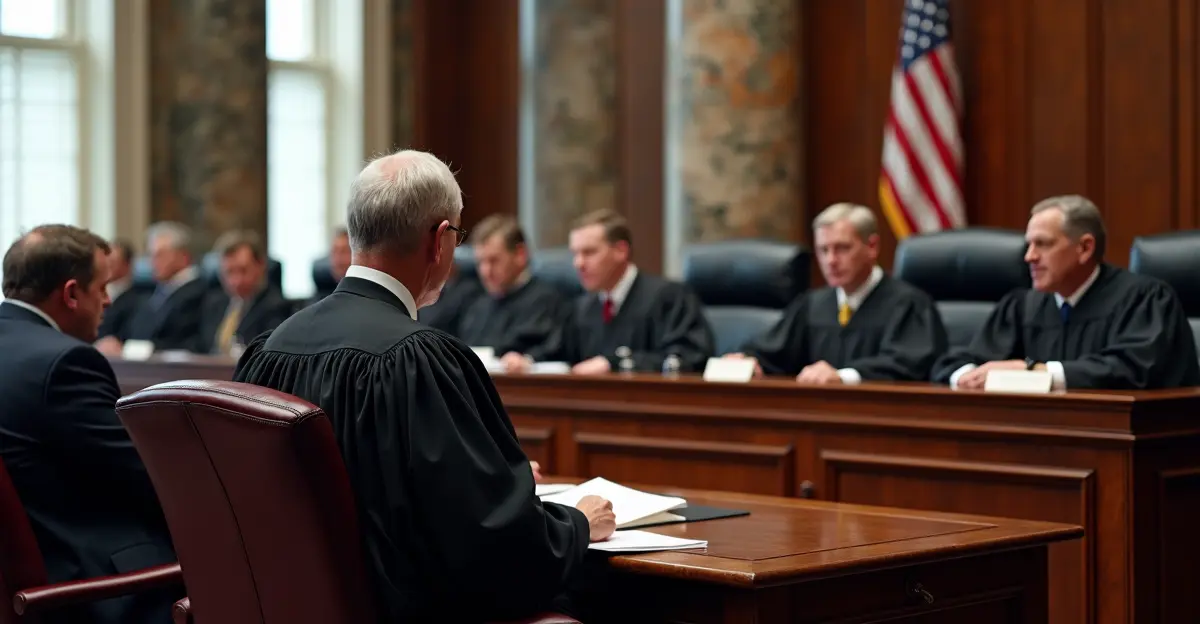
In a landmark 6-3 decision on February 20, 2026, the US Supreme Court ruled that the International Emergency Economic Powers Act (IEEPA) does not authorize the president to impose broad tariffs, striking down a cornerstone of recent trade policy and sending shockwaves through global supply chains. The ruling in Learning Resources, Inc. v. Trump held that IEEPA is not a tariff statute, forcing the administration to pivot to Section 122 of the Trade Act of 1974—only to have that authority curtailed by the US Court of International Trade (CIT) in May 2026. This legal unraveling has created unprecedented uncertainty for multinational firms and accelerated the fragmentation of world trade into competing blocs.
Background: The Rise and Fall of IEEPA Tariffs
Since February 2025, the Trump administration had imposed additional ad valorem duties under IEEPA, citing national emergencies related to illicit drug flows, synthetic opioids from China, and trade deficits. These tariffs affected billions of dollars in imports and were defended as emergency economic measures. However, importers and legal scholars argued that IEEPA—designed for asset freezes and sanctions—was never intended to authorize broad tariff powers. The Supreme Court agreed, with the majority opinion stating that "IEEPA is not a tariff statute" and that challenges to such measures fall within the exclusive jurisdiction of the CIT under 28 U.S.C. § 1581(i). The decision effectively invalidated nine executive orders dating back to 2025.
The ruling forced the White House to issue an Executive Order on February 20, 2026, terminating IEEPA-based duties and pivoting to a temporary 10% ad valorem surcharge under Section 122 of the Trade Act of 1974, citing a "large and serious balance-of-payments deficit." However, the legal limits of presidential trade authority quickly became the next battleground.
The Section 122 Pivot and CIT's May 2026 Decision
Section 122 allows the president to impose temporary import surcharges for up to 150 days to address balance-of-payments deficits. On May 7, 2026, the CIT ruled 2-1 in State of Oregon v. United States that Proclamation 11012 was unlawful. The court found that "balance-of-payments deficits" under Section 122 refers to specific historical measures of US currency liquidity and official settlements, not modern metrics like the current account or trade deficit. The CIT granted a permanent injunction for the named plaintiffs—Burlap & Barrel, Basic Fun, Inc., and the State of Washington—and ordered refunds of duties paid, but declined to issue a universal injunction. This created a fragmented landscape where only those specific importers received relief, leaving thousands of others in legal limbo.
The CIT's narrow remedy has sparked a wave of individual lawsuits, with multinational supply chain disruption becoming a central concern for businesses. The administration has signaled it will appeal, but the legal uncertainty is already reshaping corporate strategy.
Impact on Global Trade Architecture
The Supreme Court's IEEPA ruling and the CIT's Section 122 decision have created what legal experts call a "live constitutional crisis" over trade authority. For decades, presidents have wielded significant tariff powers under various statutes, but these rulings have sharply curtailed executive discretion. The immediate effect has been a scramble among multinational firms to reassess supply chains, with many accelerating diversification away from the US market.
The fragmentation of world trade into competing blocs is now accelerating faster than any policy directive could achieve. The European Union has responded by deepening its own trade defense mechanisms, including the Anti-Coercion Instrument and the Carbon Border Adjustment Mechanism (CBAM). China has moved to strengthen its Regional Comprehensive Economic Partnership (RCEP) ties, while middle powers like India, Brazil, and South Korea are hedging their bets by forming new bilateral agreements.
Retaliatory Realignments
In the wake of the US legal turmoil, the EU announced in March 2026 a new "Trade Resilience Initiative" aimed at reducing dependency on US markets for critical goods. China, meanwhile, has accelerated de-dollarization efforts and expanded yuan-denominated trade settlements with Russia, Saudi Arabia, and ASEAN nations. The three-bloc trading system—US-led, EU-led, and China-led—is becoming a reality, with each bloc developing its own standards, currencies, and dispute resolution mechanisms.
Expert Perspectives
"This is the most consequential legal development for global trade architecture in decades," said Amelia Johansson, trade policy analyst at the Peterson Institute. "The courts have effectively told the executive branch that tariff authority lies with Congress. Until Congress acts, we are in a vacuum that will be filled by litigation and executive improvisation."
Former US Trade Representative Robert Lighthizer criticized the rulings, arguing that they hamstring the president's ability to respond to national emergencies. "The courts have tied the president's hands at a time when China is using every tool in its arsenal," he told reporters.
FAQ: Understanding the IEEPA and Section 122 Rulings
What did the Supreme Court decide about IEEPA tariffs?
The Supreme Court ruled 6-3 that IEEPA does not authorize the president to impose tariffs, striking down all IEEPA-based duties imposed since 2025. The decision affirmed that IEEPA is a sanctions statute, not a tariff statute.
What is Section 122 of the Trade Act of 1974?
Section 122 allows the president to impose temporary import surcharges for up to 150 days to address balance-of-payments deficits. The CIT ruled in May 2026 that the administration's use of this authority was unlawful because the deficit cited did not meet the statutory definition.
Are the tariffs still in effect?
The IEEPA tariffs have been terminated. The Section 122 surcharge remains in effect for most importers, but the CIT's ruling only provides relief to the specific plaintiffs. Other importers must continue paying duties while pursuing individual legal challenges.
What does this mean for global supply chains?
The legal uncertainty is accelerating supply chain diversification away from the US, contributing to the fragmentation of world trade into US-led, EU-led, and China-led blocs. Multinational firms are increasingly adopting "China+1" or "nearshoring" strategies.
Will Congress step in?
There is growing bipartisan pressure for Congress to clarify presidential tariff authority. Several bills have been introduced, but no consensus has emerged. The future of US trade policy remains uncertain.
Conclusion: A New Era of Trade Fragmentation
The Supreme Court's IEEPA ruling and the CIT's Section 122 decision have fundamentally altered the landscape of US trade policy. By reining in executive tariff authority, the courts have triggered a constitutional crisis that is reshaping global trade architecture in real time. For multinational firms, the message is clear: the era of predictable US trade policy is over, and navigating a three-bloc world will require unprecedented agility. As legal battles continue and Congress debates new legislation, the only certainty is uncertainty.



Follow Discussion