


 Deutsch
 English
 Español
 Français
 Nederlands
 Português


 Share
Share




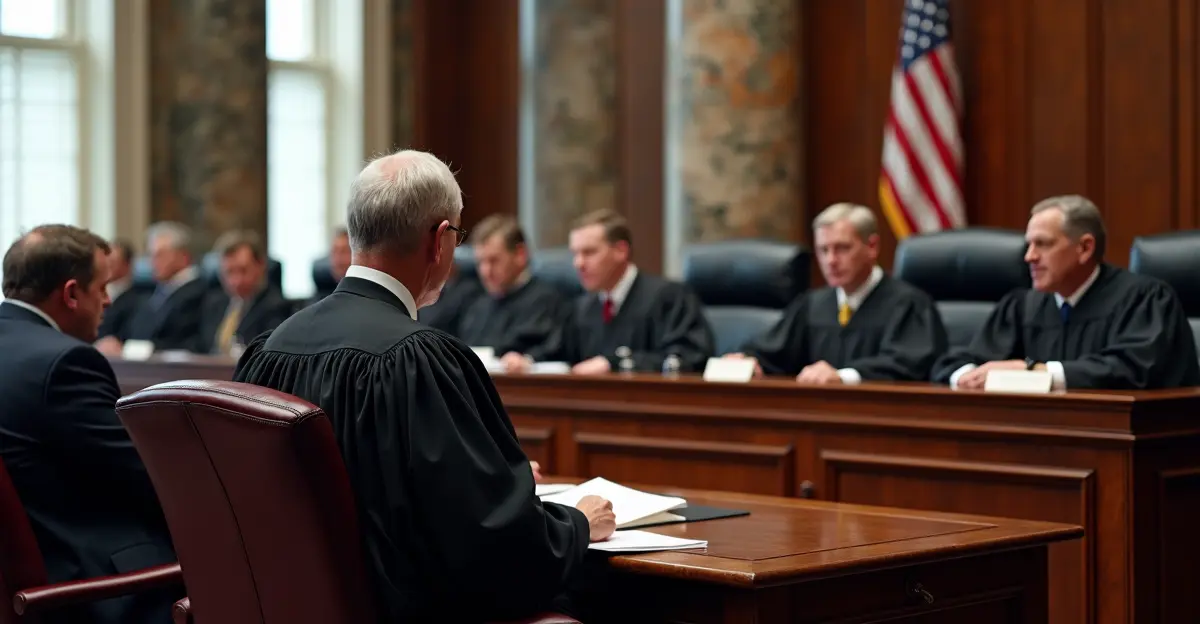
In a landmark 6-3 decision on February 20, 2026, the U.S. Supreme Court struck down presidential tariff authority under the International Emergency Economic Powers Act (IEEPA), triggering an immediate reimposition of levies under the Tariff Act of 1974 and accelerating the fragmentation of global trade. The ruling in Learning Resources, Inc. v. Trump invalidated nine executive orders dating back to 2025, creating what legal experts describe as a constitutional crisis over trade authority. The decision has deepened supply chain decoupling between the United States and China, with bilateral trade declining an estimated 30%, while ASEAN economies absorb redirected trade flows.
Background: The Legal Battle Over Tariff Authority
The International Emergency Economic Powers Act, enacted in 1977, was designed to allow presidents to regulate international commerce during declared national emergencies. However, the Supreme Court ruled that IEEPA does not authorize the president to impose broad tariffs, citing the Constitution's assignment of tariff power to Congress. The case originated from President Trump's February 1, 2025 executive orders imposing tariffs on imports from Mexico, Canada, and China, later expanded globally on April 2, 2025, with rates reaching up to 50 percent on nearly 90 companies. Various corporations and states challenged the orders, leading to Learning Resources v. Trump reaching the highest court.
The constitutional separation of powers debate centered on whether IEEPA's emergency powers could justify sweeping trade measures. The Court's majority opinion, authored by Chief Justice Roberts, held that "the power to impose tariffs is a core legislative function that Congress has not delegated through IEEPA." Within hours of the ruling, the administration pivoted to Section 122 of the Trade Act of 1974, which allows the president to impose tariffs of up to 15% for up to 150 days in response to "large and serious" balance-of-payments deficits.
Immediate Fallout: The Section 122 Surcharge
On February 20, 2026, President Trump signed a proclamation imposing a temporary 10% ad valorem import duty on articles imported into the United States, effective February 24 for 150 days, citing a $1.2 trillion annual goods trade deficit and a current account deficit of 4.0% of GDP. The White House fact sheet described tariffs as "a critical tool to reshape the global trading system." However, the U.S. Court of International Trade ruled in May 2026 that this use of Section 122 was also unlawful, deepening the trade policy legal uncertainty for businesses.
US-China Trade: A 30% Decline and Supply Chain Decoupling
The Supreme Court ruling has accelerated the decoupling of the world's two largest economies. According to the McKinsey Global Institute's March 2026 report, US-China trade fell roughly 30% due to tariffs, with the United States replacing about two-thirds of the gap from other sellers while Chinese exporters slashed prices 8% on average to find new markets. The U.S. goods trade deficit with China shrank by over 30% between April 2025 and February 2026, directly impacting China's export sector and raising questions about its GDP growth targets.
Multinational corporations are permanently redesigning supplier networks around geopolitical rather than purely economic logic. The global supply chain restructuring has shifted from globalized just-in-time models to regionalized 'local-for-local' configurations. Companies adopted 'China+1' sourcing strategies, shifting production to Vietnam (whose exports surged 26%), Mexico, and other Southeast Asian nations. The tech sector has been hit hardest, while automakers redesigned supply routes entirely.
ASEAN: The New Manufacturing Nexus
Southeast Asia has become the primary beneficiary of redirected trade flows. Vietnam now supplies 75% of US solar panel imports and is projected to grow 15-20% in low-carbon tech manufacturing. Malaysia secured a $70 billion US investment pledge in exchange for tariff exemptions on semiconductors. However, the region faces risks including transshipment crackdowns with penalties up to 250%, Chinese input dependency, and potential 100% tariffs on semiconductors. The China-ASEAN-US "Through-Route" model has emerged, where high-intensity processes remain in China while final assembly and tariff-sensitive steps are sited in ASEAN.
Erosion of the Dollar-Centric System
The crisis of tariff credibility is accelerating the fragmentation of the dollar-based financial system. BRICS+ nations are advancing alternative payment corridors, with intra-bloc local currency settlements surging past 67%. Central bank gold purchases reached a record 1,237 tonnes in 2025, and the dollar's share of global reserves has dropped below 57% for the first time in 30 years. BRICS launched BRICS Pay, an independent payment system bypassing SWIFT that integrates China's CIPS (which processed $14.7 trillion in 2025), and 'The Unit,' a gold-backed digital settlement token.
The de-dollarization trend in global trade is driven by the weaponization of financial sanctions, rising U.S. sovereign debt exceeding $36 trillion, and the fracturing of the petrodollar system after Saudi Arabia's 50-year oil exclusivity deal expired in 2024. Over 90% of trade between Russia, India, and China now occurs without dollars. While the dollar still dominates 88% of forex turnover, experts suggest this marks the beginning of a more diversified, multipolar financial system.
Strategic Implications for Multinationals
The World Economic Forum's January 2026 analysis outlines five strategic shifts reshaping business decisions: supply chain restructuring toward regionalization, capital expenditure reallocation to the US, Southeast Asia, and India, M&A strategy focused on resilience, enterprise risk management using scenario planning, and corporate governance transformation with boards becoming active strategic partners. Only 13% of organizations have deployed AI at scale for supply chain visibility, highlighting a significant capability gap.
Companies are now prioritizing geopolitical risk in supply chains over cost efficiency, a fundamental reversal of decades-old sourcing logic. The EU launched a 'Trade Resilience Initiative' while China expands its de-dollarization efforts, creating three competing trade blocs: US-led, EU-led, and China-led.
Expert Perspectives
"This is the most consequential trade architecture event of the year," said trade economist Dr. Sarah Chen of the Peterson Institute. "The Supreme Court has fundamentally altered the balance of power between Congress and the presidency on trade, and the ripple effects will be felt for decades." Legal scholar Prof. Michael Harrington of Harvard Law added: "The administration's pivot to Section 122 was always legally fragile. We are now in uncharted constitutional waters where no one is certain who has the authority to set tariff policy."
FAQ
What did the Supreme Court rule on tariffs in 2026?
On February 20, 2026, the Supreme Court ruled 6-3 in Learning Resources v. Trump that the International Emergency Economic Powers Act (IEEPA) does not authorize the president to impose broad tariffs, striking down nine executive orders.
How much has US-China trade declined?
US-China trade fell an estimated 30% due to tariffs, with the U.S. goods trade deficit with China shrinking by over 30% between April 2025 and February 2026.
What is Section 122 of the Trade Act of 1974?
Section 122 allows the president to impose tariffs of up to 15% for up to 150 days in response to "large and serious" balance-of-payments deficits. The administration used this after the Supreme Court ruling, but it was also ruled unlawful by the Court of International Trade in May 2026.
How are supply chains changing?
Multinationals are shifting from globalized just-in-time models to regionalized 'local-for-local' configurations, adopting 'China+1' sourcing to Vietnam, Mexico, and Southeast Asia, and prioritizing geopolitical security over cost efficiency.
Is the dollar losing its dominance?
The dollar's share of global reserves has dropped below 57% for the first time in 30 years, and BRICS nations are advancing alternative payment systems. However, the dollar still dominates 88% of forex turnover, suggesting a gradual transition to a multipolar system rather than an immediate collapse.
Conclusion and Future Outlook
The Supreme Court's tariff ruling has set in motion forces that will reshape global trade architecture for years to come. With Congress yet to clarify tariff authority, businesses face unprecedented legal uncertainty. The fragmentation of trade into competing blocs, the acceleration of de-dollarization, and the permanent redesign of supply chains around geopolitical logic represent a fundamental shift away from the post-Cold War liberal economic order. As Dr. Chen noted: "We are witnessing the end of one era and the beginning of another—one defined not by efficiency, but by resilience and geopolitical alignment."




Follow Discussion