


 Deutsch
 English
 Español
 Français
 Nederlands
 Português


 Share





Four American volunteers stepped out of a 3D-printed habitat in Houston on 31 October 2026, completing a 378-day NASA Mars simulation that tested how humans cope with the isolation, communication delays and tight resources of a future mission to the Red Planet. The CHAPEA 2 crew — Ross Elder, Ellen Ellis, Matthew Montgomery and James Spicer — had been sealed inside the 1,700-square-foot (about 160 square metres) Mars Dune Alpha facility at NASA’s Johnson Space Center since 19 October 2025.
The four emerged to cheers, ending the second of three planned CHAPEA missions, short for Crew Health and Performance Exploration Analog. For 378 days they worked, exercised, ate and slept almost entirely cut off from the outside world, with messages delayed by roughly 22 minutes to mimic the time a signal takes to travel between Earth and Mars.
What is the NASA CHAPEA Mars simulation?
CHAPEA is a ground-based analog program run by NASA at Johnson Space Center in Houston, Texas. Rather than launching into space, volunteers live inside a simulated Mars habitat so researchers can study the physical and psychological toll of long-duration isolation. The NASA CHAPEA analog program is one of several Mars analogs designed to prepare for a future crewed voyage to the Red Planet.
The participants were not trained astronauts. Applicants had to be US citizens or permanent residents aged 30 to 55, in good health, motivated, non-smoking and hold a university degree in a natural-science or STEM field. NASA said the requirements helped ensure the crew could handle both technical tasks and the mental strain of confinement.
Inside the 3D-printed Mars Dune Alpha habitat
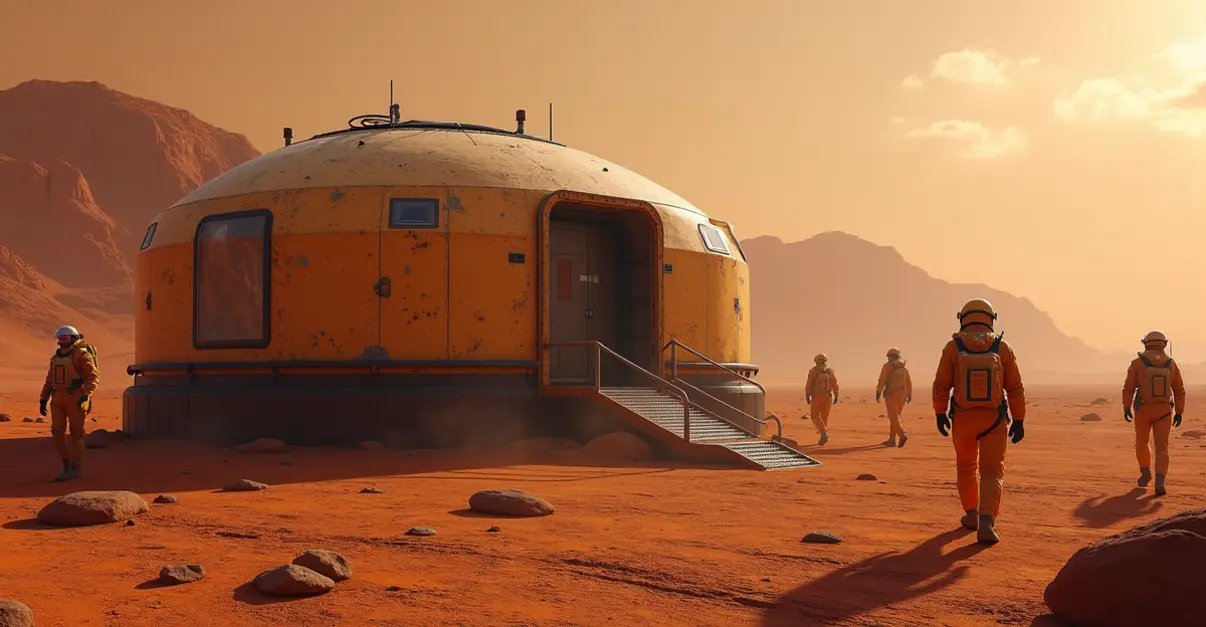
Mars Dune Alpha was built from lava concrete using a 3D printer, a construction method NASA believes could be used for future lunar or Martian settlements. Printing habitats on site would avoid launching large amounts of building material from Earth, which NASA says would be extremely expensive. The roughly 160-square-metre interior included private quarters, a shared living and dining area, a workspace with a vertical farm, a medical station and an airlock leading to a simulated Martian surface.
Key features of the Mars Dune Alpha habitat:
- 3D-printed lava-concrete walls and about 158 square metres of floor space
- Private crew quarters, exercise area, recreation space and vertical crop farm
- Airlock to a mock Martian surface with red soil and a VR-equipped exterior zone
- 22-minute communication delay and limited water, food and equipment supplies
The habitat echoes NASA’s earlier 3D-printed habitat challenge, which awarded more than US$2 million to teams between 2015 and 2019 to advance construction technologies for deep-space housing.
How the CHAPEA 2 crew spent 378 days
The volunteers maintained the habitat, repaired deliberately stressed equipment, grew crops and exercised daily so NASA could monitor the health effects of confinement. They also simulated spacewalks using virtual-reality headsets in a small exterior area, mimicking the work astronauts would perform on the Martian surface.
Flight engineer James Spicer said he was glad simply to step outside and “feel the sun, or a heavy downpour.” Medical officer Ellen Ellis thanked her colleagues for their professionalism and camaraderie and said she looked forward to hugging her husband. Commander Ross Elder said the crew was “honoured and proud to have contributed to the colossal undertaking that will ultimately lead to sending the first humans to Mars.”
| Mission | Start | End | Duration |
|---|---|---|---|
| CHAPEA 1 | 25 June 2023 | 6 July 2024 | 378 days |
| CHAPEA 2 | 19 Oct 2025 | 31 Oct 2026 | 378 days |
| CHAPEA 3 | Planned 2026/2027 | — | Longer isolation expected |
What the mission means for future Mars travel
NASA will spend about two weeks on medical checks and debriefings, comparing the crew’s physical and psychological data with pre-mission baselines. The findings are expected to inform Artemis Moon mission planning and help engineers decide how large a spacecraft or surface habitat must be for a crew to live and work safely for months or years.
Researchers are particularly interested in how isolation affects mood, team dynamics and sleep; how crops can be grown in simulated Martian soil; and how crews respond to sudden equipment failures under pressure. The results will also shape food-system design and medical support for future deep-space missions.
Frequently asked questions about the NASA Mars simulation
How long were the NASA Mars simulation volunteers inside?
The CHAPEA 2 crew stayed inside Mars Dune Alpha for 378 days, from 19 October 2025 to 31 October 2026.
Where is the NASA Mars simulation habitat located?
It sits inside a hangar at NASA’s Johnson Space Center in Houston, Texas. The habitat itself is called Mars Dune Alpha.
Were the participants real astronauts?
No. They were volunteers aged 30 to 55 who met NASA’s health, motivation and education requirements; none were trained astronauts.
Why does NASA run 378-day Mars simulations?
NASA studies how long-term isolation, communication delays and limited resources affect human health and performance, to prepare for future crewed missions to the Moon and Mars.
What is the next CHAPEA mission?
A third CHAPEA mission is scheduled to begin later in 2026 or 2027, with a longer period of isolation expected, NASA has said.

Follow Discussion