


 Deutsch
 English
 Español
 Français
 Nederlands
 Português


 Share
Share




The critical minerals arms race has become the defining geopolitical contest of 2026. As AI infrastructure, electric vehicles, and defense systems compete for the same inputs, control over lithium, copper, and rare earths is reordering alliances and security calculations. The shift turned formal on March 5, 2026, when the UN Security Council held its first emergency session on resource competition.
What Is Driving the Critical Minerals Arms Race in 2026?
Critical minerals are non-fuel materials essential to modern economies — especially energy, defense, and technology — whose supply is at risk because of concentrated processing or geopolitical tensions. The geoeconomic confrontation now ranks as the top global risk in the WEF Global Risks Report 2026, with 18% of respondents naming it the risk most likely to trigger a global crisis. Copper demand is projected to nearly double by 2035, while UNCTAD estimates lithium demand could rise more than 350% by 2040.
China's Export Controls and the Sixfold Price Shock
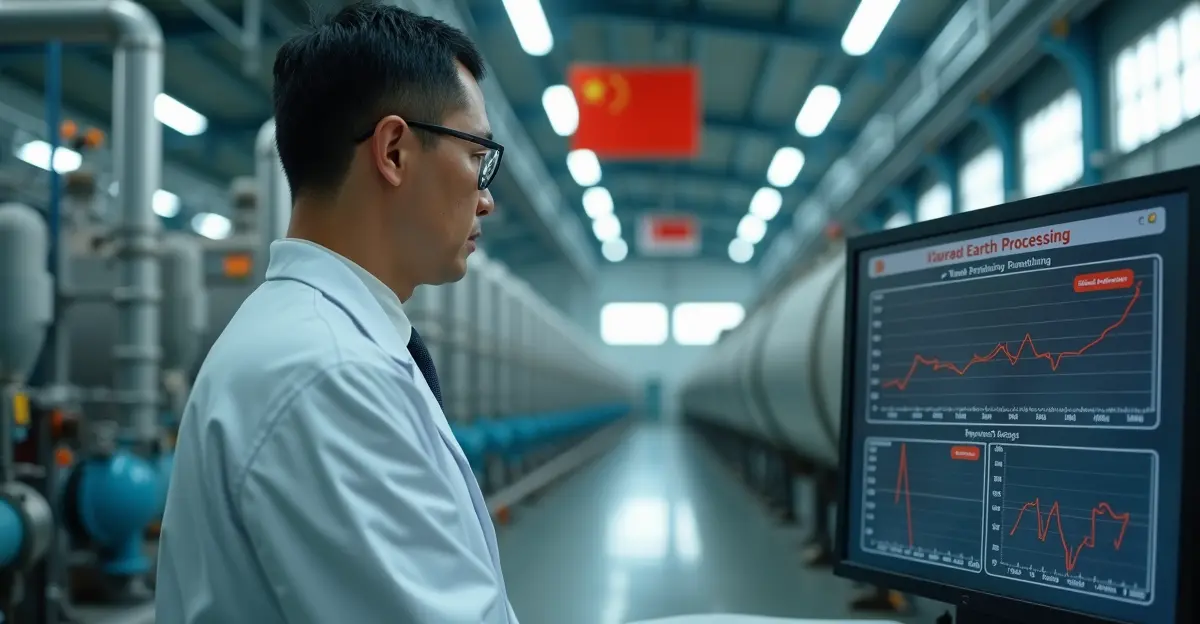
China controls roughly 90% of global rare earth processing, 80% of tungsten refining, and 60% of antimony output. Export controls announced in December 2024 and expanded in October 2025 have pushed prices up to sixfold outside China and cut European licensing approval rates below 25%, according to trade analysis. The measures target foreign military supply chains — including F-35 magnets, missiles, and offshore wind turbines — creating what analysts describe as a de facto rolling embargo.
How Washington, Latin America, and Europe Are Responding
Washington's $30 Billion Mobilization
Washington has mobilized more than $30 billion, launched the FORGE alliance with 54 nations, signed 11 bilateral frameworks, and created Project Vault, a $10–12 billion strategic reserve.
Latin America's Copper and Lithium Leverage
Latin America holds about 40% of global copper reserves and 60% of lithium resources. The IEA Global Critical Minerals Outlook 2026 projects the region could capture $185 billion in value by 2035, but only one-fifth would come from refining without new processing capacity.
Europe's Critical Raw Materials Act
Europe's Critical Raw Materials Act sets 2030 targets of 10% extraction, 40% processing, and 25% recycling, with a 65% limit on single-country dependence. Yet only five of 47 strategic projects are fully funded.
What the UN Emergency Session Means for Global Order
The March 5 meeting, chaired by U.S. Secretary of Energy Chris Wright, marked the first formal UNSC treatment of critical minerals as strategic assets tied to conflict and sovereignty. Under-Secretary-General Rosemary DiCarlo said critical mineral trade reached roughly $2.5 trillion in 2023 — more than 10% of global trade — and could triple by 2030. “The surge fuels geopolitical competition, human rights abuses, and environmental damage,” she warned. The UN briefing also spotlighted resource-driven conflict in the eastern DRC, which supplies over 70% of cobalt.
Expert Perspectives: A Narrow Window
Analysts warn that rebuilding independent Western supply chains could take 20 to 30 years, leaving a narrow 12-to-18-month window for diversification. China's 15th Five-Year Plan further entrenches its dominance in refined lithium, cobalt, rare earths, and graphite while promoting yuan-denominated trading, keeping pressure on the global critical minerals supply chain.
Frequently Asked Questions
What are critical minerals?
Critical minerals are non-fuel materials essential for energy, defense, and technology whose supply chains are vulnerable to disruption. In 2026, the focus is on lithium, copper, rare earths, cobalt, nickel, and graphite.
Why did China impose rare earth export controls?
China controls about 90% of rare earth processing and used export controls to pressure foreign militaries. The measures sent prices up to sixfold higher outside China and cut European approval rates below 25%.
How is the US responding?
The US mobilized more than $30 billion, launched FORGE with 54 nations, signed 11 bilateral frameworks, and created the $10–12 billion Project Vault reserve.
What role does Latin America play?
Latin America holds roughly 40% of global copper reserves and 60% of lithium resources, making it central to supply-chain diversification. The IEA projects $185 billion in potential economic value by 2035.
What did the UN Security Council do in March 2026?
On March 5, 2026, the UNSC held its first formal briefing on energy, critical minerals, and security, warning that competition could fuel conflict, human rights abuses, and environmental damage.
The Road Ahead
In 2026, the critical minerals race is no longer a trade dispute but a contest over who powers the next decade of AI, defense, and clean energy. With copper demand set to nearly double by 2035 and China's processing dominance intact, the scramble for lithium, copper, and rare earths will continue to reshape global power.
Follow Discussion