


 Deutsch
 English
 Español
 Français
 Nederlands
 Português


 Share
Share




The NATO 2% deadline has become the defining test of alliance credibility as leaders prepare for the July 2026 Ankara summit. Although all 32 members are projected to meet the 2% of GDP defense spending target for the first time since the Cold War, the numbers mask a deeper reckoning: Berlin and Rome remain fiscally fragile, Washington is pivoting to the Indo-Pacific, and a new 5% GDP goal by 2035 is already straining NATO burden-sharing.
What Is NATO's 2% Defense Spending Deadline?
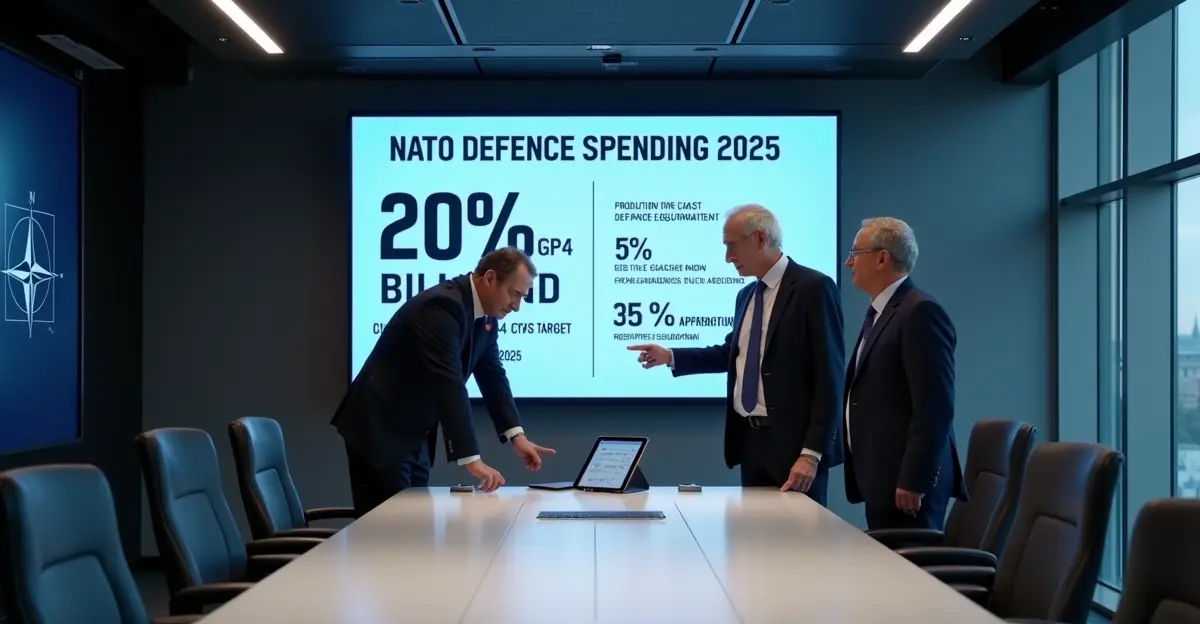
The 2% target is a political commitment, not a treaty obligation. First floated in 2006 and formalized at the 2014 Wales Summit after Russia's annexation of Crimea, it requires allies to spend at least 2% of GDP on defense and 20% of that on new equipment and research. Russia's 2022 full-scale invasion of Ukraine turned the benchmark into a floor. By 2026, NATO's combined defense spending has passed $1.5 trillion, with Poland leading at 4.48% of GDP and Lithuania and Latvia above 3%.
The 2026 Reckoning: Burden-Sharing Meets a US Pivot
Behind the headline figures, the US Indo-Pacific pivot is forcing Europe to confront long-deferred choices. The United States accounts for roughly 70% of NATO defense spending, and Congress has grown increasingly vocal about European free-riding. At the Ankara summit, Secretary General Mark Rutte reaffirmed Article 5 solidarity, but Washington's Indo-Pacific force posture signals that American attention and assets are shifting away from Europe.
Berlin and Rome: Fiscal Gaps and Creative Accounting
Germany and Italy illustrate the structural problem. Both technically crossed 2% in 2026, yet analysts caution that much of the increase comes from one-off procurement funds, pensions, and legacy commitments rather than deployable capability. Germany would need €120 billion annually to reach the new 5% target by 2035, while Italy would need €105 billion. With sovereign debt rising, both capitals face hard trade-offs between defense, climate, and social spending.
The Emerging European Defense Pillar
These gaps are accelerating calls for a European defense pillar that can operate independently of NATO. The Hague Declaration commits allies to 5% GDP by 2035, but achieving that would require European allies to roughly double current outlays. Some officials see a parallel European strategic autonomy framework as inevitable if US reliability continues to erode. Others fear duplication could fracture command structures and dilute Article 5.
Geopolitical Consequences and Global Security
A fractured alliance would reshape global security. If Berlin and Rome fail to convert 2% accounting into real readiness, NATO's eastern flank — already reliant on Polish and Baltic spending — could face capability gaps, weakening NATO Article 5 commitments. Meanwhile, the US shift toward the Indo-Pacific would leave Europe more exposed to Russian coercion. The 2026 Ankara summit's pledge of €70 billion in military support for Ukraine in 2026 and €50 billion in procurement deals is a test of whether European defense spending translates into hardware, not headlines.
Expert Perspectives
The 2% target was always an input metric, not a measure of military effectiveness. Meeting it through pensions or creative accounting satisfies the number but not the capability. a NATO budget analyst told reporters. The real question for Berlin and Rome is whether they can sustain 2% through a downturn and still fund the 5% trajectory.
FAQ
What is NATO's 2% deadline in 2026?
It is the year all 32 allies are expected to meet the 2% of GDP defense spending target first set at the 2014 Wales Summit, ahead of the July 2026 Ankara summit.
Why are Germany and Italy considered at risk?
Both countries met 2% largely through one-off funds and legacy spending, not sustained deployable capability, and face €100 billion-plus annual gaps for the new 5% target by 2035.
How does the US Indo-Pacific pivot affect NATO?
Washington's strategic shift reduces its European force focus, increasing pressure on European allies to fund their own defense and possibly build an independent European defense pillar.
What is the new 5% NATO target?
Adopted in the June 2025 Hague Declaration, it commits members to 5% of GDP by 2035, with the 2026 Ankara summit as the first major checkpoint.
Which NATO countries spend the most on defense?
Poland leads at 4.48% of GDP, followed by Lithuania at 4.0% and Latvia at 3.73%, while the United States remains the largest absolute spender.
Conclusion: A Decisive Inflection Point
The 2026 Ankara summit will not settle the burden-sharing debate; it will expose whether the 2% target was a ceiling or a floor. For Berlin and Rome, the coming years will determine whether they become credible security providers or remain the alliance's fiscal weak links. The transatlantic defense reckoning is no longer a future scenario — it is already underway.


Follow Discussion