


 Deutsch
 English
 Español
 Français
 Nederlands
 Português


 Share
Share




Global demand for lithium, rare earths, cobalt, and copper is projected to multiply four to six times by 2040, transforming critical minerals into the defining resource competition of the decade. As of 2026, China controls between 60% and 80% of global refined processing for these minerals, creating strategic vulnerabilities that the United States and European Union are racing to address. The February 2026 Critical Minerals Ministerial, hosted by the U.S. State Department, produced 11 new bilateral agreements and launched the FORGE alliance, while the EU pushes forward with its Critical Raw Materials Act. Both the IMF's April 2026 World Economic Outlook and the WEF Global Risks Report identify resource competition and geoeconomic confrontation as top-tier global risks for 2026, underscoring the urgency of this story.
China's Dominance in Mineral Processing
China's grip on critical mineral supply chains is unprecedented. According to the ODI, China is projected to supply over 60% of refined lithium and cobalt, and roughly 80% of battery-grade graphite and rare earths by 2035. This dominance is not limited to extraction; it spans the entire processing ecosystem, from crushing and refining to magnet manufacturing. The China rare earths dominance forces Western nations to confront a stark reality: even if new mines open outside China, the processing infrastructure remains overwhelmingly Chinese. The country's 15th Five-Year Plan, expected to be finalized in 2026, will further shape domestic production, processing, and recycling policies, potentially tightening Beijing's hold on these strategic resources.
The US Response: FORGE Alliance and $30 Billion Push
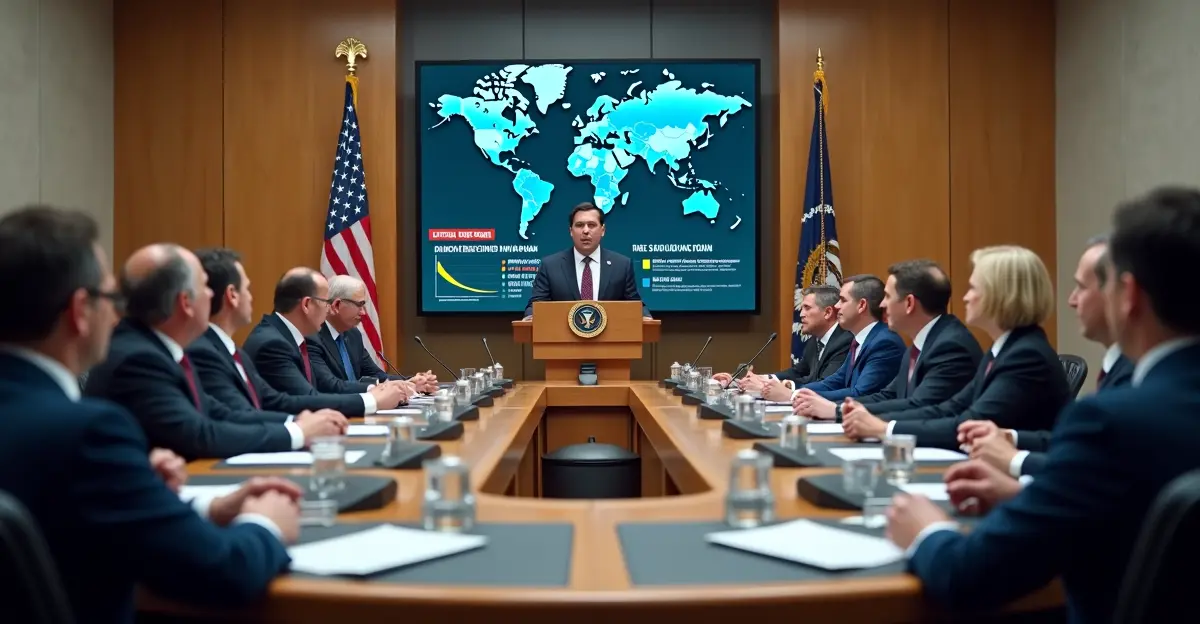
On February 4, 2026, the U.S. Department of State convened the Critical Minerals Ministerial, chaired by Secretary of State Marco Rubio alongside Vice President JD Vance. Representatives from 54 countries and the European Commission attended, including 43 foreign ministers. The centerpiece of the event was the launch of FORGE (Forum on Resource Geostrategic Engagement), chaired by South Korea, which succeeds the Minerals Security Partnership. FORGE aims to create a preferential trade-and-investment zone for critical minerals, including coordinated price floors to counter adversarial market manipulation.
The U.S. has mobilized over $30 billion in government financing for strategic minerals projects over the past six months. Notable initiatives include EXIM Bank's Project Vault—a $10 billion domestic strategic reserve for critical minerals—and Pax Silica, a public-private partnership securing technology supply chains for AI, robotics, batteries, and advanced manufacturing. The ministerial produced 11 new bilateral critical minerals frameworks with countries including Argentina, Morocco, the Philippines, the UAE, and the UK, bringing the total to 21 bilateral deals in five months. This shift from multilateral frameworks to bilateral and minilateral agreements marks the most significant attempt to reshape global mineral markets since the 1970s OPEC oil embargoes.
Project Vault and Domestic Mining
The $12 billion Project Vault public-private partnership establishes a U.S. Strategic Critical Minerals Reserve, modeled on the Strategic Petroleum Reserve. Simultaneously, the U.S. is boosting domestic mining through projects like Resolution Copper in Arizona and new lithium operations in Nevada and California. However, experts at the Council on Foreign Relations warn that expanding traditional mining alone is unlikely to overcome the scale of China's dominance, which spans the entire critical minerals ecosystem. The US critical minerals strategy must therefore focus on processing, recycling, and international partnerships to create a viable alternative supply chain.
The EU's Critical Raw Materials Act and ReSourceEU Plan
The European Union's Critical Raw Materials Act, adopted in 2024, sets ambitious 2030 benchmarks: 10% domestic extraction, 40% processing, and 25% recycling of annual needs, while ensuring no more than 65% of any strategic raw material comes from a single third country. In March 2026, the Council of the EU adopted a position to reinforce security of supply and circularity, and the European Commission announced up to €3 billion ($3.5 billion) in funding for 2026 under the new ReSourceEU Action Plan.
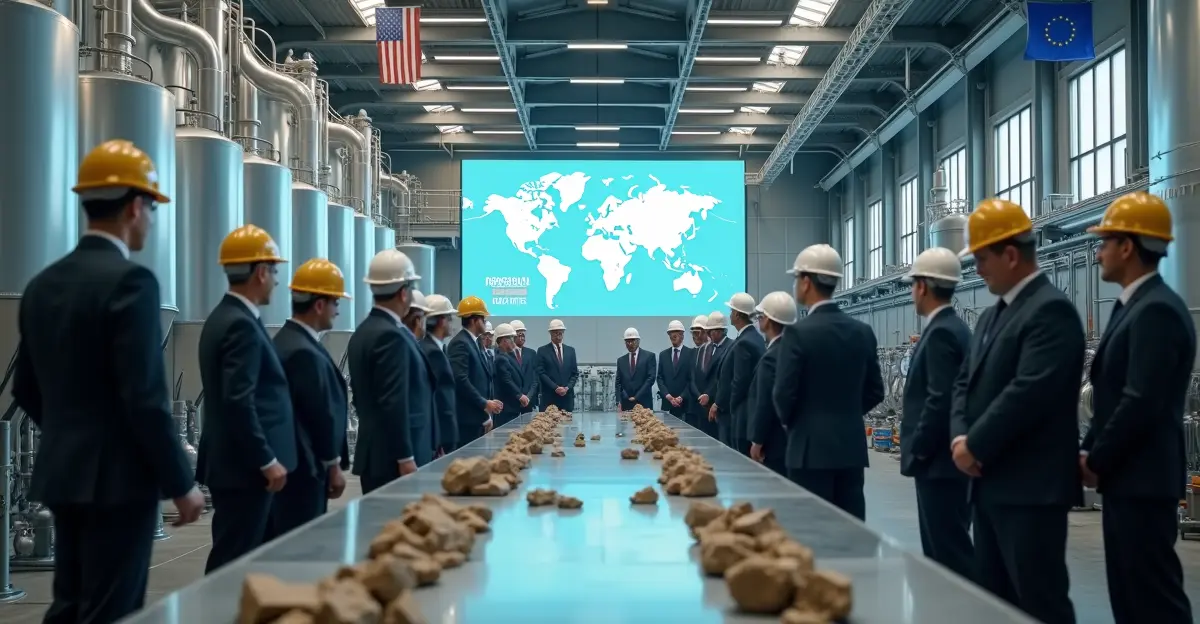
Key measures include regulatory fast-tracking for 60 strategic projects, €250 million EIB support for Vulcan Energy's German lithium project, support for Greenland Resources' molybdenum mine, new export restrictions on scrapped permanent magnets and aluminum, and a ban on waste lithium-ion battery exports to non-OECD countries from September 2026. The EU is also establishing a European Critical Raw Materials Centre modeled on Japan's JOGMEC and deepening partnerships with resource-rich countries in Ukraine, the Western Balkans, and North Africa. Despite these efforts, the EU struggles to scale investment compared to the U.S. and China, facing pressure to provide credible demand signals and price floors to attract private capital.
Resource Nationalism in the Global South
As demand surges, resource-rich nations in the Global South are asserting greater control over their mineral wealth. The Democratic Republic of Congo supplies roughly 70% of global cobalt, while Chile, Peru, and Argentina anchor copper and lithium supply. Countries like Indonesia have imposed export bans on raw nickel ore to force domestic processing, while Mexico and Chile have moved to nationalize lithium reserves. This resource nationalism risks creating new supply bottlenecks and driving up costs for Western consumers. The WEF Global Risks Report 2026 identifies geoeconomic confrontation as the top short-term risk, with resource competition as a key driver. The IMF's April 2026 World Economic Outlook warns that geopolitical fragmentation could slow global growth to 3.1% in 2026, with a severe scenario of prolonged energy and mineral market turbulence risking recession.
Strategic Vulnerabilities and Military Readiness
Critical minerals are not just an economic issue—they are a national security imperative. Rare earths are essential for permanent magnets used in missile guidance systems, radar, jet engines, and electric vehicle motors. China's control over 85-90% of rare earth refining means that any disruption could cripple Western defense production. The U.S. Department of Defense has identified critical minerals as a strategic vulnerability, and the FORGE alliance explicitly aims to secure supply chains for defense applications. The critical minerals military readiness nexus is driving unprecedented cooperation between defense departments and mining companies, with the Pentagon investing in domestic rare earth processing facilities.
Expert Perspectives
"The critical minerals challenge is the most significant resource competition since the Cold War," says Olena Borodyna, Senior Geopolitical Risks Advisor at ODI. "China's processing dominance is not easily replicated—it took decades of strategic investment and policy support. The West must think in terms of decades, not quarters." Vice President JD Vance, speaking at the Critical Minerals Ministerial, described reference prices maintained through adjustable tariffs across production stages as a key tool to counter Chinese market manipulation. South Korea, as chair of FORGE, is expected to play a pivotal role in linking disparate bilateral agreements into a system covering two-thirds of the global economy.
FAQ
What are critical minerals?
Critical minerals are raw materials essential for green energy technologies, electronics, defense systems, and advanced manufacturing. Key examples include lithium, cobalt, nickel, rare earth elements, copper, and graphite. They are termed 'critical' due to their economic importance and supply risk.
Why does China dominate critical mineral processing?
China invested heavily in processing infrastructure over the past two decades, supported by state subsidies, lax environmental regulations, and strategic industrial policy. It now controls 60-90% of global refining capacity for most critical minerals, a lead that is difficult to overcome due to the capital intensity and technical expertise required.
What is the FORGE alliance?
FORGE (Forum on Resource Geostrategic Engagement) is a U.S.-led plurilateral alliance launched in February 2026, chaired by South Korea. It aims to create a preferential trade-and-investment zone for critical minerals, including coordinated price floors, to counter Chinese market manipulation and secure diversified supply chains.
How much is the US investing in critical minerals?
The U.S. government has mobilized over $30 billion in letters of interest, investments, and loans for critical mineral supply chain projects. This includes $10 billion for Project Vault, a strategic reserve, and $5 billion for supply chain development, alongside private-sector partnerships.
What are the risks of resource nationalism?
Resource nationalism—where countries impose export bans, nationalize mines, or demand domestic processing—can create supply bottlenecks, drive up prices, and increase geopolitical tensions. It threatens the diversification strategies of consuming nations and could lead to retaliatory trade measures.
Conclusion and Future Outlook
The scramble for critical minerals in 2026 represents a fundamental shift in global power dynamics. China's entrenched processing dominance, the U.S. and EU's defensive countermeasures, and rising resource nationalism in the Global South are reshaping supply chains and alliances. The IMF and WEF both warn that geoeconomic confrontation could trigger a material global crisis, making this the most strategically urgent resource story of the year. Success will depend on sustained investment, technological innovation in recycling and substitution, and unprecedented international cooperation. The next five years will determine whether the West can break China's stranglehold or whether critical minerals become the new oil—a source of strategic vulnerability and geopolitical leverage for decades to come.


Follow Discussion