


 Deutsch
 English
 Español
 Français
 Nederlands
 Português


 Share
Share




On February 4, 2026, the United States hosted the inaugural Critical Minerals Ministerial in Washington, D.C., bringing together representatives from 54 nations and the European Commission to launch an ambitious counteroffensive against China's stranglehold on the global critical minerals supply chain. The ministerial—led by Secretary of State Marco Rubio and Vice President JD Vance—unveiled FORGE (Forum on Resource Geostrategic Engagement), a plurilateral coalition designed to create a preferential trade-and-investment zone for critical minerals, signed 11 new bilateral framework agreements, and committed over $30 billion to supply chain projects including Project Vault, a $10 billion domestic strategic reserve. The event marks Washington's most aggressive response to date against a vulnerability that the World Economic Forum's Global Risks Report 2026 identified as the top global threat: geoeconomic confrontation.
The Strategic Context: Why Critical Minerals Matter Now
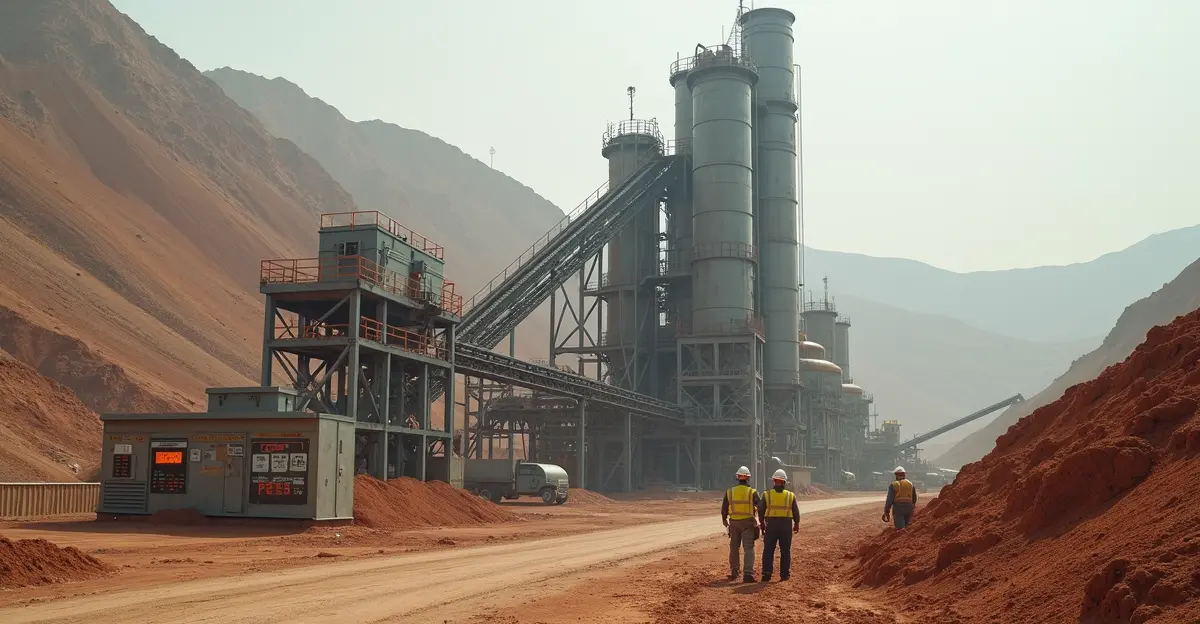
Critical minerals—including rare earth elements, lithium, cobalt, graphite, and tungsten—are the building blocks of modern technology. They power everything from electric vehicle batteries and wind turbines to advanced military systems, artificial intelligence infrastructure, and semiconductor manufacturing. China currently controls approximately 90% of global rare earth processing capacity, 80% of tungsten processing, and 60% of antimony processing, according to a multi-institutional analysis published in early 2026. This dominance extends beyond mining into the more lucrative and strategically vital stages of smelting, separation, and refining—creating a two-layer advantage that is extraordinarily difficult to replicate.
The geoeconomic confrontation with China has intensified as Beijing weaponizes its control. Export controls introduced in 2025–2026 triggered price spikes of up to sixfold for certain materials outside China, while licensing approval rates for European firms fell below 25% in some sectors. Over 80% of European companies remain dependent on Chinese supply chains for minerals essential to defense, electric vehicles, and renewable energy. The WEF's Global Risks Report 2026, published in January, ranked geoeconomic confrontation as the risk most likely to trigger a material global crisis in 2026, with 18% of respondents citing it as the top threat—ahead of state-based armed conflict at 14%.
FORGE: A New Architecture for Mineral Security
The centerpiece of the ministerial was the launch of FORGE, which succeeds the Minerals Security Partnership (MSP) as the primary vehicle for U.S.-led critical minerals diplomacy. Unlike the MSP's project-by-project approach, FORGE aims to create a functioning plurilateral system covering roughly two-thirds of the global economy. The Republic of Korea will chair the forum through June 2026.
How FORGE Works
FORGE is designed as a preferential trade-and-investment zone with coordinated reference prices and adjustable tariffs to counter adversarial market manipulation. According to the Atlantic Council, the initiative seeks to align trade policy, price signals, and market access across partner economies to provide the stable, long-term conditions that mining projects require—often decades to deliver returns. The forum will also coordinate investment screening, technology transfer protections, and joint stockpiling strategies.
The ministerial produced 11 new bilateral critical minerals framework agreements or memoranda of understanding with countries including Argentina, Morocco, Peru, the Philippines, the United Arab Emirates, and the United Kingdom. These brought the total number of bilateral deals signed in the preceding five months to 21. The Pax Silica initiative, launched in December 2025, complements FORGE by focusing on semiconductor and AI supply chain security, with the U.S. contributing $250 million toward an investment consortium for energy and critical mineral supply chains.
Project Vault: A $10 Billion Domestic Strategic Reserve
President Donald Trump announced Project Vault, a $12 billion public-private partnership (including a $10 billion Export-Import Bank loan and nearly $2 billion in private investment) to establish the U.S. Strategic Critical Minerals Reserve. The reserve will store essential raw materials—including rare earths, lithium, cobalt, and graphite—in secure facilities across the United States to protect domestic manufacturers from supply shocks. Corporate partners include GE Vernova, Mercuria Energy Americas, Traxys, Hartree, Clarios, and Boeing.
Project Vault addresses a critical gap: the United States currently has no significant stockpile of processed critical minerals, leaving manufacturers vulnerable to sudden export restrictions or price manipulation. However, analysts caution that stockpiling alone cannot solve the structural problem of insufficient domestic processing capacity.
The $30 Billion Mobilization: Scope and Limitations
The U.S. government has mobilized over $30 billion in letters of interest, investments, and loans for critical mineral supply chain projects over the six months leading up to the ministerial. This includes not only Project Vault but also financing for mining projects in partner countries, processing facilities, and logistics infrastructure. The administration has emphasized public-private collaboration, with the EXIM Bank's critical minerals financing playing a central role.
Yet the scale of the challenge remains daunting. China's dominance is not merely a matter of production volume but of accumulated infrastructure, skilled labor, and vertically integrated supply chains built over decades. Rebuilding independent Western processing capacity would take an estimated 20–30 years, far exceeding the current 12–18 month geopolitical window for meaningful action, according to the Rare Earth Exchanges analysis. Furthermore, the United States faces its own structural barriers: opening a new mine domestically takes an average of 29 years—the second-longest permitting timeline in the world, after Zambia.
Can FORGE and Project Vault Realistically Challenge China?
The question at the heart of the 2026 Critical Minerals Ministerial is whether these initiatives can meaningfully reduce dependence on China or whether the world is entering a new era of strategic interdependence that exposes deeper Western vulnerabilities.
Arguments for Optimism
Proponents point to the unprecedented scale and speed of diplomatic coordination. FORGE's plurilateral structure, with coordinated price floors and adjustable tariffs, could create a parallel market that insulates partner economies from Chinese market manipulation. The 21 bilateral frameworks signed in five months demonstrate momentum that the MSP never achieved. South Korea's chairmanship brings a major processing economy into the leadership role. And Project Vault provides an immediate buffer against supply disruptions while longer-term processing capacity comes online.
Arguments for Skepticism
Critics note that FORGE's operational details remain unclear—the Atlantic Council observed that the initiative has yet to specify how reference prices will be set, how tariff adjustments will be triggered, or how enforcement will work. China's 90% processing dominance means that even with FORGE, most partner countries will remain dependent on Chinese refineries for years. The 29-year U.S. mine permitting timeline has not been reformed, despite House passage of the SPEED Act in December 2025. And China's overseas ownership of critical mineral assets in Indonesia, the Democratic Republic of Congo, and elsewhere gives Beijing leverage that bilateral agreements cannot easily neutralize.
Expert Perspectives
"FORGE represents a genuine shift from bilateral deal-making to systemic architecture," said a senior fellow at the Atlantic Council's Global Energy Center. "But architecture without enforcement is just a drawing. The test will be whether FORGE can actually coordinate price signals and investment flows in a way that changes market behavior."
A analyst at the Center for Strategic and International Studies (CSIS) noted: "Project Vault is a smart hedge, but stockpiles are finite. The real solution is processing capacity, and that requires permitting reform, workforce development, and technology transfer—none of which can be accomplished overnight."
FAQ: Critical Minerals and the 2026 Ministerial
What is FORGE?
FORGE (Forum on Resource Geostrategic Engagement) is a plurilateral coalition launched in February 2026 as the successor to the Minerals Security Partnership. It aims to create a preferential trade-and-investment zone for critical minerals with coordinated price floors and adjustable tariffs to counter adversarial market manipulation.
What is Project Vault?
Project Vault is a $12 billion public-private partnership (including a $10 billion EXIM loan) to establish a U.S. Strategic Critical Minerals Reserve, storing essential raw materials in secure domestic facilities to protect manufacturers from supply shocks.
How much does China control critical mineral processing?
China controls approximately 90% of global rare earth processing, 80% of tungsten processing, and 60% of antimony processing. Its dominance is expected to remain above 80% through 2030.
What countries signed agreements at the ministerial?
Eleven new bilateral frameworks were signed with Argentina, Morocco, Peru, the Philippines, the UAE, the UK, and others, bringing the total to 21 deals in five months.
Can FORGE realistically challenge China's dominance?
Analysts are divided. FORGE's plurilateral structure and $30 billion in financing represent an unprecedented response, but China's decades-long infrastructure advantage, 29-year U.S. mine permitting timelines, and lack of operational details for FORGE raise questions about whether these initiatives can achieve meaningful results within the narrowing geopolitical window.
Conclusion: A New Era of Strategic Interdependence?
The 2026 Critical Minerals Ministerial marks a pivotal moment in the global struggle for resource security. FORGE, Project Vault, and the $30 billion mobilization represent the most ambitious Western response to date against China's critical minerals dominance. Yet the structural realities—China's 90% processing control, the 20–30 year timeline to build alternatives, and the 29-year U.S. mine permitting process—suggest that the world may be entering not an era of Western independence, but one of managed strategic interdependence. The future of critical mineral supply chains will likely be defined not by a clean break from China, but by a complex web of competing alliances, stockpiles, and price mechanisms that reshape—but do not eliminate—dependence. The next 12–18 months will determine whether FORGE becomes a genuine alternative or another well-intentioned framework that fails to overcome the gravity of China's entrenched position.


Follow Discussion