


 Deutsch
 English
 Español
 Français
 Nederlands
 Português


 Share
Share




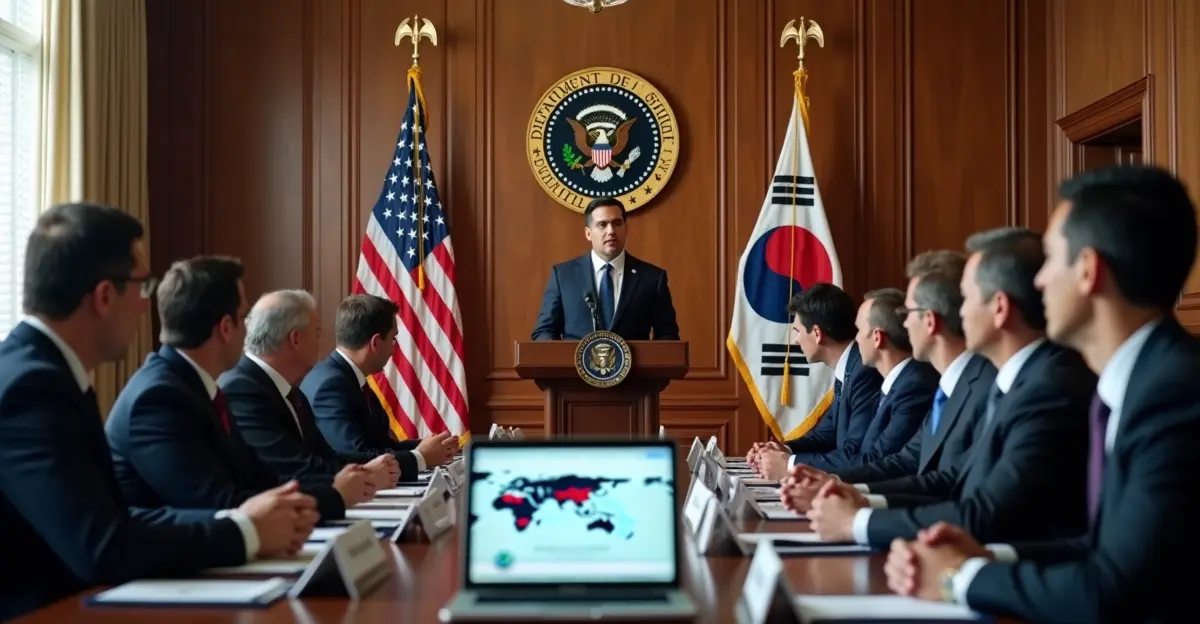
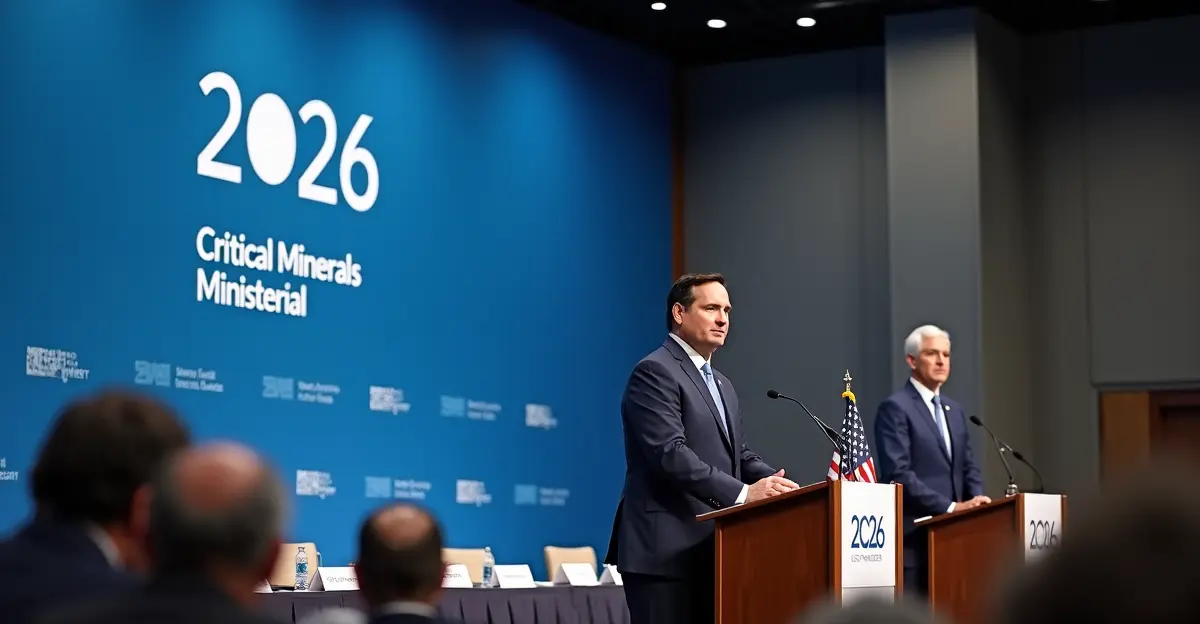
On February 4, 2026, the United States hosted the inaugural Critical Minerals Ministerial in Washington, D.C., bringing together representatives from 54 countries and the European Commission to launch the Forum on Resource Geostrategic Engagement (FORGE). With over $30 billion mobilized—including a record $10 billion Export-Import Bank loan for Project Vault—and 21 bilateral framework agreements signed in just five months, Washington is attempting to build a parallel, allied-controlled critical minerals supply chain to counter China's dominant hold on rare earths, lithium, and cobalt refining. This article examines whether the FORGE coalition can overcome the structural paradox of surging long-term demand versus collapsing short-term commodity prices, and what the escalation of mineral-statecraft means for global energy transition timelines and great-power competition.
What Is FORGE and Why Was It Created?
FORGE—the Forum on Resource Geostrategic Engagement—is a plurilateral coalition announced by Secretary of State Marco Rubio and Vice President JD Vance as the successor to the Biden-era Minerals Security Partnership (MSP). Unlike the MSP, which focused on project-level coordination among a smaller group of nations, FORGE operates on a 'membership by trade' model, creating a preferential trade-and-investment zone for critical minerals. South Korea was named the inaugural chair. The initiative aims to reduce the overconcentration of supply chains that has enabled political coercion, particularly by China, which controls approximately 90% of global rare earth processing, 80% of tungsten, and 60% of antimony.
The Minerals Security Partnership evolution into FORGE reflects a recognition that voluntary coordination was insufficient to counter China's state-backed industrial strategy. The new framework includes coordinated price floors—what Vance called 'reference prices at each stage of production'—maintained through adjustable tariffs for member nations. This mechanism is designed to protect Western mining and processing investments from Chinese price dumping, a practice that has historically crushed competitors whenever new supply threatened Beijing's market share.
The $30 Billion Mobilization: Project Vault and Beyond
The financial firepower behind FORGE is unprecedented. The U.S. government has mobilized over $30 billion in letters of interest, loans, and investments for strategic mineral projects. The centerpiece is Project Vault, a $12 billion public-private partnership anchored by a $10 billion direct loan from the Export-Import Bank of the United States—more than double the largest financing in EXIM's history—plus approximately $2 billion in private capital. Project Vault establishes the U.S. Strategic Critical Minerals Reserve, an independently governed entity that will stockpile essential raw materials in secure facilities across the country. Of take partners include Boeing, GE Vernova, General Motors, Mercuria, Traxys, Hartree, and Clarios.
The 21 bilateral framework agreements signed since October 2025 span every continent and include resource-rich nations such as Argentina (lithium), Morocco (phosphates and cobalt), the Democratic Republic of the Congo (cobalt and copper), Peru (copper), the Philippines (nickel), and Australia (rare earths and lithium). These agreements typically include provisions for joint investment, technology transfer, and streamlined permitting for mining and processing projects.
The Structural Paradox: Soaring Demand vs. Collapsing Prices
FORGE faces a fundamental economic challenge. While long-term demand projections for critical minerals are staggering—the IEA's Global Critical Minerals Outlook 2025 projects that overall demand could double by 2035 and quadruple by 2050 under net-zero scenarios—short-term commodity prices have collapsed. Lithium carbonate prices fell over 80% from their 2022 peak through early 2025, while cobalt and nickel prices have also suffered from oversupply driven largely by Chinese and Indonesian production expansions.
This price collapse creates a paradox: the very market conditions that make Western governments anxious to secure supply chains also make it economically unattractive for private capital to invest in new mines and processing facilities outside China. The critical minerals price floor mechanism proposed by Vance is designed to address this by guaranteeing minimum returns for producers within the FORGE bloc. However, implementing such price floors requires complex coordination on tariff policy, stockpile management, and enforcement mechanisms that have yet to be fully detailed.
Analysts project that 2026 is the inflection year where consumption outpaces mine capacity for copper and lithium. The Materials Dispatch Q2 2026 Early-Warning Map identifies four minerals under simultaneous stress: heavy rare earth elements, lithium, copper, and cobalt. Chinese export controls have already caused a ~95% collapse in U.S. yttrium imports, with prices surging to 69 times year-ago levels. Lithium carbonate prices have rebounded 57% in five months as the market pivots from oversupply to projected deficits by 2028.
Can FORGE Overcome China's Structural Advantages?
China's dominance in critical minerals is not accidental but the result of decades of strategic industrial policy, including state financing, vertical integration, and export controls. The Council on Foreign Relations argues that the U.S. cannot out-mine or out-process China's position and recommends an innovation-led strategy focused on materials substitution, waste recovery, and AI-enabled research. FORGE's emphasis on recycling and secondary supply—including the Pax Silica initiative for AI-related supply chains—reflects this thinking.
However, the timeline for building independent Western supply chains is daunting. A multi-institutional analysis found that over 80% of European companies depend on Chinese supply chains for materials essential to defense, EVs, and renewable energy, and that rebuilding independent alternatives would take 20-30 years. The same analysis warns that China is weaponizing control rather than scarcity, using temporary, reversible restrictions to maintain pricing power while discouraging large-scale Western alternative investment. The window for decisive action is narrowing to 12-18 months.
The geopolitical implications of mineral supply chains extend beyond economics. Critical minerals are essential for AI, robotics, batteries, autonomous systems, and defense manufacturing. Vice President Vance explicitly framed FORGE as a national security imperative, stating that 'the nation that controls critical minerals will control the technologies of the future.'
Expert Perspectives
'FORGE represents the most ambitious attempt by the United States to translate critical minerals ambitions into a functional collaborative architecture,' said a senior fellow at the Atlantic Council. 'But the proof will be in execution—can member states agree on price floors, share stockpiles, and enforce trade rules consistently?'
Industry leaders have welcomed the financial commitments but caution that permitting reform, skilled labor availability, and infrastructure development remain significant bottlenecks. EXIM Chairman Jovanovic emphasized that Project Vault is designed to 'shield domestic manufacturers from supply shocks and fundamentally strengthen America's critical minerals sector.'
FAQ
What is FORGE in critical minerals?
FORGE (Forum on Resource Geostrategic Engagement) is a U.S.-led plurilateral coalition launched in February 2026 to coordinate critical mineral policy, investment, and trade among allied nations. It succeeds the Minerals Security Partnership and aims to create a preferential trade zone with coordinated price floors to counter China's dominance.
How much funding has been mobilized for critical minerals?
The U.S. government has mobilized over $30 billion in letters of interest, loans, and investments, including $10 billion from the Export-Import Bank for Project Vault, which establishes a U.S. Strategic Critical Minerals Reserve.
Which countries have signed bilateral agreements with the U.S.?
Twenty-one bilateral framework agreements have been signed since October 2025, including with Argentina, Morocco, the Democratic Republic of the Congo, Peru, the Philippines, Australia, the United Kingdom, the United Arab Emirates, and Uzbekistan.
Why are critical mineral prices falling despite growing demand?
Short-term oversupply, driven largely by Chinese and Indonesian production expansions, has caused prices for lithium, cobalt, and nickel to collapse. However, analysts project that consumption will outpace mine capacity for copper and lithium starting in 2026, leading to potential deficits by 2028.
What is the price floor mechanism proposed by FORGE?
Vice President Vance proposed 'reference prices at each stage of production' for critical minerals, maintained through adjustable tariffs for FORGE member nations. This mechanism is designed to protect producers from Chinese price dumping and incentivize investment in non-Chinese supply chains.
Conclusion: A Defining Moment for Mineral Statecraft
The launch of FORGE and the mobilization of over $30 billion mark a significant escalation in the global competition for critical minerals. Whether the coalition can overcome the structural paradox of near-term price weakness versus long-term demand growth, and whether it can build functional supply chains before China's window of dominance closes further, will determine not only the success of the energy transition but also the balance of economic and military power in the coming decades. The next 12-18 months will be critical.

Follow Discussion