


 Deutsch
 English
 Español
 Français
 Nederlands
 Português


 Share
Share




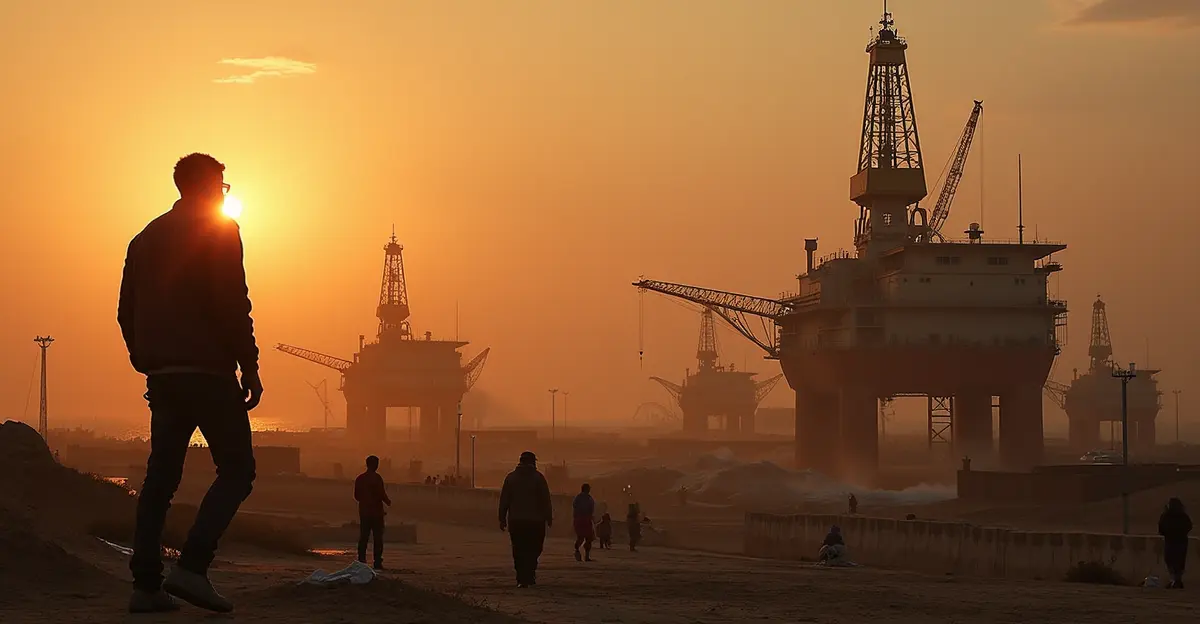
The February 2026 escalation of conflict in the Middle East has triggered the largest energy price surge in four years, sending shockwaves through the global economy. The World Bank's April 2026 Commodity Markets Outlook projects a 24% increase in energy prices for the year, while the International Monetary Fund (IMF) has revised global growth down to 3.1% in its latest World Economic Outlook. This dual shock is simultaneously accelerating renewable energy investment in some regions and forcing others back toward fossil fuel dependency, creating a complex and uneven landscape for the energy transition.
Context: The Largest Oil Supply Shock in History
The crisis began with attacks on energy infrastructure and the effective closure of the Strait of Hormuz, a chokepoint through which roughly one-fifth of the world's daily oil and LNG supply passes. According to the World Bank, global oil supply crashed by 10.1 million barrels per day in March 2026, the largest monthly decline on record. Brent crude oil prices surged approximately 65% month-on-month, averaging $103 per barrel in March and peaking near $119 per barrel in early April, according to the U.S. Energy Information Administration (EIA). The IMF's April 2026 World Economic Outlook, titled 'Global Economy in the Shadow of War', assumes a limited conflict scenario but warns that downside risks dominate, including prolonged conflict and worsening geopolitical fragmentation.
The Strait of Hormuz disruption has paralyzed shipping: transits collapsed by over 95%, and insurance premiums skyrocketed. Major Middle East producers including Saudi Arabia, Iraq, and Kuwait were forced to cut production as storage facilities overflowed. The IEA plans to recommend releasing 400 million barrels of oil, the largest coordinated release in history.
Inflationary Fallout and Central Bank Dilemmas
The energy price surge is feeding directly into inflation. A CEPR analysis using a DSGE model estimates that headline PCE inflation in the United States could rise by 1.7 percentage points (annualized) in Q1 2026 due to the oil shock, adding 0.6 percentage points to Q4/Q4 headline inflation for the year. The World Bank warns that developing economies face 5.1% inflation, with growth downgraded to 3.6%.
Central banks are caught in a policy bind. The Federal Reserve held its policy rate at 3.5% to 3.75% in March 2026, with St. Louis Fed President Alberto Musalem describing the outlook as 'highly uncertain'. The European Central Bank and Bank of England face similar challenges, as higher energy costs stoke inflation while economic growth slows. According to Politico, the phrase 'all bets are off' captures the sentiment among central bankers, whose previous forecasts have been thrown into disarray. The IMF global growth forecast 2026 reflects this tension, projecting a slowdown to 3.1% with risks tilted to the downside.
Divergent Paths: Green Acceleration vs. Fossil Fuel Relapse
Renewable Investment Surges in Some Regions
The crisis is acting as a powerful catalyst for renewable energy investment in parts of the world. The European Commission's AccelerateEU Communication, presented on 22 April 2026, explicitly cites the Middle East conflict as a reason to strengthen energy resilience and accelerate the clean energy transition. The plan includes closer EU coordination on gas storage, oil stock releases, and a push for more homegrown clean energy with electrification targets.
In the Middle East itself, renewable capacity surged 44% in 2025 to approximately 43.7 GW, led by solar PV at 34.5 GW, according to the MENA Energy Outlook 2026. Investment in regional renewable projects rose 28% year-on-year to $12.9 billion in 2025, driven partly by AI infrastructure demand. Saudi Arabia nearly tripled its operational renewable capacity to ~11.7 GW, while the UAE launched a 5.2 GW solar park with 19 GWh of battery storage. The global renewable energy investment trends show that clean energy spending reached $2.2 trillion out of $3.3 trillion total energy investment in 2025, according to the World Economic Forum.
Fossil Fuel Dependency Deepens Elsewhere
However, the crisis is also forcing some countries back toward fossil fuels. The IEA's State of Energy Policy 2026 notes that many nations are pursuing 'a near-term return to domestic coal in some jurisdictions' alongside efforts to reduce long-term dependence on oil and gas imports. Bangladesh shut universities to conserve power; China halted fuel exports; South Korea imposed fuel price caps for the first time in 30 years. The IEA's 2026 Energy Crisis Policy Response Tracker documents a wide range of emergency measures, from work-from-home mandates to fuel rationing and speed limit reductions across dozens of countries.
The World Bank warns that fertilizer prices are expected to rise 31%, threatening food security. The Strait of Hormuz carries 20-30% of global fertilizer volumes, and urea prices have jumped nearly 46% since March. The UN's Food and Agriculture Organization (FAO) warns that despite a fragile ceasefire, shipping remains paralyzed, and farmers facing higher input costs may reduce yields in the coming season, potentially driving up food prices later in 2026. The global food security risks 2026 are acute, with the World Food Programme warning that over 360 million people face acute food insecurity.
Geopolitical Consequences for Oil-Dependent Emerging Economies
The crisis hits oil-dependent emerging economies hardest. The IMF has warned governments against relying on blanket fuel subsidies, which strain public finances and distort market signals. With global public debt projected near or above 100% of GDP, rising borrowing costs limit fiscal flexibility. Countries like India, Pakistan, and Bangladesh face a triple shock: higher energy import bills, fertilizer shortages threatening agricultural output, and reduced fiscal space for social spending.
The World Bank projects that 45 million more people could be pushed into acute food insecurity. The UN Conference on Trade and Development (UNCTAD) reports that major importers like Brazil and India, as well as developing nations in Africa, face significant exposure to fertilizer supply disruptions. Higher transport costs, surging insurance premiums, and rising bunker fuel prices are compounding pressures on agricultural supply chains.
Expert Perspectives
Economists are divided on the long-term implications. The Atlantic Council's 2026 Global Energy Agenda notes that geopolitical tensions were already viewed as the dominant force shaping energy systems before the crisis, with roughly half of survey respondents citing conflict as the greatest driver of disruption in 2025. The DNV report finds that solar and wind capacity in MENA is set for tenfold growth by 2040, suggesting that the crisis may accelerate structural shifts already underway.
However, the IMF warns that the conflict could leave lasting economic scars, including persistent output losses and slow recoveries. Chapter 3 of the IMF's World Economic Outlook analyzes the lasting damage of armed conflicts, emphasizing that recoveries depend on sustained peace. The energy transition geopolitical risks remain substantial, as the crisis exposes the vulnerability of global energy systems to geopolitical shocks.
Frequently Asked Questions
What caused the 2026 energy price surge?
The February 2026 escalation of conflict in the Middle East, including attacks on energy infrastructure and the effective closure of the Strait of Hormuz, triggered the largest oil supply shock in history. Global oil supply fell by 10.1 million barrels per day in March 2026, and Brent crude prices surged to nearly $119 per barrel.
How much will energy prices rise in 2026?
The World Bank projects a 24% increase in energy prices for 2026, with Brent crude oil forecast to average $86 per barrel. However, if the conflict escalates, prices could reach $115 per barrel. The EIA forecasts Brent peaking at $115 per barrel in Q2 2026.
What is the IMF's global growth forecast for 2026?
The IMF projects global growth of 3.1% in 2026 and 3.2% in 2027, assuming a limited conflict. Downside risks include prolonged conflict, worsening geopolitical fragmentation, and trade tensions.
How is the crisis affecting the green energy transition?
The crisis is having divergent effects. In some regions, such as the European Union and parts of the Middle East, it is accelerating investment in renewable energy and energy independence. In others, it is forcing a temporary return to coal and other fossil fuels to meet immediate energy needs.
Which countries are most vulnerable to the crisis?
Oil-dependent emerging economies in Asia and Africa are most vulnerable, facing higher energy import costs, fertilizer shortages, and reduced fiscal space. The World Bank warns that 45 million more people could be pushed into acute food insecurity.
Conclusion: A Pivotal Moment for the Energy Transition
The 2026 energy shock represents a pivotal moment for the global energy system. The crisis has exposed the fragility of fossil fuel-dependent supply chains and the geopolitical risks embedded in the current energy architecture. While the short-term response has included emergency measures and, in some cases, a return to coal, the medium-term trajectory points toward accelerated investment in renewables and energy efficiency. The IMF and World Bank both emphasize that the policy choices made in the coming months will determine whether the crisis becomes a catalyst for a faster, more resilient energy transition or a setback that deepens fossil fuel lock-in. The 2026 energy crisis long-term outlook will depend on the interplay between geopolitical developments, policy responses, and technological innovation.





Follow Discussion