


 Deutsch
 English
 Español
 Français
 Nederlands
 Português


 Share
Share




The International Monetary Fund's April 2026 World Economic Outlook has delivered its starkest recession warning in years, presenting three harrowing scenarios for a global economy reeling from the US-Israel conflict with Iran and the near-total closure of the Strait of Hormuz. Released on April 14, 2026, the report comes as oil prices remain highly volatile following Iran's renewed closure of the strategic waterway on April 19—making this the most consequential global economic story unfolding in real time. Under the baseline scenario, global growth slows to 3.1% with oil averaging $82 per barrel; under the severe scenario, oil spikes to $110–$125 per barrel, inflation exceeds 6%, and the world faces a near-recession with growth falling to just 2.0%.
Background: The Largest Oil Supply Disruption in History
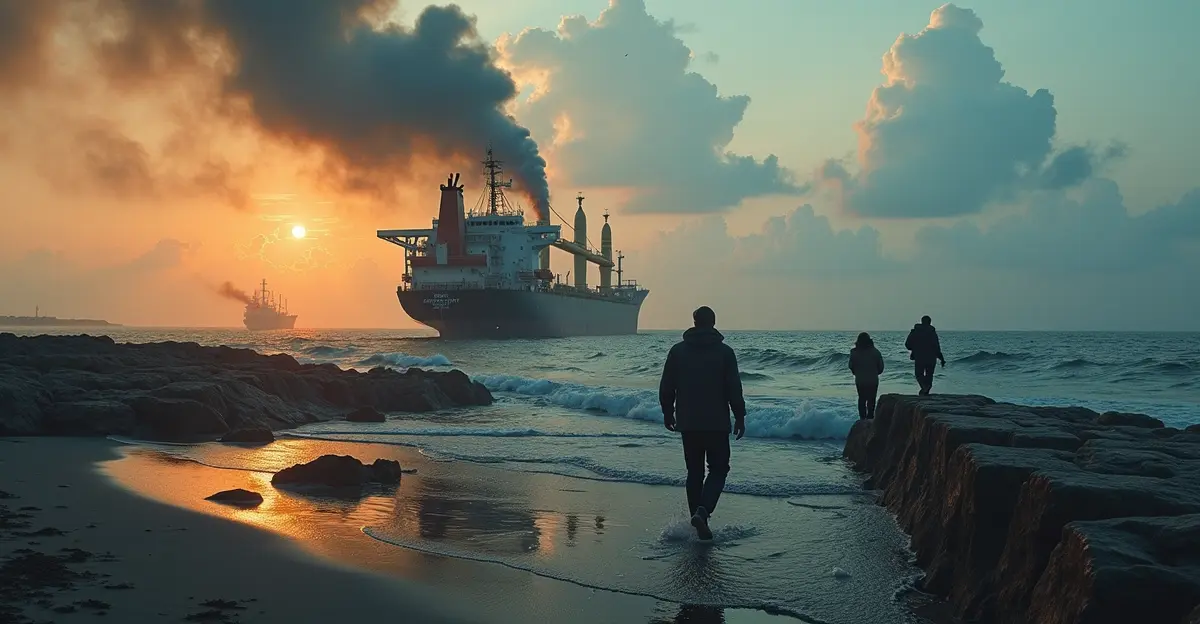
The Strait of Hormuz, a narrow 33-kilometer-wide chokepoint between Oman and Iran, handles roughly 20 million barrels of oil per day—about 20% of global petroleum liquids consumption—along with 20–25% of the world's liquefied natural gas trade. Following the outbreak of the US-Israel conflict with Iran on February 28, 2026, Iran closed the strait, triggering what the International Energy Agency has characterized as the "largest supply disruption in the history of the global oil market." Ship transits collapsed by about 95%, from 130 per day in February to just 6 in March, virtually halting a critical energy corridor. By mid-March, Iraq, Saudi Arabia, Kuwait, UAE, Qatar, and Bahrain had shut in an estimated 7.5 million barrels per day, rising to 9.1 million barrels per day in April. The global energy crisis of 2026 has exposed deep structural vulnerabilities in the world's energy architecture.
The IMF's Three Scenarios: From Slowdown to Near-Recession
IMF Chief Economist Pierre-Olivier Gourinchas presented three distinct trajectories for the global economy, warning that the world currently sits between the reference and adverse scenarios, drifting closer to the adverse one with each passing day of disruption.
Baseline Scenario (Reference Forecast)
Assuming a short-lived conflict with a 19% increase in energy prices and oil averaging $82 per barrel, global GDP growth is projected at 3.1% in 2026 and 3.2% in 2027, with headline inflation at 4.4%. This scenario already represents a significant downgrade from the pre-conflict expectation of 3.4% growth. Emerging market and developing economies face particularly pronounced slowdowns and inflation increases, with the economic impact on developing nations being disproportionately severe.
Adverse Scenario
Under the adverse scenario—assuming further disruption and tighter financial conditions, with oil at $100 per barrel—global growth drops to 2.5% and inflation rises to 5.4%. This scenario reflects a world where energy disruptions persist for several more months, forcing central banks to maintain tighter monetary policy and squeezing household purchasing power across advanced and emerging economies alike.
Severe Scenario
The most alarming projection, the severe scenario, envisions energy disruptions extending into 2027 with oil prices surging to $110–$125 per barrel. Under these conditions, global growth collapses to just 2.0%—a level historically associated with near-recessionary conditions—while inflation exceeds 6%. The Dallas Federal Reserve's modeling confirms that a closure lasting two quarters could push oil prices to $115 per barrel, with growth remaining negative through Q3 2026 and real GDP remaining below pre-closure levels for years afterward.
Structural Vulnerabilities Exposed by the Crisis
Energy Chokepoints and the Limits of Supply Chain Diversification
The Strait of Hormuz crisis has laid bare the fragility of global energy supply chains. Unlike previous disruptions such as the 1973 Yom Kippur War or the 1990 Gulf War, the current blockade removes nearly 20% of global oil supplies from the market, making it three to five times larger in scale. The UNCTAD rapid assessment warns that persistent disruptions risk a cascading crisis, increasing debt vulnerabilities for 3.4 billion people already spending more on debt servicing than on health or education. While Gulf states have begun pivoting to alternative routes—Saudi Arabia's Red Sea hubs saw a 35% increase in Q1 2026 cargo throughput—these measures remain insufficient to compensate for the loss of the Strait. The limits of supply chain diversification are becoming painfully apparent as shipping costs surge and insurance premiums skyrocket.
The Macroeconomic Trade-Offs of Rising Defense Spending
The IMF's WEO dedicates a full chapter to analyzing the macroeconomic implications of rising defense spending. The report finds that while military spending can boost short-term activity, it also increases inflation, worsens fiscal deficits by about 2.6 percentage points of GDP, and raises public debt by about 7 percentage points within three years. This "guns versus butter" trade-off is forcing governments worldwide to make painful choices between defense, healthcare, education, and social welfare. Higher interest rates compound the challenge by making defense borrowing more expensive, while sustained imbalances favoring defense limit productivity-enhancing investments in infrastructure and social programs.
Impact on Key Sectors and Regions
The crisis is reverberating across the global economy. Top oil traders including Vitol Group, Gunvor Group, and Trafigura Group have warned that the ongoing closure risks triggering a global recession, with Vitol's CEO noting the war has already eliminated about 4 million barrels per day of demand. The consumption hit is most acute in Asia, where petrochemical producers have scaled back operations and airlines are canceling flights. In Europe, the suspension of Qatari LNG and the closure of the Strait have precipitated a second major energy crisis, with Dutch TTF gas benchmarks nearly doubling to over €60/MWh by mid-March. The European Central Bank postponed its planned interest rate reductions on March 19, raising its 2026 inflation forecast and cutting GDP growth projections. The macroeconomic trade-offs of defense spending are particularly acute for European nations facing simultaneous energy and security crises.
Expert Perspectives
"The world currently sits between the reference and adverse scenarios, drifting closer to the adverse one with each passing day of disruption," warned IMF Chief Economist Pierre-Olivier Gourinchas in the report's foreword. "Central banks must prioritize taming inflation over protecting growth, and broad fuel subsidies should be avoided in favor of targeted support for vulnerable households."
The Dallas Federal Reserve's analysis underscores the unprecedented scale of the disruption: "A closure lasting one quarter would raise average WTI oil prices to $98 per barrel and lower annualized global real GDP growth by 2.9 percentage points. If the closure extends to two quarters, oil prices could reach $115 per barrel, with growth remaining negative through Q3 2026."
Sinem Cengiz, a Kuwaiti journalist, conveyed in her analysis how the immeasurable social and psychological impact in the economic, political, and security spheres is unlikely to fade. The Qatar-funded Middle East Council on Global Affairs suggested the war has "irreversibly shaken" the region's image, exposing a deep-seated fragility beneath the facade of the Gulf's rapid economic transformation.
Frequently Asked Questions
What is the Strait of Hormuz and why does it matter for the global economy?
The Strait of Hormuz is a narrow maritime chokepoint between Oman and Iran through which approximately 20 million barrels of oil per day—about 20% of global consumption—and 20–25% of global LNG trade transits. Its closure represents the largest oil supply disruption in history.
What are the IMF's three scenarios for 2026 global growth?
The baseline scenario projects 3.1% growth with oil at $82/barrel; the adverse scenario projects 2.5% growth with oil at $100/barrel; and the severe scenario projects just 2.0% growth with oil at $110–$125/barrel and inflation exceeding 6%.
How high could oil prices go if the Strait remains closed?
The Dallas Federal Reserve estimates that a two-quarter closure could push WTI oil prices to $115 per barrel, while the IMF's severe scenario sees Brent crude averaging $110–$125 per barrel. Spot prices briefly touched $126 per barrel in March 2026.
Which countries are most vulnerable to this crisis?
Low-income energy-importing developing countries are most exposed, facing higher import costs, weaker currencies, tighter financial conditions, and rising borrowing costs. Asian economies are particularly affected due to their heavy reliance on Gulf oil exports.
What policy responses does the IMF recommend?
The IMF recommends targeted, temporary fiscal support for vulnerable households rather than broad fuel subsidies, preserving price signals, central bank tightening if inflation expectations become unanchored, and faster adoption of renewable energy to strengthen resilience to energy shocks.
Conclusion: A More Fragmented and Volatile Landscape
The Strait of Hormuz crisis has exposed structural vulnerabilities that will reshape the global economic landscape for years to come. The IMF's scenarios make clear that the world is navigating between a painful slowdown and a full-blown recession, with the outcome dependent on the duration of the conflict and the effectiveness of policy responses. The crisis has accelerated the fragmentation of global trade networks, forced a reassessment of energy security strategies, and imposed difficult fiscal trade-offs on governments already burdened by high debt levels. As Gourinchas noted, fostering adaptability, maintaining credible policy frameworks, and reinforcing international cooperation are essential to navigating the current shocks. The global economic outlook for 2026 remains deeply uncertain, but one conclusion is inescapable: the era of cheap, secure energy and stable globalization has given way to a more volatile and fragmented world.

Follow Discussion