


 Deutsch
 English
 Español
 Français
 Nederlands
 Português


 Share
Share




Goldman Sachs CEO David Solomon has warned that the risk of a US recession could be triggered by a single social media post, stating the economy is 'only one tweet away' from a downturn. Speaking at the Paley Center in Manhattan on April 21, 2026, Solomon highlighted how geopolitical tensions—particularly the ongoing conflict with Iran—combined with President Donald Trump's frequent social media communications, create an environment where financial markets can swing violently on a single statement. While Goldman Sachs economists currently place the probability of a recession at roughly 20%, Solomon's remarks underscore the fragility of the current economic expansion.
Context: Geopolitical Tensions and Market Volatility
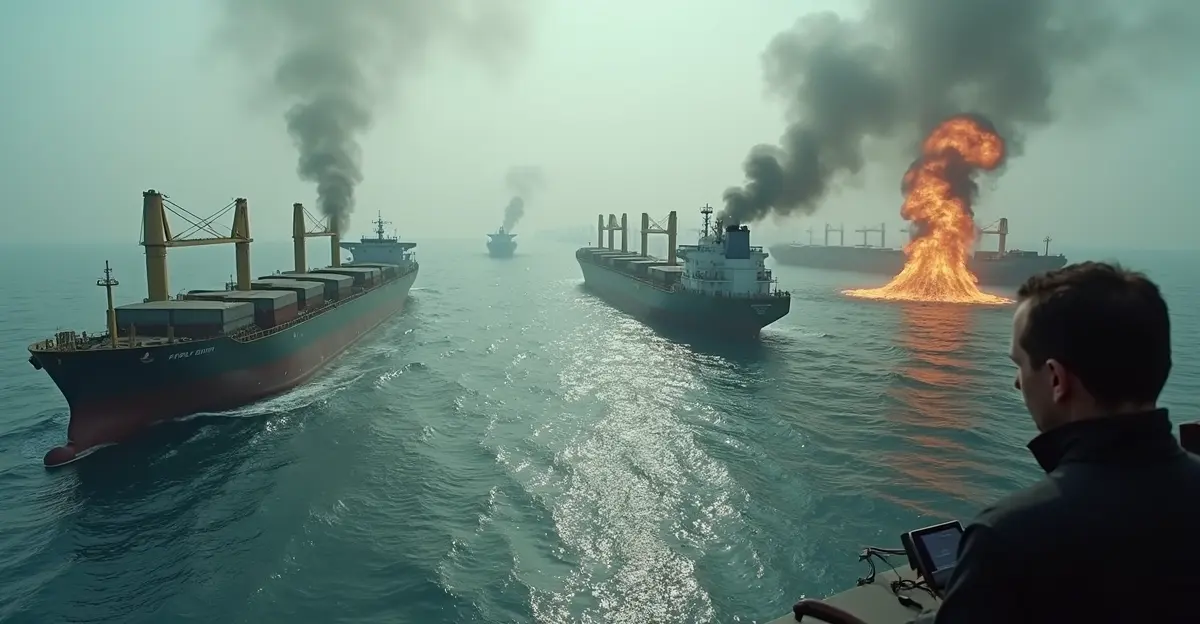
The warning comes amid the most severe geopolitical crisis in decades. On February 28, 2026, the US and Israel launched an air war against Iran, assassinating Supreme Leader Ali Khamenei. In retaliation, Iran's Islamic Revolutionary Guard Corps (IRGC) blocked shipping through the Strait of Hormuz, a critical chokepoint through which approximately 25% of the world's seaborne oil and 20% of liquefied natural gas transits. The resulting oil supply shock has been described as the largest since the 1970s, with Brent crude surging from around $72 per barrel to nearly $120 at its peak.
Solomon pointed to a recent example of market sensitivity: Trump posted on Truth Social that Iran had agreed not to close the Strait of Hormuz—a claim Iran never confirmed—causing stock prices to rally and oil prices to drop. 'The risk of a US recession could rise suddenly depending on how the administration reacts to the Iran war on social media,' Solomon said. The comment reflects growing concerns that the impact of social media on financial markets can amplify economic instability.
Goldman Sachs Recession Probability and Economic Outlook
Current Recession Forecasts
Goldman Sachs economists currently estimate a 20% probability of a US recession within the next 12 months, up from the baseline 15% they consider normal in a stable economic environment. This elevated risk reflects several converging factors:
- Oil price shock: Brent crude has remained elevated, with Solomon projecting prices between $80 and $100 per barrel over the next three to six months. However, he warned that a further escalation could push prices to $170 per barrel.
- Inflationary pressures: Core PCE inflation, while forecast to fall to 2.1% by December 2026, remains sticky due to energy costs.
- Consumer confidence decline: Recent surveys show the sharpest drop in consumer sentiment since the early days of the COVID-19 pandemic.
- Labor market uncertainty: Unemployment is expected to stabilize at 4.5%, but risks remain from weak job growth and companies using AI to reduce labor costs.
Earlier in March 2026, Goldman Sachs had raised its recession odds to 30% following the initial oil price surge, but subsequent data showing resilient GDP growth—projected at 2.5% for 2026—allowed the bank to lower its estimate. The key driver of growth is the 'One Big Beautiful Bill Act,' which includes business and personal tax cuts that are expected to boost economic activity in the second half of the year.
Oil Price Trajectory
Solomon provided a detailed outlook on energy markets. He expects Brent crude to trade between $80 and $100 per barrel in the near term, but warned that a severe escalation of the Iran conflict could send prices to $170 per barrel. The Dallas Federal Reserve has modeled that a one-quarter closure of the Strait of Hormuz would raise West Texas Intermediate (WTI) oil prices to $98 per barrel and lower global real GDP growth by an annualized 2.9 percentage points in Q2 2026. If the strait remains closed for three quarters, oil prices could reach $132 per barrel.
The 2026 Strait of Hormuz crisis has already caused the largest monthly oil price increase in history, with March 2026 recording a 51% jump. Around 20,000 mariners and 2,000 ships have become stranded in the Persian Gulf, and tanker traffic through the strait has dropped to near zero.
Impact on Financial Markets and Investors
Financial markets have shown remarkable resilience despite the geopolitical turmoil. The S&P 500 and Nasdaq Composite have erased wartime losses and reached new record highs, with Trump himself expressing surprise that stocks did not fall more sharply. However, Solomon cautioned that sustained high energy prices will likely begin to show up in economic data later in 2026.
'Persistently high energy prices are likely to negatively impact economic data expected to be released later in the year,' Solomon warned. This suggests that while markets have so far shrugged off the crisis, the real economy may face headwinds in the coming months. The Federal Reserve is expected to cut interest rates by 25 basis points in June and September, with the terminal rate projected at 3% to 3.25%, as policymakers attempt to balance inflation concerns with growth risks.
The Goldman Sachs 2026 recession forecast remains a key benchmark for institutional investors. Solomon's 'one tweet away' comment, while later characterized by a Goldman spokesperson as 'obviously making a joke,' reflects a genuine concern about the unpredictability of the current policy environment.
FAQ: US Recession Risk 2026
What did Goldman Sachs CEO David Solomon say about a US recession?
Solomon said the US recession risk is 'only one tweet away,' meaning a single social media post by President Trump about geopolitical events could trigger a market selloff and economic downturn. He made the comment at the Paley Center in Manhattan on April 21, 2026.
What is the current probability of a US recession according to Goldman Sachs?
Goldman Sachs economists estimate a 20% probability of a US recession within the next 12 months, up from a baseline of 15% in a stable economic environment.
How high could oil prices go if the Iran conflict escalates?
Solomon warned that oil prices could reach $170 per barrel in a severe escalation scenario. Currently, Brent crude is trading between $80 and $100 per barrel.
What is the Strait of Hormuz crisis?
The 2026 Strait of Hormuz crisis began on February 28, 2026, when the US and Israel launched military action against Iran. Iran retaliated by blocking shipping through the Strait of Hormuz, a critical waterway for global oil supplies, causing the largest oil supply shock since the 1970s.
How are financial markets responding to the geopolitical tensions?
Despite the crisis, US stock markets have reached new record highs. However, Solomon warned that sustained high energy prices will likely impact economic data later in 2026, potentially dampening market optimism.




Follow Discussion